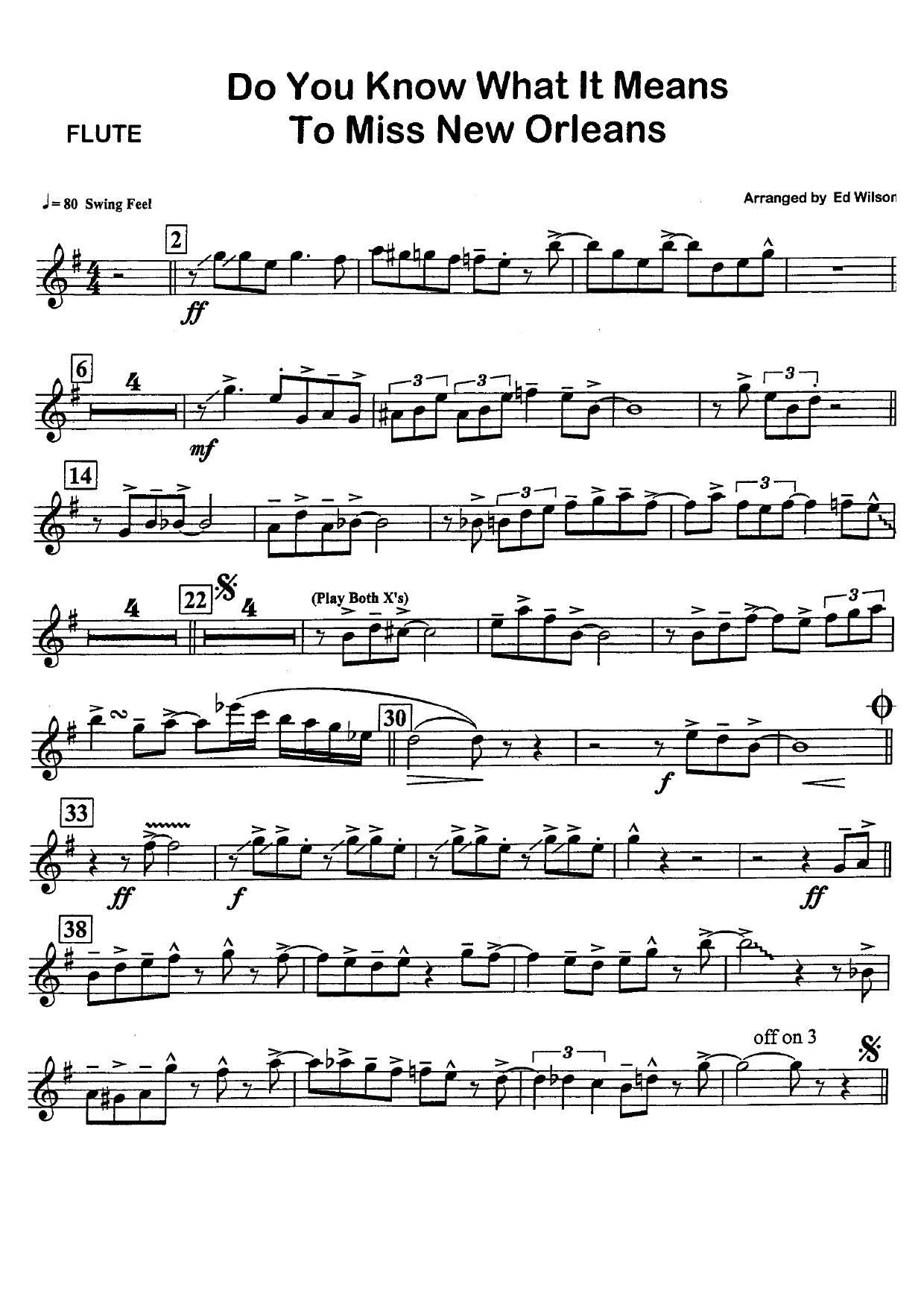
Do You Know What It Means To Miss New Orleans voc. (E.Wilson)
Composed by Louis Alter
Arranged by Ed Wilson
- Ensemble: Big Band
- Pages: 60
- Instruments (24): Flute, Clarinet, Alto Sax 1, Alto Sax 2, Tenor Sax 1, Tenor Sax 2, Baritone Sax, Trumpet 1, Trumpet 2, Trumpet 3, Trumpet 4, Trombone 1, Trombone 2, Trombone 3, Trombone 4, Piano, Guitar, Bass, Drum Kit, Voice, Bb Solo, C Bass Clef Solo, C Treble Clef Solo, Eb Solo
- Difficulty: advanced
- Content: Individual Parts
- Format: PDF Download (Instant)
- Price: $24.99
Louis Alter and Eddie DeLange penned "Do You Know What It Means to Miss New Orleans" for the 1947 film *New Orleans*, where it was immortally introduced by Billie Holiday and Louis Armstrong. This quintessential jazz standard captures the deep, aching nostalgia of the Crescent City, serving as an emotional anchor for traditional and mainstream jazz repertoires alike. Its enduring legacy lies in its ability to evoke the sultry warmth, second-line syncopation, and soulful melancholy of Louisiana, making it an essential vehicle for vocalists looking to connect with a rich historical lineage. Ed Wilson’s sophisticated big band arrangement breathes fresh vitality into the classic tune, establishing a relaxed, medium-swing groove propelled by a warm, rolling bassline and crisp ride-cymbal pulsations. The chart opens with an atmospheric, harmonically rich introduction that sets an evocative, bittersweet mood before settling comfortably into a laid-back pocket. Wilson utilizes lush, Ellingtonian saxophone voicings and muted brass interplay to create a transparent, breathing texture that gives the vocal soloist ample room to emote without ever having to force their projection against a heavy backing wall. Throughout the chart, the arrangement balances vocal-centric storytelling with exquisite instrumental commentary. The woodwind and brass sections trade subtle countermelodies and response figures that echo the classic New Orleans polyphonic tradition, translated smoothly into a modern 17-piece big band vocabulary. A tasteful modulation lifts the emotional center of the chart just before a tightly knit, harmonically sophisticated shout chorus that swells with understated power rather than aggressive volume. The ensemble writing demands precise articulation, controlled dynamic shading, and a deep sense of stylistic swing, ensuring that every section shares an equal voice in shaping the narrative. Advanced high school ensembles, collegiate jazz orchestras, and professional community big bands will find this chart an ideal centerpiece for concert programs or festival sets. While the technical demands on individual players are moderate, the true challenge and reward lie in achieving a unified stylistic cohesion—mastering the back-phrased swing style and achieving a velvety blend across the 17 instruments. Showcasing a premier vocal soloist alongside mature ensemble writing, this 60-page arrangement offers a masterclass in mood, texture, and swing tradition. Achieving the authentic, laid-back feel of this arrangement requires strict adherence to a relaxed medium-swing tempo, avoiding any tendency to rush the backbeat. Conductor focus should center on the rhythm section; the bass player must anchor the groove with a steady, walking foundation, while the drummer maintains an open, breathy ride cymbal pattern with crisp hi-hat chicks on beats two and four. Horn players need to execute short notes with a warm, rounded articulation rather than a clipped staccato, ensuring the traditional jazz phrasing breathes naturally. Pay close attention to dynamic contrast between the vocal accompaniment figures and the background pads; the brass should utilize cup or bucket mutes where indicated to blend seamlessly beneath the singer. During the shout chorus, resist the urge to over-blow; the richness of Ed Wilson’s extended harmonies relies on precise intonation and balanced section blending to achieve its full emotional impact. Q: What instruments and parts are included in this 60-page big band package? A: The 17-instrument arrangement includes a vocal lead sheet, two alto saxophones, two tenor saxophones, a baritone saxophone, four trumpets, four trombones, piano, guitar, bass, and drums. Q: What is the difficulty level of Ed Wilson's arrangement? A: This chart is graded as intermediate-to-advanced (suitable for strong high school, collegiate, and professional big bands), primarily due to the requirement for mature stylistic control, blend, and subtle phrasing rather than extreme technical velocity. Q: What is the historical background and musical style of "Do You Know What It Means To Miss New Orleans"? A: Originally written by Louis Alter and Eddie DeLange for the 1947 film *New Orleans* starring Louis Armstrong and Billie Holiday, this piece is a cornerstone jazz standard that embodies the nostalgic, soulful, and swing-era traditions of Louisiana jazz. Q: What makes this specific arrangement by Ed Wilson unique? A: Wilson balances lush, modern big band harmonies and subtle counter-lines with an authentic respect for the traditional New Orleans idiom, providing a sophisticated framework that elevates the vocal soloist without overshadowing them. Q: What is the recommended performance tempo and duration for this arrangement? A: The piece is set at a comfortable, relaxed medium-swing tempo (around 108 to 116 BPM), resulting in a performance duration of approximately 3.5 to 4.5 minutes depending on vocal styling and solo extensions.
Questions and answers
- What is included in the Do You Know What It Means To Miss New Orleans voc. (E.Wilson) PDF?
- The verified current file contains a conductor score and individual parts across 60 pages.
- How many instruments or parts are listed for Do You Know What It Means To Miss New Orleans voc. (E.Wilson)?
- The verified instrumentation list contains 24 entries for this Big Band arrangement.
- Who is credited for Do You Know What It Means To Miss New Orleans voc. (E.Wilson)?
- Composer: Louis Alter. Arranger: Ed Wilson.
- What difficulty is listed for Do You Know What It Means To Miss New Orleans voc. (E.Wilson)?
- The verified difficulty level is advanced.
- Can I preview Do You Know What It Means To Miss New Orleans voc. (E.Wilson) before buying?
- Yes. The product page provides a preview generated from the current PDF file.
- How is Do You Know What It Means To Miss New Orleans voc. (E.Wilson) delivered?
- After successful payment, the digital PDF is made available for download. The displayed price is $24.99.
Musicians Also Search For
Do You Know What It Means To Miss New Orleans voc. Ed Wilson PDF • Do You Know What It Means To Miss New Orleans voc. Ed Wilson sheet music • Do You Know What It Means To Miss New Orleans voc. arranged by Ed Wilson • Ed Wilson big band charts • Ed Wilson jazz arrangements PDF • Do You Know What It Means To Miss New Orleans voc. Louis Alter sheet music • Do You Know What It Means To Miss New Orleans voc. Louis Alter big band arrangements • Louis Alter big band charts • Do You Know What It Means To Miss New Orleans voc. big band arrangements • Do You Know What It Means To Miss New Orleans voc. big band PDF download • Do You Know What It Means To Miss New Orleans voc. jazz sheet music • big band sheet music download • Do You Know What It Means To Miss New Orleans voc. conductor score PDF • Do You Know What It Means To Miss New Orleans voc. individual parts download • Do You Know What It Means To Miss New Orleans voc. sheet music PDF • buy Do You Know What It Means To Miss New Orleans voc. sheet music • download Do You Know What It Means To Miss New Orleans voc. PDF • Do You Know What It Means To Miss New Orleans voc. jazz charts • best Ed Wilson big band arrangements • Louis Alter arranged by Ed Wilson • Do You Know What It Means To Miss New Orleans voc. printable sheet music • big band repertoire PDF