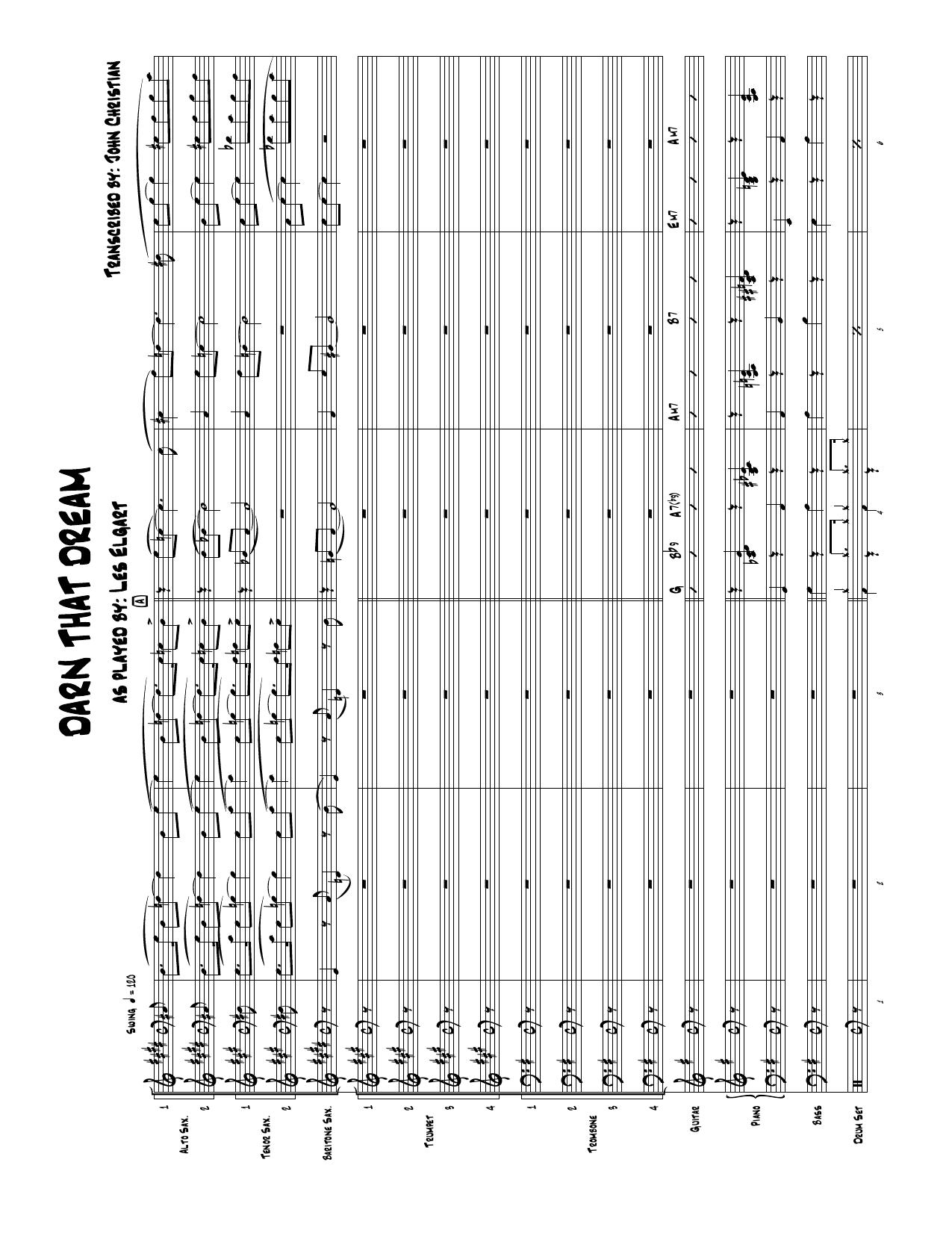
Darn That Dream (J.Christian) sheet music preview

Darn That Dream (J.Christian)

Composed by John Christian

Arranged by J.Christian

  • Ensemble: Big Band
  • Pages: 26
  • Instruments (17): Alto Sax 1, Alto Sax 2, Tenor Sax 1, Tenor Sax 2, Baritone Sax, Trumpet 1, Trumpet 2, Trumpet 3, Trumpet 4, Trombone 1, Trombone 2, Trombone 3, Trombone 4, Guitar, Piano, Bass, Drum Set
  • Difficulty: medium
  • Content: Individual Parts
  • Format: PDF Download (Instant)
  • Price: $24.99

Written by Jimmy Van Heusen and Eddie DeLange for the 1939 Broadway musical *Swingin' the Dream*, "Darn That Dream" quickly transcended its theatrical origins to become one of the most enduring ballads in the American Songbook. Immortalized early on by Benny Goodman with vocalist Mildred Bailey, and later revisited by bebop and modal pioneers alike, the tune occupies a unique space in jazz history. It balances a deceptively simple, yearning melody with sophisticated harmonic underpinnings that invite deep reinterpretation. This timeless standard represents the pinnacle of late-1930s popular songcraft, bridging the melodic accessibility of the swing era with the rich, extended harmony that would soon fuel the modern jazz revolution. Conceived as a lush, evocative ballad with a sophisticated medium-slow swing pulse, J.Christian’s contemporary big band setting transforms the familiar standard into an expansive, cinematic journey. The arrangement explores a rich harmonic palette, leveraging lush, open-horn voicings and dense chromatic passing chords to evoke a mood of bittersweet nostalgia and late-night introspection. Rather than treating the melody as a mere nostalgic throwback, the chart infuses the ensemble with a modern warmth, building from fragile, exposed solo statements into towering, harmonically adventurous climaxes that test the band’s dynamic control and collective sensitivity. J.Christian approaches the ensemble with an acute awareness of big band texture, balancing transparent woodwind-heavy passages with thick, brass-driven counterpoint. The arrangement wastes no time establishing its character, opening with a moody, harmonically rich introduction that sets a contemplative tone before handing the primary melodic weight to a featured lead alto saxophone or flugelhorn. A hallmark of J.Christian’s writing style is the seamless integration of modern modal colorations within traditional swing structures; here, this is showcased through soaring sax solis and a meticulously paced shout chorus that avoids sheer volume in favor of brilliant voicing and tension-and-release phrasing. Advanced high school, collegiate, and professional jazz orchestras will find this chart an exceptional vehicle for developing ensemble blend, intonation, and expressive maturity. While the technical demands on individual players are moderate—avoiding excessive high-note extremes in the trumpet section—the interpretive and stylistic demands are high. Success relies heavily on the band's ability to maintain a relaxed, forward-moving time feel at a slow tempo, balance complex chordal textures, and execute subtle rubato shifts. It stands as an ideal centerpiece for a formal concert program, festival performance, or recording project seeking to showcase a band's lyrical sophistication. Achieving the proper emotional weight in this arrangement requires absolute mastery of the underlying rubato-in-tempo feel. The conductor must guard against the tendency for slow ballads to drag; maintain an internal pulse that breathes while keeping the eighth-note subdivisions conversational and relaxed. The sax section needs meticulous intonation tuning during the dense, harmonically complex soli passages, paying special attention to inner-voice balance where minor seconds and major sevenths provide the signature tension. Brass players should approach mutes (if utilized in the intro) with a dark, warm timbre rather than a biting edge, ensuring the blend remains velvety. During the developmental middle section, encourage the rhythm section to play with a sparse, transparent accompaniment, utilizing comping that hints at Bill Evans-style voicings rather than heavy-handed block chords. Rehearsals should initially focus on sectional balance and dynamic shaping before attempting full-ensemble runs, as the chart's emotional impact depends entirely on the stark contrast between whispered, intimate textures and full-ensemble swells. Q: What instruments and parts are included in this big band package? A: The 21-instrument instrumentation features a standard contemporary big band lineup comprising Alto Saxophone 1 & 2, Tenor Saxophone 1 & 2, Baritone Saxophone, Trumpet 1 through 4, Trombone 1 through 4, Bass Trombone, Guitar, Piano, Bass, Drums, and a comprehensive conductor score spanning 26 pages. Q: What is the difficulty level of this specific arrangement? A: This chart is graded as advanced, making it best suited for collegiate ensembles, advanced high school bands, and professional community jazz orchestras equipped with strong section leaders and mature soloists. Q: What is the historical and stylistic context of this chart? A: Rooted in the 1939 Jimmy Van Heusen and Eddie DeLange jazz standard, this arrangement reinterprets the classic swing-era ballad through a modern, harmonically sophisticated lens that emphasizes lush textures and emotive phrasing. Q: What makes J.Christian’s arrangement of "Darn That Dream" unique? A: This setting distinguishes itself through its innovative use of open-horn voicings, subtle chromatic inner-voice movement, and a carefully structured build that replaces a traditional high-volume shout chorus with a sophisticated, dynamically nuanced climax. Q: What is the performance duration and tempo guideline for this piece? A: The arrangement is designed to be performed at a contemplative medium-slow ballad tempo (around 66 to 72 beats per minute on the quarter note) with a total duration of approximately 5 to 6 minutes depending on solo expansiveness.

Questions and answers

What is included in the Darn That Dream (J.Christian) PDF?
The verified current file contains a conductor score and individual parts across 26 pages.
How many instruments or parts are listed for Darn That Dream (J.Christian)?
The verified instrumentation list contains 17 entries for this Big Band arrangement.
Who is credited for Darn That Dream (J.Christian)?
Composer: John Christian. Arranger: J.Christian.
What difficulty is listed for Darn That Dream (J.Christian)?
The verified difficulty level is medium.
Can I preview Darn That Dream (J.Christian) before buying?
Yes. The product page provides a preview generated from the current PDF file.
How is Darn That Dream (J.Christian) delivered?
After successful payment, the digital PDF is made available for download. The displayed price is $24.99.

Musicians Also Search For

Darn That Dream J.Christian PDFDarn That Dream J.Christian sheet musicDarn That Dream arranged by J.ChristianJ.Christian big band chartsJ.Christian jazz arrangements PDFDarn That Dream John Christian sheet musicDarn That Dream John Christian big band arrangementsJohn Christian big band chartsDarn That Dream big band arrangementsDarn That Dream big band PDF downloadDarn That Dream jazz sheet musicbig band sheet music downloadDarn That Dream conductor score PDFDarn That Dream individual parts downloadDarn That Dream sheet music PDFbuy Darn That Dream sheet musicdownload Darn That Dream PDFDarn That Dream jazz chartsbest J.Christian big band arrangementsJohn Christian arranged by J.ChristianDarn That Dream printable sheet musicbig band repertoire PDF

All arrangements by J.Christian All John Christian sheet music