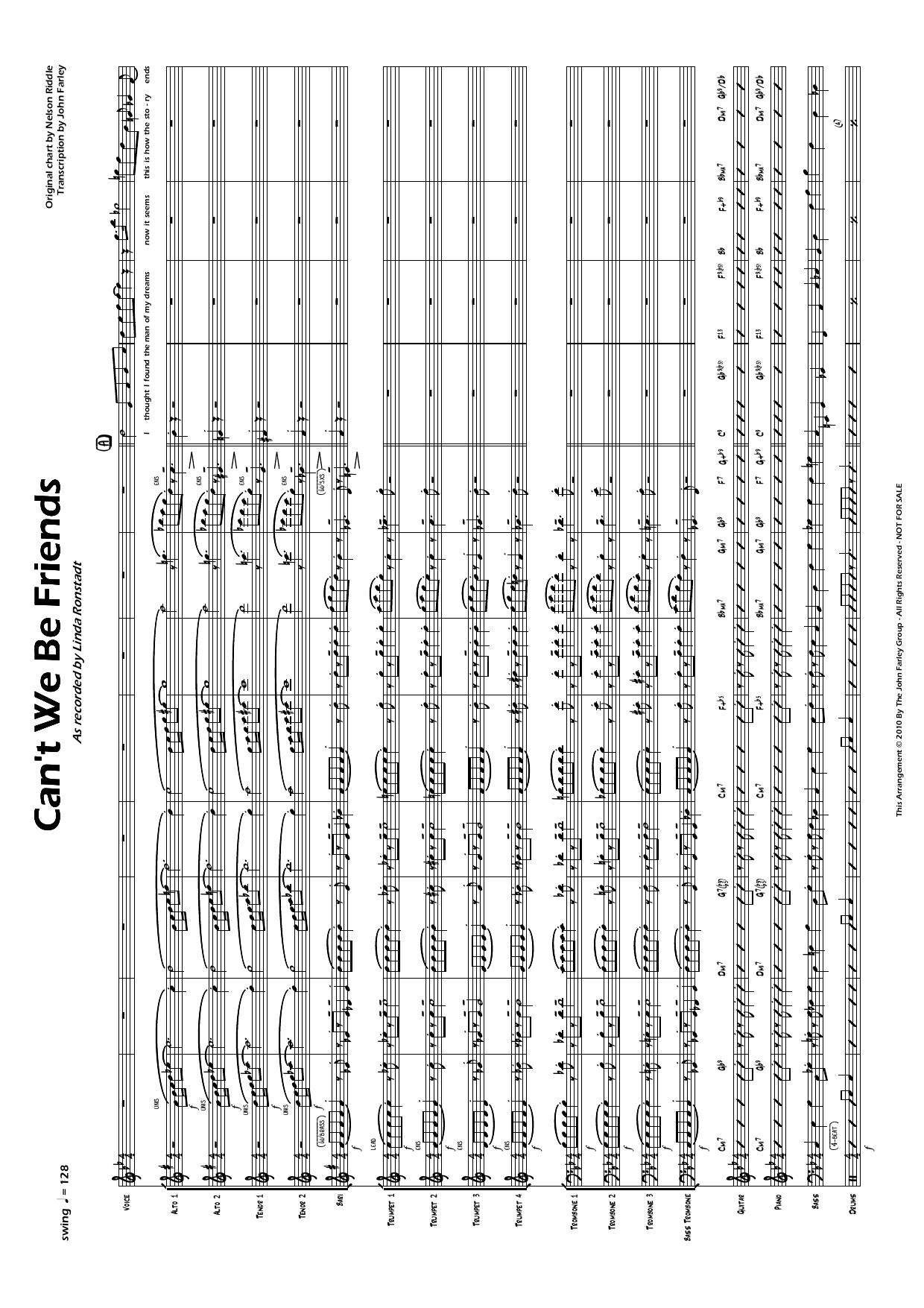
Can't We Be Friends (J.Farley-L.Ronstadt-N.Riddle)
Composed by Nelson Riddle
Arranged by John Farley
- Ensemble: Big Band Vocal
- Style: Jazz Standard
- Pages: 43
- Difficulty: easy
- Content: Sheet Music
- Format: PDF Download (Instant)
- Price: $24.99
"Can't We Be Friends," a timeless jazz standard, emerges from the rich tapestry of the American Songbook, originally composed by Kay Swift with lyrics by Paul James in 1929. While Nelson Riddle is credited in the title, his profound influence often came through his iconic orchestral arrangements that defined the sound of many classic vocalists. The song itself, a poignant ballad exploring the complexities of a strained relationship, gained widespread recognition through numerous interpretations by jazz and pop luminaries. Ella Fitzgerald's definitive 1956 recording, often featuring a lush orchestral backing, cemented its status as a cornerstone of the vocal jazz repertoire, embodying the sophisticated emotional depth characteristic of the mid-20th century jazz era. Its enduring appeal lies in its elegant harmonic progression and lyrical narrative, making it a favorite for vocalists seeking to convey nuanced sentiment. John Farley's arrangement of "Can't We Be Friends" for big band and vocal soloist masterfully reimagines this classic, infusing it with a contemporary yet respectful sensibility. The arrangement is set in a medium swing tempo, typically around 120-130 BPM, providing a comfortable groove that allows both the vocalist and the ensemble to shine. Farley's signature approach is evident in his sophisticated voicings, particularly in the brass and saxophone sections, which feature rich, often extended harmonies that support the vocal line without overpowering it. The mood is one of wistful elegance, transitioning from a tender opening to moments of swinging intensity, culminating in a powerful, yet controlled, full-ensemble statement. The arrangement is primarily in the key of F Major, offering a bright yet warm tonal palette that suits the song's reflective nature. This arrangement features the vocalist prominently, carrying the melody through the initial A sections and often engaging in call-and-response with the ensemble. Farley strategically employs soli sections, particularly in the saxophones, which echo and elaborate on melodic fragments, adding textural depth. A standout feature is the inclusion of an open solo section, typically over the form of the tune, allowing for improvisation by a tenor saxophone or trumpet, providing an opportunity for individual expression within the ensemble context. The shout chorus builds dynamically, showcasing the full power of the big band, before returning to a more intimate setting for the final vocal statement. Technical challenges include precise ensemble articulation, maintaining a consistent swing feel, and navigating Farley's characteristic harmonic voicings, which require good intonation and blend from all sections. The reward lies in performing a truly expressive and dynamically varied interpretation of a beloved standard. "Can't We Be Friends (J.Farley-L.Ronstadt-N.Riddle)" is ideally suited for college-level jazz ensembles, advanced community big bands, and professional groups. Its demands on ensemble precision, harmonic understanding, and dynamic control make it an excellent vehicle for developing sophisticated musicality. The vocal part, while beautifully crafted, requires a vocalist with strong interpretive skills and a solid grasp of jazz phrasing. The arrangement offers ample opportunities for individual sections to contribute significantly, fostering a cohesive and high-level performance experience. Conductors should emphasize a relaxed, yet precise, medium swing feel throughout "Can't We Be Friends," aiming for a tempo around 120-130 BPM. Pay close attention to the dynamic contrasts, from the subtle opening vocal entrance to the powerful shout chorus, ensuring a natural ebb and flow. Technical challenges include maintaining tight ensemble articulation, particularly in the brass figures, and achieving balanced voicings in the saxophone soli sections. Rehearsal should focus on intonation within the extended harmonies and ensuring the rhythm section provides a solid, unwavering foundation. The vocalist needs to be encouraged to interpret the lyrics with genuine emotion, allowing the band to support and enhance their storytelling. No special techniques like plunger mutes or falls are explicitly notated, allowing for a clean, classic big band sound. Q: What instruments and parts are included in this arrangement? A: This arrangement for big band and vocal includes parts for Vocal, Alto Sax 1-2, Tenor Sax 1-2, Baritone Sax, Trumpet 1-4, Trombone 1-3, Bass Trombone, Piano, Bass, and Drums. Q: What is the difficulty level of this arrangement? A: This arrangement is considered advanced, suitable for college-level, advanced community, or professional big bands. It requires strong ensemble precision, harmonic understanding, and dynamic control. Q: What is the musical style and historical context of "Can't We Be Friends"? A: "Can't We Be Friends" is a classic jazz standard from the American Songbook, originally composed in 1929. It represents the sophisticated vocal jazz style of the mid-20th century, popularized by artists like Ella Fitzgerald. Q: What makes John Farley's arrangement of "Can't We Be Friends" unique? A: John Farley's arrangement features sophisticated voicings, strategic soli sections for saxophones, and a dynamically building shout chorus, all while maintaining a respectful yet fresh interpretation of the original standard. It includes an open solo section for improvisation. Q: What is the typical performance duration and tempo for this arrangement? A: The typical performance duration for this arrangement is approximately 4-5 minutes, depending on the length of the improvised solo. It is set at a medium swing tempo, usually performed around 120-130 beats per minute.
Musicians Also Search For
Can't We Be Friends John Farley PDF • Can't We Be Friends John Farley sheet music • Can't We Be Friends arranged by John Farley • John Farley big band vocal charts • John Farley jazz arrangements PDF • Can't We Be Friends Nelson Riddle sheet music • Can't We Be Friends Nelson Riddle big band vocal arrangement • Nelson Riddle big band vocal charts • Can't We Be Friends big band vocal arrangement • Can't We Be Friends big band vocal PDF download • Can't We Be Friends jazz ensemble sheet music • big band vocal sheet music instant download • Can't We Be Friends sheet music with parts • Can't We Be Friends Jazz Standard chart • Jazz Standard big band vocal arrangements • buy Can't We Be Friends sheet music online • download Can't We Be Friends PDF • Can't We Be Friends jazz chart • best John Farley big band vocal arrangements • Nelson Riddle songs arranged by John Farley • Can't We Be Friends printable sheet music • big band vocal repertoire PDF