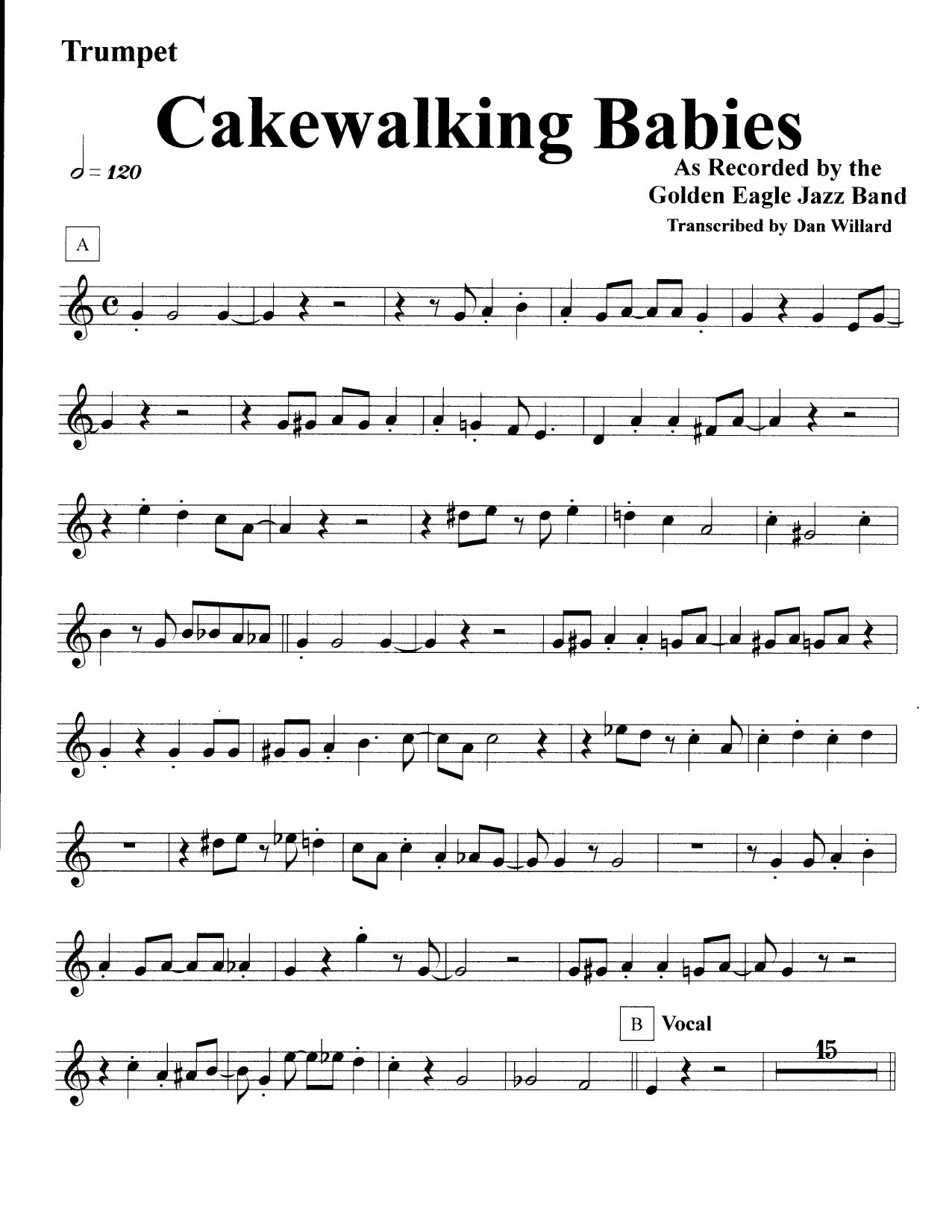
Cakewalking Babies (D.Willard)
Composed by Clarence Williams
Arranged by Dan Willard
- Ensemble: Dixieland Band
- Style: Dixieland
- Pages: 9
- Instruments (4): Trumpet, Clarinet, Trombone, Piano/Banjo
- Difficulty: easy
- Content: Individual Parts
- Format: PDF Download (Instant)
- Price: $18.99
"Cakewalking Babies," a vibrant staple of early jazz, traces its origins to the 1920s, a golden era when the infectious rhythms of Dixieland and ragtime were sweeping the nation. Originally composed by the prolific Clarence Williams, this tune became synonymous with the "Red Hot Peppers" recordings featuring the legendary Jelly Roll Morton, and later, the iconic Bessie Smith with Clarence Williams' Blue Five. It embodies the joyous, improvisational spirit of New Orleans jazz, characterized by collective improvisation, a driving two-beat feel, and a buoyant melodic sensibility. The piece itself is a celebration of the "cakewalk," a dance that originated in African American communities, known for its strutting, high-stepping movements, perfectly captured in the music's playful energy and syncopated melodies. As a jazz standard, "Cakewalking Babies" remains a cornerstone for ensembles seeking to authentically recreate the sound and feel of traditional jazz. Dan Willard's arrangement of "Cakewalking Babies" for Dixieland Band masterfully captures the historical essence while providing a meticulously crafted framework for modern ensembles. Willard, known for his deep respect for traditional jazz idioms and his ability to write arrangements that are both authentic and accessible, approaches this piece with a clear understanding of its stylistic demands. The arrangement is set in a bright, medium-up tempo 2/4 feel, maintaining the original's infectious energy. Willard's signature lies in his judicious use of ensemble voicings that emulate the collective improvisation characteristic of Dixieland, yet are clearly notated to ensure clarity and precision. Expect to hear well-balanced counter-melodies and rhythmic interplay between the front-line instruments (trumpet, clarinet, trombone), providing a rich textural tapestry without sacrificing individual voice. The arrangement features the melody initially carried by the trumpet, followed by a full ensemble chorus that showcases Willard's skillful voicings. Subsequent sections offer ample opportunity for featured solos over the classic chord changes, allowing individual musicians to interpret the Dixieland style with their own improvisational flair. A particularly rewarding aspect is the inclusion of a spirited shout chorus towards the end, bringing the entire ensemble together in a powerful, cohesive statement that builds to an exhilarating finish. Technical challenges primarily revolve around maintaining a consistent, driving two-beat feel, executing precise rhythmic figures, and navigating the characteristic Dixieland ornamentation such as scoops, falls, and vibrato. This arrangement is ideally suited for high school and college Dixieland bands, as well as community and semi-professional ensembles seeking an authentic, well-structured, and highly rewarding performance piece that pays homage to the roots of jazz. Its clarity and thoughtful construction make it an excellent teaching tool for understanding Dixieland style, while its inherent joy ensures an engaging experience for both performers and audiences. Conductors should emphasize a consistent, driving 2/4 feel throughout, focusing on a strong rhythmic foundation from the tuba/bass and banjo/piano. The tempo should be bright and energetic, around quarter note = 120-130 BPM, to capture the authentic cakewalk spirit. Encourage front-line players to listen intently to each other during ensemble sections, aiming for a unified, yet distinct, collective sound reminiscent of traditional Dixieland improvisation. Articulation is key: short, detached notes for rhythmic clarity, with occasional legato phrases for melodic expression. Brass players should practice precise fall-offs and scoops, while the clarinetist should focus on a fluid, agile melodic line with characteristic vibrato. Rehearsal time should be dedicated to balancing the counter-melodies in the ensemble choruses, ensuring no single voice overpowers the others. Solos should be encouraged to embrace the melodic and rhythmic vocabulary of early jazz, utilizing blues scales and arpeggios over the changes. Q: What instruments are included in this arrangement of "Cakewalking Babies"? A: This arrangement is scored for a standard Dixieland Band, typically including Trumpet, Clarinet, Trombone, Banjo (or Piano), Tuba (or String Bass), and Drums. Q: What is the difficulty level of this arrangement? A: This arrangement is rated as Medium-Easy to Medium, making it appropriate for high school, college, and community Dixieland bands. It offers stylistic challenges suitable for developing musicians while being accessible. Q: What musical style and historical context does "Cakewalking Babies" represent? A: This piece is a quintessential example of Dixieland jazz from the 1920s, embodying the collective improvisation, syncopated rhythms, and joyous spirit characteristic of early New Orleans jazz and ragtime influences. Q: What makes Dan Willard's arrangement of "Cakewalking Babies" unique? A: Willard's arrangement stands out for its authentic capture of the Dixieland style through meticulously crafted ensemble voicings that emulate collective improvisation, clear notation, and a well-structured form that includes featured solos and a spirited shout chorus. Q: What is the typical performance duration or tempo for this piece? A: Played at a bright, medium-up tempo (approximately quarter note = 120-130 BPM), "Cakewalking Babies" typically runs for about 2:30 to 3:30 minutes, depending on the length and number of improvised solos.
Questions and answers
- What is included in the Cakewalking Babies (D.Willard) PDF?
- The verified current file contains individual parts across 9 pages.
- How many instruments or parts are listed for Cakewalking Babies (D.Willard)?
- The verified instrumentation list contains 4 entries for this Dixieland Band arrangement.
- Who is credited for Cakewalking Babies (D.Willard)?
- Composer: Clarence Williams. Arranger: Dan Willard.
- What difficulty is listed for Cakewalking Babies (D.Willard)?
- The verified difficulty level is easy.
- What style is listed for Cakewalking Babies (D.Willard)?
- The catalog lists the style as Dixieland.
- Can I preview Cakewalking Babies (D.Willard) before buying?
- Yes. The product page provides a preview generated from the current PDF file.
- How is Cakewalking Babies (D.Willard) delivered?
- After successful payment, the digital PDF is made available for download. The displayed price is $18.99.
Musicians Also Search For
Cakewalking Babies Dan Willard PDF • Cakewalking Babies Dan Willard sheet music • Cakewalking Babies arranged by Dan Willard • Dan Willard dixieland band charts • Dan Willard jazz arrangements PDF • Cakewalking Babies Clarence Williams sheet music • Cakewalking Babies Clarence Williams dixieland band arrangements • Clarence Williams dixieland band charts • Cakewalking Babies dixieland band arrangements • Cakewalking Babies dixieland band PDF download • Cakewalking Babies jazz sheet music • dixieland band sheet music download • Cakewalking Babies individual parts download • Cakewalking Babies sheet music PDF • Cakewalking Babies Dixieland charts • Dixieland dixieland band arrangements • buy Cakewalking Babies sheet music • download Cakewalking Babies PDF • Cakewalking Babies jazz charts • best Dan Willard dixieland band arrangements • Clarence Williams arranged by Dan Willard • Cakewalking Babies printable sheet music • dixieland band repertoire PDF