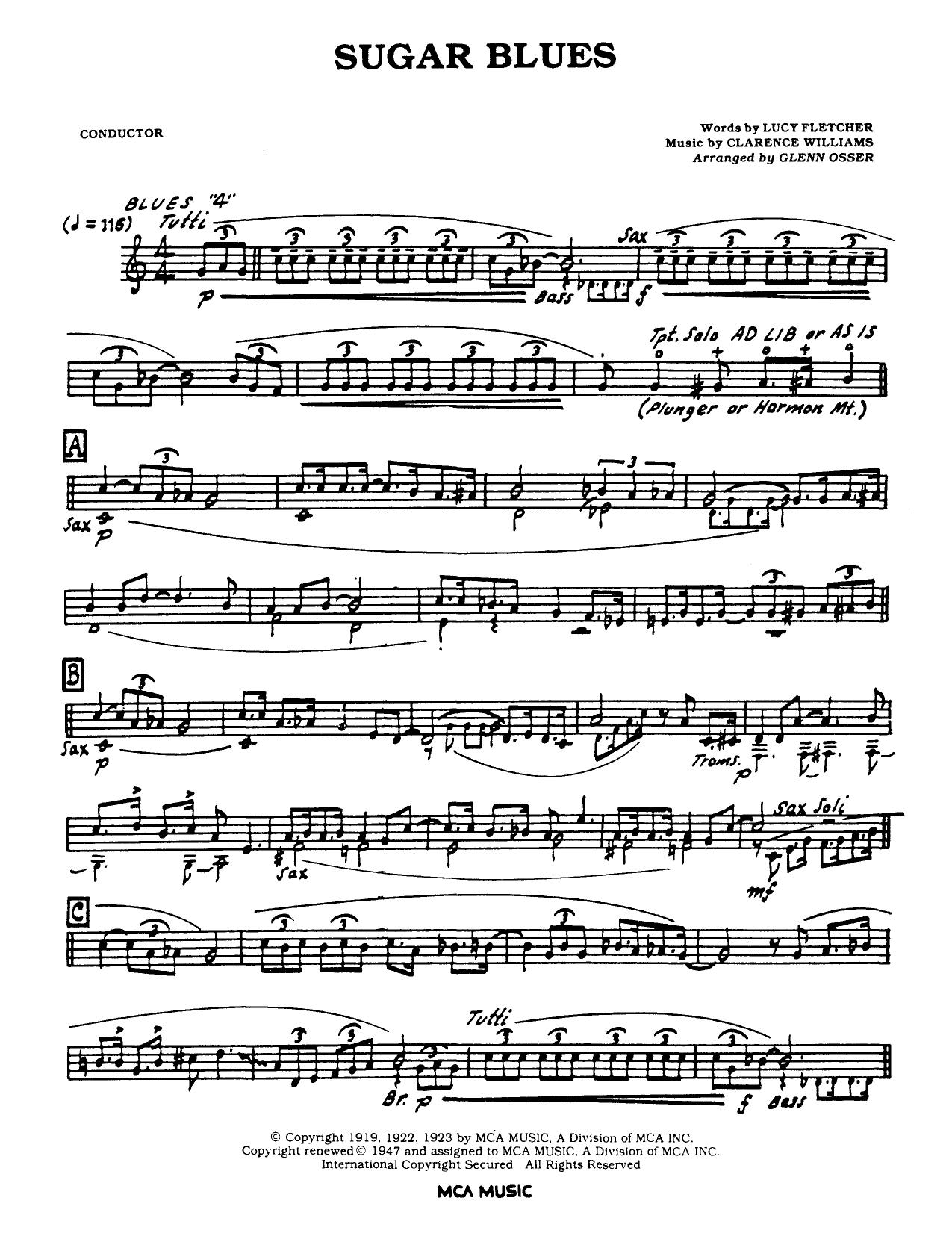
Sugar Blues (G.Osser) sheet music preview

Sugar Blues (G.Osser)

Composed by Clarence Williams

Arranged by Glenn Osser

  • Ensemble: Big Band
  • Pages: 37
  • Instruments (18): Conductor, 1st Eb Alto Saxophone, 3rd Eb Alto Saxophone, 2nd Bb Tenor Saxophone, 4th Bb Tenor Saxophone, 5th Eb Baritone Saxophone, 1st Bb Trumpet, 2nd Bb Trumpet, 3rd Bb Trumpet, 4th Bb Trumpet, 1st Trombone, 2nd Trombone, 3rd Trombone, 4th Trombone, Piano, String Bass, Drums, Guitar
  • Difficulty: medium
  • Content: Individual Parts
  • Format: PDF Download (Instant)
  • Price: $24.99

Originally penned in 1919 by Clarence Williams with lyrics by Lucy Fletcher, "Sugar Blues" became an enduring early jazz anthem largely defined by Clyde McCoy’s iconic, plunger-muted 1931 recording, which later served as his lifelong theme song. This classic composition bridges the gap between traditional New Orleans polyphony and the emerging swing idiom, characterized by its infectious, blues-infused melody and playful, swaggering harmonic framework. As a staple of the early jazz and swing repertoires, the tune invites ensembles to explore the roots of jazz phrasing, where vocal-like inflections and theatrical expression are just as vital as clean execution and rhythmic precision. Glenn Osser’s masterful big band treatment infuses the historical composition with a vibrant, mid-century broadcast-era polish while preserving its essential barrelhouse charm. Operating at a breezy, infectious medium-swing tempo, the chart opens with a jaunty motif before unfolding into rich, sophisticated horn voicings that showcase Osser's signature arranging style. The mood is celebratory, nostalgic, and rhythmically driving, evoking the sophisticated atmosphere of 1940s radio dance bands. Harmonic color is added through clever chord substitutions and lush reed solis that give the ensemble a remarkably full, polished sound despite the compact instrumentation. The melodic narrative shifts fluidly across the ensemble, giving the saxophones ample room to shine in tight, harmonized soli sections while the brass punctuate the arrangement with crisp, witty staccato figures. Solo opportunities are integrated naturally into the form, allowing a featured trumpeter or saxophonist to stretch out over standard blues changes with a playful, conversational approach. Technical demands center less on breakneck velocity and more on stylistic authenticity—specifically, the mastery of articulated swing eighth notes, subtle dynamic contrast, and stylistic consistency between the brass and reed sections. The climax builds toward a spirited shout chorus that reinterprets the main theme with intensified brass power and rhythmic urgency before a clever, understated button ending. Advanced high school, college, and skilled community big bands will find this arrangement an exceptionally rewarding addition to their repertoire. Because it requires a refined sense of swing and stylistic maturity rather than extreme technical pyrotechnics, it serves as an ideal vehicle for teaching stylistic phrasing and ensemble blend. Audiences respond enthusiastically to its familiar yet freshly styled melodies, making it a standout programming choice for vintage jazz retrospectives, pops concerts, and educational festival performances alike. To capture the authentic swagger of Glenn Osser’s setting, the ensemble must maintain a relaxed yet forward-driving medium-swing feel, avoiding any tendency to rush the quarter-note pulse. The primary technical challenge lies in the articulation: all off-beat accents should be crisp and punchy, while connected lines require a smooth, vocal-like legato. Brass players should make liberal use of plunger mutes, cup mutes, and half-valve effects where indicated to emulate the signature vocal cries of the early jazz tradition. Rehearsal should initially focus on the reed section's intonation during the intricate soli passages, ensuring that vibrato is matched across the entire saxophone section. Conductors should pay close attention to dynamic balance during the transitions, ensuring the rhythm section keeps a steady, transparent groove that underpins the horns without overpowering them. Q: What instruments and parts are included in this arrangement? A: This arrangement is scored for a flexible 8-instrument big band instrumentation, featuring parts for Alto Saxophone, Tenor Saxophone, Baritone Saxophone, Trumpet, Trombone, and a complete rhythm section support structure. Q: What is the difficulty level of this Glenn Osser chart? A: It is graded as medium difficulty, making it highly accessible for advanced high school ensembles, college bands, and professional community jazz orchestras looking for stylistic variety. Q: What is the historical style and context of "Sugar Blues"? A: Composed by Clarence Williams and famously popularized by Clyde McCoy, the piece is a foundational jazz standard that transitions traditional blues idioms into a swinging, theatrical big band format. Q: What makes this specific arrangement by Glenn Osser unique? A: Osser blends the vintage, plunger-muted humor of early jazz with the sophisticated, lush harmonic voicings and crisp sectional writing characteristic of the golden age of radio dance bands. Q: What is the recommended performance tempo and duration? A: The chart is designed to be performed at a comfortable medium-swing tempo (approximately 120–126 BPM), resulting in a performance duration of roughly 3 to 4 minutes depending on solo extensions.

Questions and answers

What is included in the Sugar Blues (G.Osser) PDF?
The verified current file contains a conductor score and individual parts across 37 pages.
How many instruments or parts are listed for Sugar Blues (G.Osser)?
The verified instrumentation list contains 18 entries for this Big Band arrangement.
Who is credited for Sugar Blues (G.Osser)?
Composer: Clarence Williams. Arranger: Glenn Osser.
What difficulty is listed for Sugar Blues (G.Osser)?
The verified difficulty level is medium.
Can I preview Sugar Blues (G.Osser) before buying?
Yes. The product page provides a preview generated from the current PDF file.
How is Sugar Blues (G.Osser) delivered?
After successful payment, the digital PDF is made available for download. The displayed price is $24.99.

Musicians Also Search For

Sugar Blues Glenn Osser PDFSugar Blues Glenn Osser sheet musicSugar Blues arranged by Glenn OsserGlenn Osser big band chartsGlenn Osser jazz arrangements PDFSugar Blues Clarence Williams sheet musicSugar Blues Clarence Williams big band arrangementsClarence Williams big band chartsSugar Blues big band arrangementsSugar Blues big band PDF downloadSugar Blues jazz sheet musicbig band sheet music downloadSugar Blues conductor score PDFSugar Blues individual parts downloadSugar Blues sheet music PDFbuy Sugar Blues sheet musicdownload Sugar Blues PDFSugar Blues jazz chartsbest Glenn Osser big band arrangementsClarence Williams arranged by Glenn OsserSugar Blues printable sheet musicbig band repertoire PDF

All arrangements by Glenn Osser All Clarence Williams sheet music