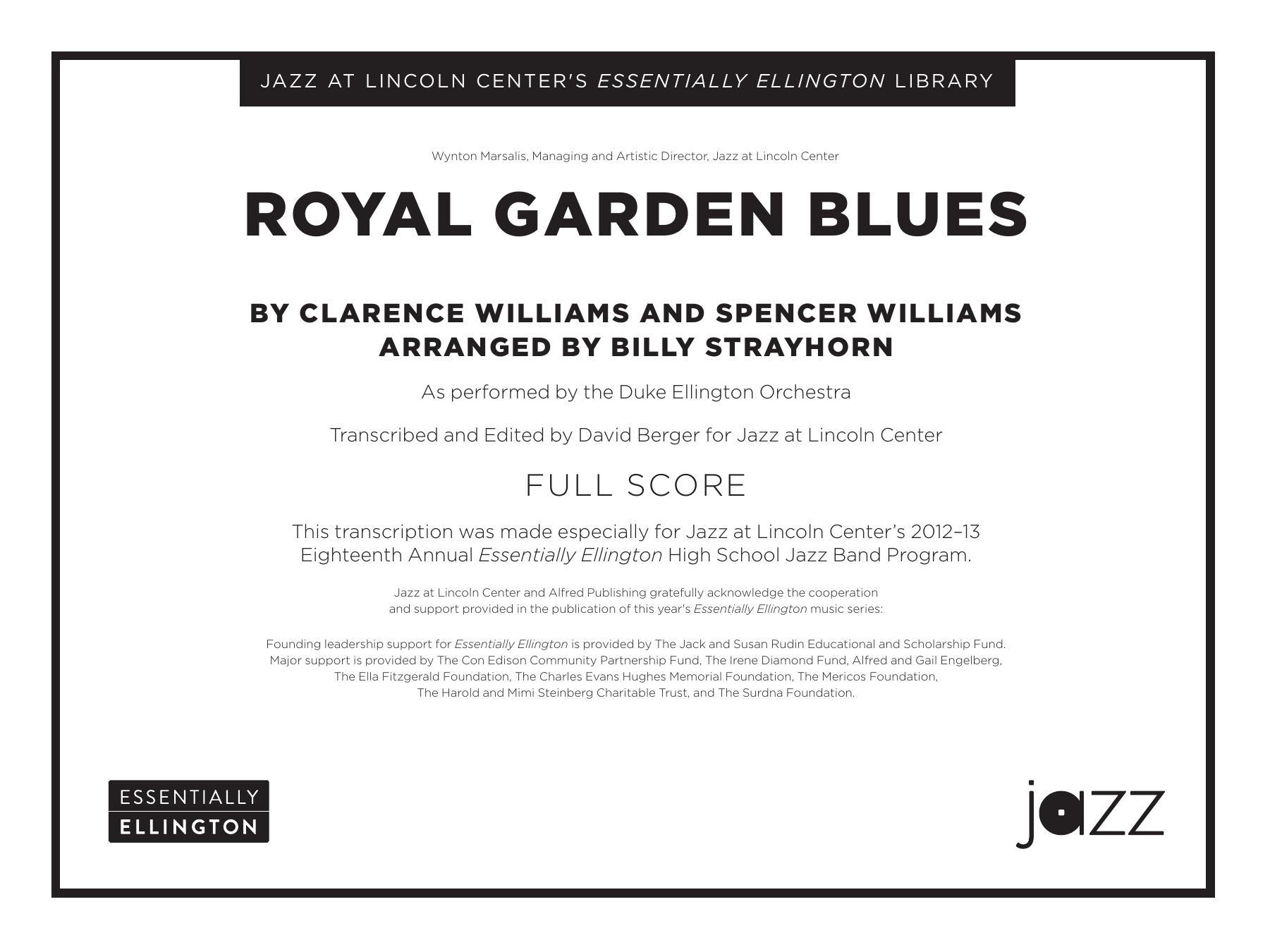
Royal Garden Blues (B.Strayhorn)
Composed by Clarence Williams
Arranged by Duke Ellington & B.Strayhorn.D.Berger
- Ensemble: Big Band
- Pages: 56
- Instruments (17): Reed 1 - Alto Sax, Reed 2 - Alto Sax, Reed 3 - Clarinet / Tenor Sax, Reed 4 - Tenor Sax, Reed 5 - Baritone Sax, Trumpet 1, Trumpet 2, Trumpet 3, Trumpet 4, Trumpet 5, Trombone 1, Trombone 2, Trombone 3, Guitar, Piano, Bass, Drums
- Difficulty: advanced
- Content: Individual Parts
- Format: PDF Download (Instant)
- Price: $24.99
Clarence Williams’s immortal 1919 classic "Royal Garden Blues" occupies a foundational place in the early jazz canon, serving as an essential bridge between New Orleans polyphony and the sophisticated language of the big band era. Originally popularized during the roaring twenties by jazz pioneers and later embraced by the swing royalty, the tune’s driving blues architecture has made it a timeless vehicle for improvisational expression. When filtered through the visionary lens of Duke Ellington and Billy Strayhorn—with transcription and editorial work by David Berger—the composition sheds its early-century rustic charm and transforms into a sophisticated, harmonically rich masterpiece tailored for the modern jazz orchestra. At a pulsing, infectious medium swing tempo, this arrangement crackles with the inimitable elegance and understated intensity characteristic of the Ellington-Strayhorn collaboration. The key centers around rich blues tonalities, weaponizing shifting tonal colors, lush reed voicings, and sudden dynamic contrasts to evoke a mood that is simultaneously sophisticated and earthy. The arrangement avoids predictable blues clichés by deploying unexpected harmonic extensions, signature Ellingtonian-style muted brass colors, and interlocking counterpoint between the sections. The emotional arc moves effortlessly from sultry, late-night atmospheric tension to exuberant, high-energy collective swing. David Berger’s meticulous restoration and editing of this Ellington/Strayhorn treatment highlights their genius for orchestration and color. Rather than treating the 17-instrument big band as a monolithic block, the arrangers divide and recombine the ensemble—utilizing a distinct clarinet voice alongside traditional saxophones—to create transparent textures reminiscent of Ellington’s small-group recordings. The charts feature interlocking reed solis, subtle plunger work in the brass, and meticulously crafted shout choruses that build organically. The melody is shared democratically across the ensemble, passing fluidly from the reed section to punchy brass interventions, creating an ongoing musical dialogue. Advanced high school, collegiate, and professional jazz ensembles will find this chart profoundly rewarding, though it demands a high degree of stylistic maturity and listening awareness. The primary technical challenges lie not in breakneck speeds, but in ensemble precision, dynamic subtlety, and the execution of authentic swing phrasing. Section leaders must guide their players toward a relaxed, behind-the-beat feel while maintaining crisp articulation. Featured solo sections provide ample space for standout improvisers to stretch out over traditional blues forms, making this arrangement an exceptional centerpiece for festival programming and sophisticated concert sets alike. Conductors approaching this arrangement of "Royal Garden Blues" must prioritize stylistic authenticity, specifically cultivating a relaxed, driving medium-swing feel that avoids stiffness. The rhythm section should anchor the groove with a steady, unhurried quarter-note pulse, ensuring the bass walks with a pronounced, acoustic-style weight while the drummer utilizes crisp hi-hat control on beats two and four. Technically, the chart demands precise execution of dynamic shadings; subtle whisper-to-roar crescendos in the ensemble require strict control from the brass and reeds alike. Trumpets and trombones should be well-versed in plunger technique and expressive mutes (straight, cup, and bucket) to capture the authentic Ellingtonian tonal palette. Rehearsals should initially isolate the inner voices of the reed section—noting the unique inclusion of the clarinet part—to balance the intricate chordal voicings. Insist that articulation markings, from ghosted notes to sharp accents, are uniform across all sections to achieve the signature Ellington swagger. Q: What instruments and parts are included in this arrangement? A: The standard 17-instrument big band instrumentation comprises Alto Saxophone 1, Alto Saxophone 2, Clarinet, Tenor Saxophone, Baritone Saxophone, 4 Trumpets, 3 Trombones, Piano, Guitar, Bass, and Drums, complete with a comprehensive 56-page conductor score. Q: What is the difficulty level of this chart? A: This arrangement is graded as advanced, making it ideal for collegiate, advanced high school, community, and professional big bands that possess strong stylistic awareness and section cohesion. Q: What is the historical context of this specific version? A: Based on Clarence Williams's 1919 classic, this version reflects the sophisticated arranging approach of Duke Ellington and Billy Strayhorn, expertly transcribed and edited by jazz scholar David Berger. Q: What makes this Ellington/Strayhorn/Berger arrangement unique? A: It uniquely blends early jazz vernacular with advanced Ellingtonian voicings, incorporating a featured clarinet voice, colorful muted brass textures, and intricate harmonic shifts that elevate a standard 12-bar blues. Q: What is the recommended tempo and performance duration? A: The piece is designed for a medium swing tempo, typically clocking in around 3.5 to 5 minutes depending on the length of the improvised solos taken during the form.
Questions and answers
- What is included in the Royal Garden Blues (B.Strayhorn) PDF?
- The verified current file contains a conductor score and individual parts across 56 pages.
- How many instruments or parts are listed for Royal Garden Blues (B.Strayhorn)?
- The verified instrumentation list contains 17 entries for this Big Band arrangement.
- Who is credited for Royal Garden Blues (B.Strayhorn)?
- Composer: Clarence Williams. Arranger: Duke Ellington & B.Strayhorn.D.Berger.
- What difficulty is listed for Royal Garden Blues (B.Strayhorn)?
- The verified difficulty level is advanced.
- Can I preview Royal Garden Blues (B.Strayhorn) before buying?
- Yes. The product page provides a preview generated from the current PDF file.
- How is Royal Garden Blues (B.Strayhorn) delivered?
- After successful payment, the digital PDF is made available for download. The displayed price is $24.99.
Musicians Also Search For
Royal Garden Blues Duke Ellington & B.Strayhorn.D.Berger PDF • Royal Garden Blues Duke Ellington & B.Strayhorn.D.Berger sheet music • Royal Garden Blues arranged by Duke Ellington & B.Strayhorn.D.Berger • Duke Ellington & B.Strayhorn.D.Berger big band charts • Duke Ellington & B.Strayhorn.D.Berger jazz arrangements PDF • Royal Garden Blues Clarence Williams sheet music • Royal Garden Blues Clarence Williams big band arrangements • Clarence Williams big band charts • Royal Garden Blues big band arrangements • Royal Garden Blues big band PDF download • Royal Garden Blues jazz sheet music • big band sheet music download • Royal Garden Blues conductor score PDF • Royal Garden Blues individual parts download • Royal Garden Blues sheet music PDF • buy Royal Garden Blues sheet music • download Royal Garden Blues PDF • Royal Garden Blues jazz charts • best Duke Ellington & B.Strayhorn.D.Berger big band arrangements • Clarence Williams arranged by Duke Ellington & B.Strayhorn.D.Berger • Royal Garden Blues printable sheet music • big band repertoire PDF