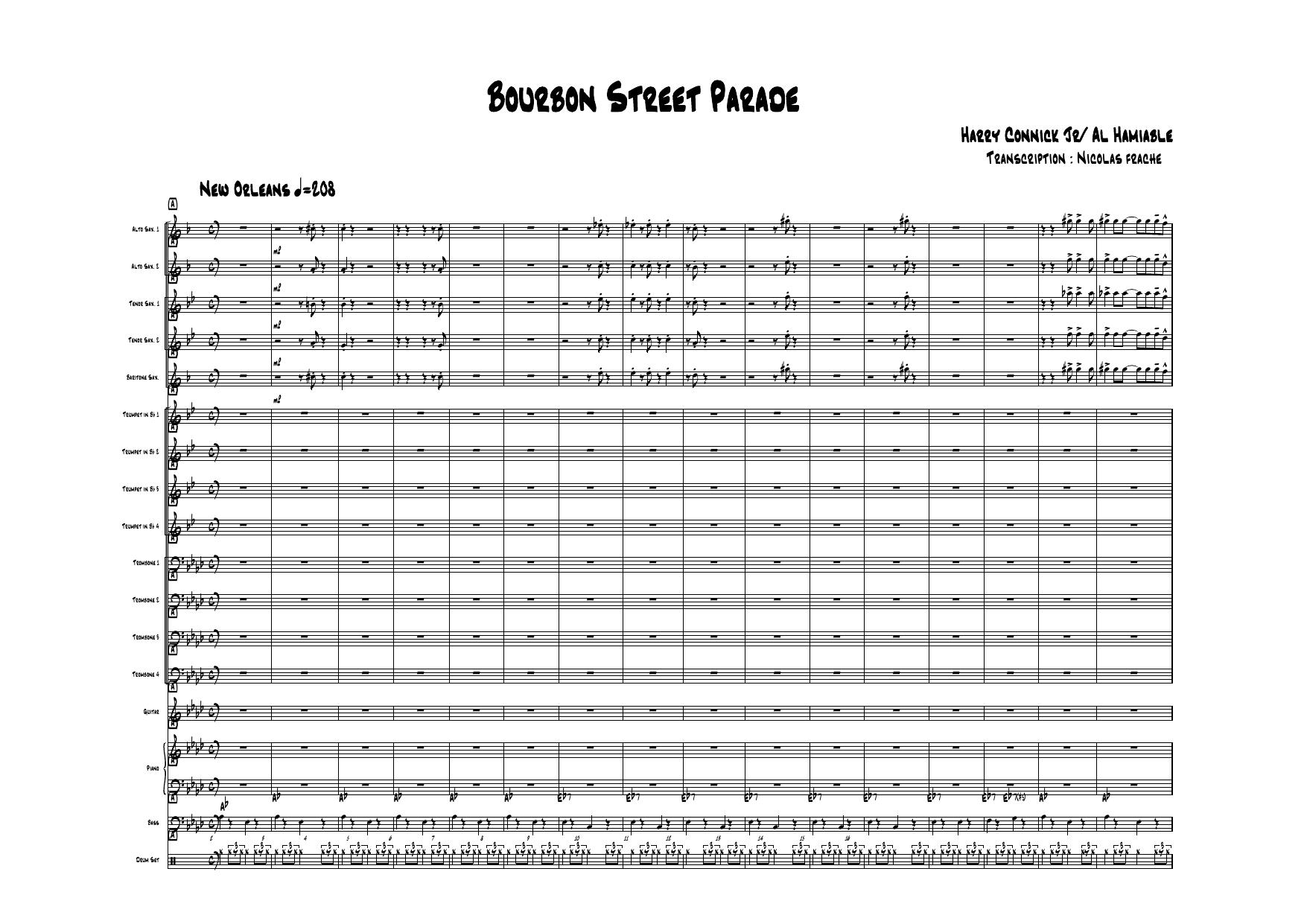
Bourbon Street Parade (H.Connick jr.)
Composed by Paul Barbarin
Arranged by Harry Connick Jr
- Ensemble: Big Band
- Pages: 75
- Instruments (17): Alto Saxophone 1, Alto Saxophone 2, Tenor Saxophone 1, Tenor Saxophone 2, Baritone Saxophone, Trumpet 1, Trumpet 2, Trumpet 3, Trumpet 4, Trombone 1, Trombone 2, Trombone 3, Trombone 4, Guitar, Piano, Bass, Drum Set
- Difficulty: advanced
- Content: Individual Parts
- Format: PDF Download (Instant)
- Price: $24.99
Paul Barbarin’s timeless New Orleans jazz anthem "Bourbon Street Parade" received a definitive modern revival when superstar pianist, vocalist, and arranger Harry Connick Jr. applied his virtuosic, big-band sensibilities to the tune. Originally penned in the mid-20th century by legendary New Orleans drummer Paul Barbarin, the composition has long served as a quintessential staple of traditional Dixieland and street-beat repertoire. Connick’s ingenious reimagining bridges the gap between classic Crescent City second-line tradition and the sophisticated swagger of mid-century big band jazz, injecting a vibrant, high-energy aesthetic that honors its roots while demanding contemporary precision from every section of the ensemble. Driven by an infectious, bouncing medium-up swing and second-line groove, this chart radiates an irrepressible celebratory mood. The harmonic language expands far beyond traditional three-chord Dixieland structures, incorporating Connick's signature extended and altered chords, blues-infused voicings, and clever chromatic passing tones. The dynamic arc moves seamlessly from sultry, muted brass statements to roaring, high-octane shout choruses that evoke the electric atmosphere of a Mardi Gras parade rolling down Canal Street. The interplay between the rhythm section and the horn lines creates a heavy, danceable pulse that demands absolute rhythmic synchronization and an authentic, laid-back yet driving articulation. Connick’s arrangement brilliantly redistributes thematic material across the entire 17-piece big band, moving far beyond standard frontline-and-rhythm configurations. The saxophones enjoy lush, intricate soli sections that require pristine blend and agile fingerwork, while the trumpets and trombones alternate between punchy, staccato punctuations and rich, harmonized background figures. Solos are open for featured players, allowing room for expressive, blues-drenched improvisation in the classic New Orleans style. Technical challenges primarily lie in maintaining a consistent, buoyant groove without rushing, mastering the intricate dynamic contrasts, and executing the sharp, stylized articulations—such as short-toned accents and controlled falls—that give the chart its authentic character. Advanced high school, collegiate, and professional jazz orchestras will find this comprehensive 75-page publication an exceptionally rewarding centerpiece for festival programs and concert sets. Because it requires a mature rhythm section capable of locking into an authentic second-line/swing hybrid feel and a horn section comfortable with modern big-band pyrotechnics, it pushes ensembles to refine their sectional listening and stylistic versatility. Conductor and performer alike will appreciate the meticulous detail in the included full conductor score, making it a masterclass in how to honor traditional roots through a contemporary big-band lens. Achieving an authentic performance of this arrangement requires careful attention to the stylistic fusion of traditional New Orleans second-line drumming and modern big band swing. The rhythm section is the engine room: the drummer must balance a driving swing ride cymbal pattern with the syncopated, snare-heavy accents characteristic of a New Orleans street parade. Horn players should avoid playing straight classical quarters or overly stiff eighth notes; instead, apply a relaxed, horizontal jazz articulation with slight weight given to the upbeats where indicated. Key technical hurdles include navigating Connick's dense harmonic voicings in the brass, which require careful internal tuning within sections. Utilize plunger mutes, cup mutes, and subtle doits in the brass and saxes strictly as marked to achieve the textural colorations intended by the arranger. Rehearsals should begin under tempo to lock in the elusive second-line pocket, gradually pushing toward the target performance tempo while maintaining absolute clarity in fast transitional lines. Q: What instruments and parts are included in this big band arrangement? A: The 75-page publication features a complete 17-instrument big band instrumentation, including Alto Saxophone 1, Alto Saxophone 2, Tenor Saxophone 1, Tenor Saxophone 2, Baritone Saxophone, four trumpets, four trombones, piano, guitar, bass, drums, and a comprehensive full conductor score. Q: What is the difficulty level of this chart? A: This arrangement is graded as advanced, suited for high school jazz ensembles with strong section players, collegiate big bands, and professional groups due to its demanding stylistic nuances, extended harmonies, and rhythmic precision. Q: What is the stylistic background and historical context of the piece? A: Originally composed by legendary New Orleans drummer Paul Barbarin as a traditional street beat anthem, this version is specifically arranged by Harry Connick Jr. to merge traditional Crescent City second-line feels with modern, sophisticated big band jazz harmonies. Q: What makes this specific arrangement unique compared to standard versions? A: While most versions of "Bourbon Street Parade" stay within traditional Dixieland bounds, Connick’s treatment infuses the tune with clever chromatic passing tones, lush contemporary saxophone solis, and roaring modern shout choruses. Q: What is the recommended performance tempo and duration? A: The arrangement is set in a driving, bouncy medium-up tempo feel, typically clocking in at around 3 to 4 minutes depending on the length of improvised solo sections integrated into the form.
Questions and answers
- What is included in the Bourbon Street Parade (H.Connick jr.) PDF?
- The verified current file contains a conductor score and individual parts across 75 pages.
- How many instruments or parts are listed for Bourbon Street Parade (H.Connick jr.)?
- The verified instrumentation list contains 17 entries for this Big Band arrangement.
- Who is credited for Bourbon Street Parade (H.Connick jr.)?
- Composer: Paul Barbarin. Arranger: Harry Connick Jr.
- What difficulty is listed for Bourbon Street Parade (H.Connick jr.)?
- The verified difficulty level is advanced.
- Can I preview Bourbon Street Parade (H.Connick jr.) before buying?
- Yes. The product page provides a preview generated from the current PDF file.
- How is Bourbon Street Parade (H.Connick jr.) delivered?
- After successful payment, the digital PDF is made available for download. The displayed price is $24.99.
Musicians Also Search For
Bourbon Street Parade Harry Connick Jr PDF • Bourbon Street Parade Harry Connick Jr sheet music • Bourbon Street Parade arranged by Harry Connick Jr • Harry Connick Jr big band charts • Harry Connick Jr jazz arrangements PDF • Bourbon Street Parade Paul Barbarin sheet music • Bourbon Street Parade Paul Barbarin big band arrangements • Paul Barbarin big band charts • Bourbon Street Parade big band arrangements • Bourbon Street Parade big band PDF download • Bourbon Street Parade jazz sheet music • big band sheet music download • Bourbon Street Parade conductor score PDF • Bourbon Street Parade individual parts download • Bourbon Street Parade sheet music PDF • buy Bourbon Street Parade sheet music • download Bourbon Street Parade PDF • Bourbon Street Parade jazz charts • best Harry Connick Jr big band arrangements • Paul Barbarin arranged by Harry Connick Jr • Bourbon Street Parade printable sheet music • big band repertoire PDF