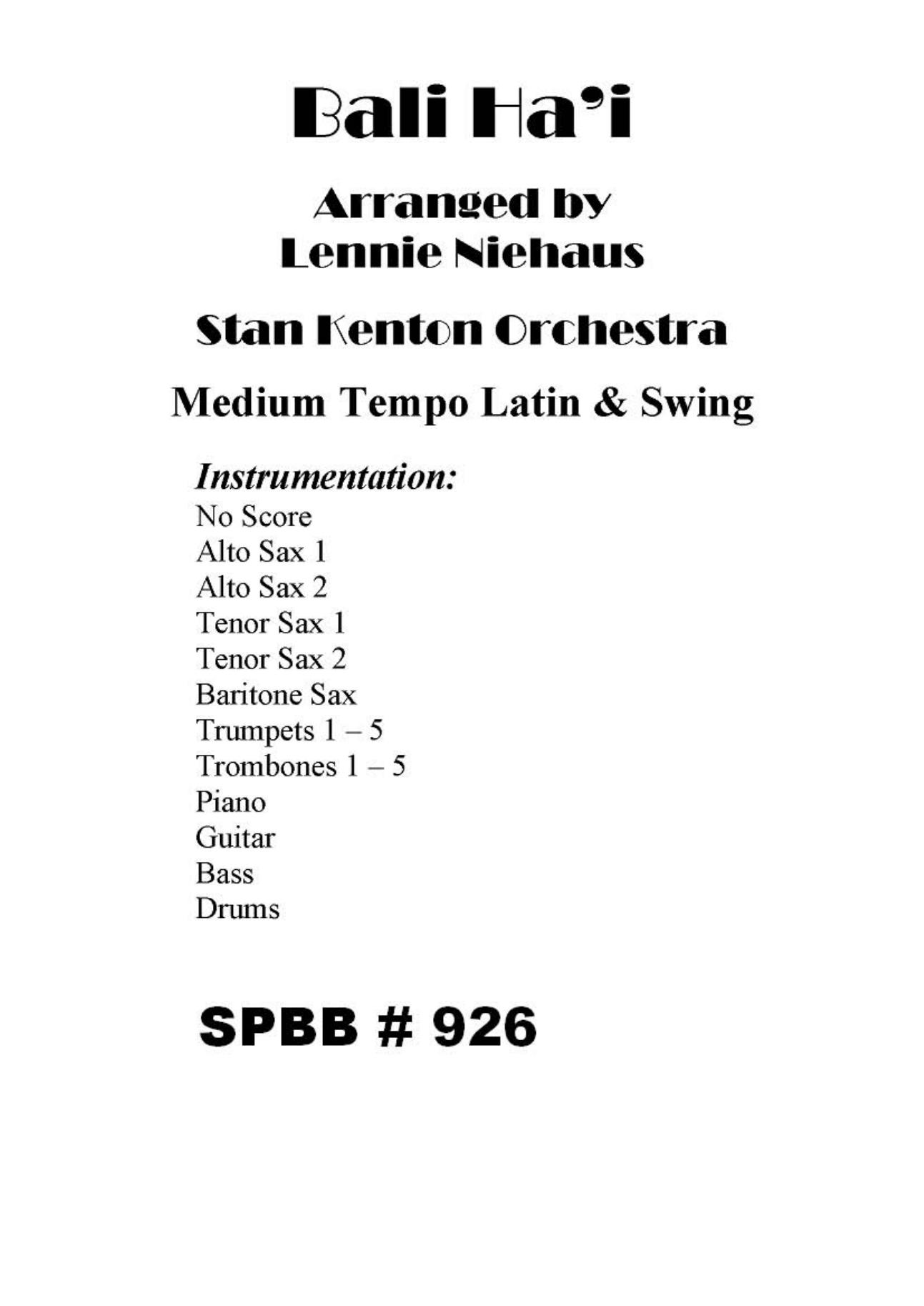
Bali Hai (L.Niehaus)
Composed by Richard Rodgers
Arranged by Lennie Niehaus
- Ensemble: Big Band
- Pages: 52
- Instruments (19): Alto Saxophone 1, Alto Saxophone 2, Tenor Saxophone 1 (Solo), Tenor Saxophone 2, Baritone Saxophone, Trumpet 1, Trumpet 2, Trumpet 3, Trumpet 4, Trumpet 5, Trombone 1, Trombone 2, Trombone 3, Trombone 4, Bass Trombone 5, Piano, Guitar, Bass, Drums
- Difficulty: advanced
- Content: Individual Parts
- Format: PDF Download (Instant)
- Price: $24.99
Rodgers and Hammerstein’s iconic melody "Bali Ha'i," introduced in the 1949 landmark Broadway musical *South Pacific*, found an unexpected and brilliant second life within the jazz idiom, championed by West Coast cool school architect Lennie Niehaus. Originally conceived as a mysterious, alluring island invocation sung by the character Bloody Mary, the tune's modal-leaning intervals and sophisticated pentatonic flavorings made it a prime candidate for sophisticated jazz interpretation. While vocalists like Ella Fitzgerald and instrumentalists such as Ben Webster explored its hypnotic charm, Niehaus’s big band setting transforms the theater standard into a masterclass of West Coast cool orchestration, balancing lush, impressionistic harmonies with an understated, driving momentum. Opening with a spacious, atmospheric intro that hints at the exoticism of the original setting, this arrangement quickly settles into a relaxed, effortless medium swing feel in 4/4 time. Niehaus avoids heavy-handed, bombastic brass writing in favor of transparent, linear counterpoint and pristine, floating saxophone voicings. The emotional arc moves from tranquil and evocative to quietly jubilant, driven by subtle harmonic shifts and crystalline chord extensions that showcase the West Coast penchant for cool-jazz sophistication without sacrificing emotional resonance. The ensemble textures are remarkably clean, utilizing close-interval harmonizations in the reeds and warm, muted brass pads that evoke a breezy, coastal elegance. As the chart unfolds, the melodic weight shifts masterfully across the ensemble. The saxophones—anchored by two altos, two tenors, and a baritone—frequently carry the primary thematic material, utilizing Niehaus’s signature linear writing style where every part maintains a strong, horizontal melodic identity. A standout feature of the arrangement is a brilliantly crafted, harmonically rich soli section that demands pristine intonation and light, articulate tongue phrasing from the reed section. While ensemble interplay remains the primary focus, the chart provides ample space for featured soloists to stretch out over accessible changes, supported by crisp background figures from the brass. Advanced high school ensembles, collegiate big bands, and professional community jazz orchestras will find this 19-instrument chart an ideal vehicle for developing stylistic versatility, section balance, and light-touch swing articulation. Unlike high-octane East Coast shout-chorus charts, Niehaus’s "Bali Ha'i" requires supreme control, dynamic restraint, and an immaculate sense of swing subdivision. It offers a refreshing, highly sophisticated departure from standard up-tempo burners, rewarding audiences and performers alike with its timeless, cinematic cool-jazz aesthetic. Conductors should approach this arrangement with an emphasis on transparency, balance, and relaxed West Coast swing phrasing. The tempo should remain moderate; pushing the metronome too fast will destroy the floating, impressionistic quality that defines Niehaus's writing. Ensure the rhythm section maintains an unhurried, driving pulse without heavy-handed accents on beats two and four—the hi-hat should sizzle cleanly while the bass walks with an even, half-note or light quarter-note feel. Technical challenges center primarily on intonation within close-voiced sax solis and maintaining a unified dynamic ceiling across the ensemble. Brass players should utilize cup or straight mutes where indicated to preserve the subdued, cool-school color palette, avoiding aggressive edge in favor of a warm, round tone. Rehearsal time should be heavily invested in achieving uniform articulation among the saxophones, ensuring that short notes are properly clipped and long notes bloom without artificial swelling. Q: What instrumentation and parts are included in this arrangement? A: This standard big band chart is scored for a 19-instrument ensemble, comprising Alto Saxophone 1, Alto Saxophone 2, Tenor Saxophone 1, Tenor Saxophone 2, Baritone Saxophone, standard brass configurations, and a full rhythm section. The complete physical or digital edition spans 52 pages of comprehensive score and individual parts. Q: What is the difficulty level of this Lennie Niehaus arrangement? A: This piece is best suited for advanced high school, collegiate, and professional big bands that possess strong reading skills and refined section control. The primary challenges lie in intonation, balance, and stylistic restraint rather than extreme technical pyrotechnics. Q: What musical style and historical era does this chart represent? A: It represents the West Coast cool jazz era of the 1950s, adapting a 1949 Richard Rodgers Broadway standard into a sophisticated, swinging instrumental vehicle. The style emphasizes linear counterpoint, pastel harmonic colorations, and a relaxed, understated groove. Q: What makes this specific arrangement unique compared to other big band charts? A: Lennie Niehaus avoids conventional, heavy East Coast shout choruses in favor of transparent, harmonically luminous voicings and intricate linear writing for the saxophones. Its unique blend of exotic modal flavorings and cool-jazz sophistication sets it apart from standard swing-era arrangements. Q: What is the expected performance duration and tempo feel of the piece? A: The arrangement is set in a relaxed, medium swing tempo (4/4 time) designed to breathe and flow naturally. Depending on the chosen tempo and the inclusion of improvised solo choruses, the typical performance duration ranges between 3.5 and 5 minutes.
Questions and answers
- What is included in the Bali Hai (L.Niehaus) PDF?
- The verified current file contains individual parts across 52 pages.
- How many instruments or parts are listed for Bali Hai (L.Niehaus)?
- The verified instrumentation list contains 19 entries for this Big Band arrangement.
- Who is credited for Bali Hai (L.Niehaus)?
- Composer: Richard Rodgers. Arranger: Lennie Niehaus.
- What difficulty is listed for Bali Hai (L.Niehaus)?
- The verified difficulty level is advanced.
- Can I preview Bali Hai (L.Niehaus) before buying?
- Yes. The product page provides a preview generated from the current PDF file.
- How is Bali Hai (L.Niehaus) delivered?
- After successful payment, the digital PDF is made available for download. The displayed price is $24.99.
Musicians Also Search For
Bali Hai Lennie Niehaus PDF • Bali Hai Lennie Niehaus sheet music • Bali Hai arranged by Lennie Niehaus • Lennie Niehaus big band charts • Lennie Niehaus jazz arrangements PDF • Bali Hai Richard Rodgers sheet music • Bali Hai Richard Rodgers big band arrangements • Richard Rodgers big band charts • Bali Hai big band arrangements • Bali Hai big band PDF download • Bali Hai jazz sheet music • big band sheet music download • Bali Hai individual parts download • Bali Hai sheet music PDF • buy Bali Hai sheet music • download Bali Hai PDF • Bali Hai jazz charts • best Lennie Niehaus big band arrangements • Richard Rodgers arranged by Lennie Niehaus • Bali Hai printable sheet music • big band repertoire PDF