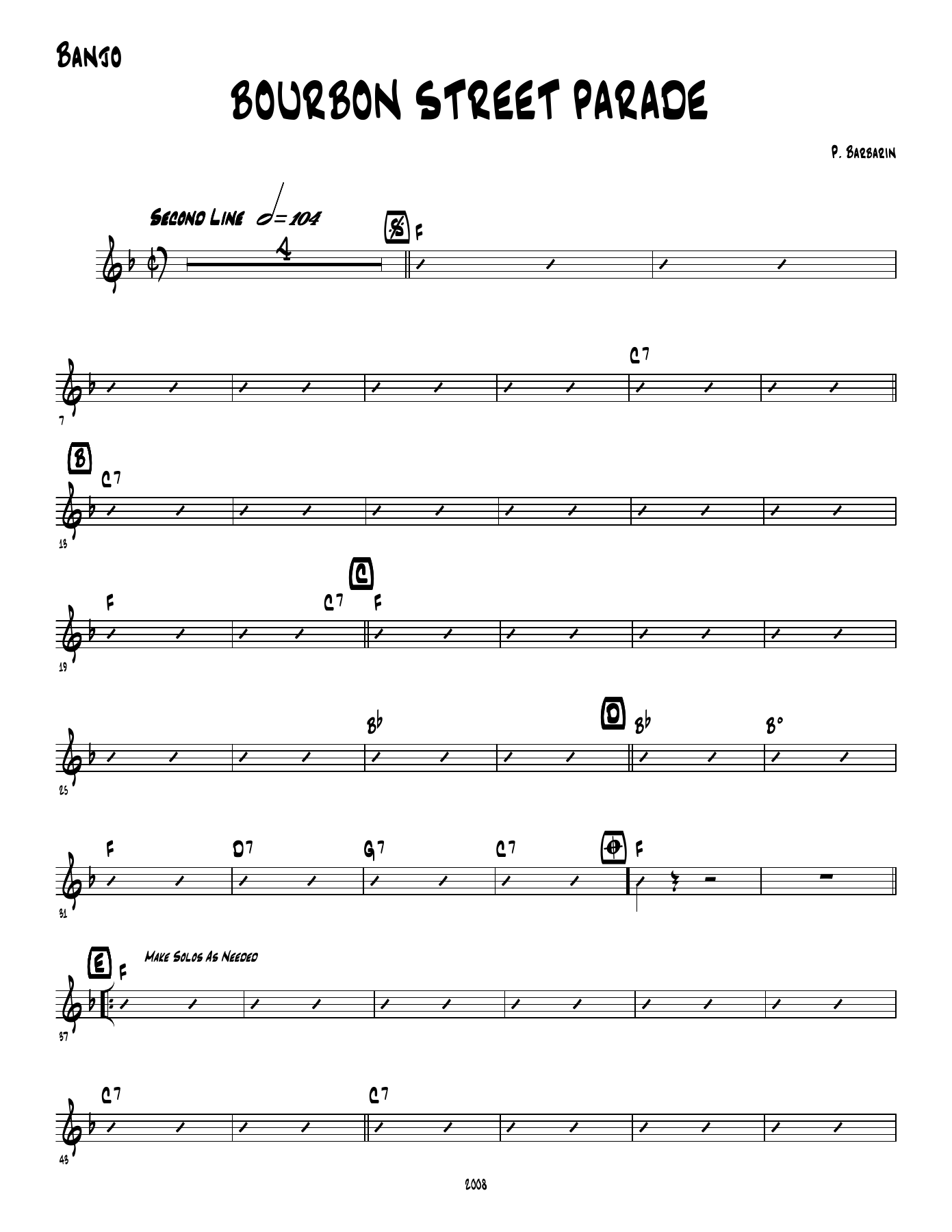
Bourbon Street Parade (P.Barbarin) sheet music preview

Bourbon Street Parade (P.Barbarin)

Composed by Paul Barbarin

Arranged by P.Barbarin

  • Ensemble: Dixieland Band
  • Style: Jazz Standard
  • Pages: 14
  • Difficulty: easy
  • Content: Sheet Music
  • Format: PDF Download (Instant)
  • Price: $18.99

"Bourbon Street Parade," a quintessential jazz standard, transports listeners directly to the vibrant, celebratory atmosphere of New Orleans. Composed by the legendary New Orleans drummer Paul Barbarin in 1949 (with some sources citing 1951), this piece stands as a testament to the enduring influence of early marching bands on the development of New Orleans jazz. Barbarin, a pivotal figure in the city's musical lineage, helped popularize this infectious tune, making it a staple in Dixieland repertoire worldwide. It embodies the rich cultural hybridity of New Orleans, blending traditional march elements with the syncopated rhythms and improvisational spirit of jazz. Musically, "Bourbon Street Parade" is characterized by its bright, medium-up tempo, typically performed in a driving 4/4 meter that often alternates between a march feel and a swinging two-beat or four-beat groove. The primary key is often Ab or F, contributing to its generally bright and accessible sound. The mood is unequivocally joyous and festive, evoking images of second-line parades winding through the historic French Quarter. The energy is consistently high, driven by a buoyant rhythm section and the collective improvisation of the front line. It's a piece designed to uplift and engage, with its memorable melody and call-and-response patterns creating an immediate connection with both performers and audiences. P. Barbarin's approach to this arrangement, as with his own performances, emphasizes the authentic New Orleans Dixieland sound. His arrangements typically feature the characteristic polyphonic improvisation where the trumpet carries the lead melody, the clarinet weaves an ornate counter-melody above it, and the trombone provides a rhythmic and harmonic foundation with "tailgate" glissandos and smears. This arrangement highlights these roles, ensuring each instrument contributes to the rich, layered texture without a single leader dominating. The melody is typically introduced by the trumpet, with subsequent choruses opening up for collective improvisation, a hallmark of the style. While specific written solos may be indicated, the spirit of the arrangement encourages spontaneous melodic invention within the Dixieland framework. The technical challenges lie in maintaining rhythmic precision within the collective improvisation and executing the stylistic nuances, such as precise articulation and expressive bends. The reward is found in the communal joy of performance and the creation of an authentic, swinging New Orleans sound. This arrangement is ideally suited for high school, college, and community Dixieland bands seeking an authentic and engaging piece that captures the spirit of traditional jazz. Its clear delineation of parts, combined with opportunities for individual expression, makes it an excellent teaching tool for understanding Dixieland ensemble dynamics. Professional ensembles will appreciate its faithful adherence to the style and the inherent energy it brings to any performance. The arrangement's 14 pages suggest a comprehensive, yet manageable, scope for a standard Dixieland ensemble. Conductors should emphasize a buoyant, medium-up tempo feel, allowing for the natural swing and syncopation inherent in Dixieland. The rhythm section, particularly the drums, should establish a solid foundation, often alternating between a 2/4 march feel and a 4/4 swing feel to add variety, as heard in Paul Barbarin's own recordings. Technical challenges include achieving a balanced polyphonic texture during collective improvisation, where each horn maintains its distinct melodic line while contributing to the overall harmony. Clarinetists should focus on fluid embellishments and counter-melodies, while trombonists should master the characteristic tailgate smears and glissandos. Trumpeters lead the melodic charge with clear, articulate phrasing. Encourage musicians to listen intently to each other, responding dynamically within the ensemble. Special techniques like growls, falls, and doits should be incorporated tastefully to enhance the authentic New Orleans sound. Rehearsals should prioritize rhythmic tightness and stylistic interpretation over individual virtuosity, fostering a cohesive and spirited performance. **Q: What instruments/parts are included in this arrangement?** A: This arrangement for Dixieland Band typically includes parts for Trumpet, Clarinet, Trombone, Piano, Banjo/Guitar, Bass (or Tuba), and Drums. This instrumentation allows for the characteristic polyphonic texture of the Dixieland style. **Q: What is the difficulty level of this arrangement?** A: This arrangement is suitable for intermediate to advanced high school, college, and community Dixieland bands. While the core melody is accessible, achieving an authentic Dixieland sound requires proficiency in stylistic interpretation, collective improvisation, and rhythmic precision. **Q: What is the historical context and musical style of "Bourbon Street Parade"?** A: "Bourbon Street Parade" is a classic Dixieland jazz standard composed by Paul Barbarin in 1949 (or 1951). It embodies the New Orleans jazz tradition, blending elements of military marches with the syncopated rhythms and improvisational nature of early jazz. **Q: What makes this specific arrangement unique or distinctive?** A: This arrangement, penned by the original composer Paul Barbarin, offers an authoritative and authentic rendition of the piece. It faithfully captures the polyphonic interplay, call-and-response patterns, and the driving, festive spirit characteristic of traditional New Orleans Dixieland, reflecting Barbarin's deep understanding of the genre. **Q: What is the typical performance duration and tempo for "Bourbon Street Parade"?** A: "Bourbon Street Parade" is typically performed at a medium-up to up-tempo, with a buoyant and driving feel, often around 180 BPM. The duration can vary based on the number of improvised choruses, but a typical performance might range from 3 to 5 minutes.

Musicians Also Search For

Bourbon Street Parade P.Barbarin PDFBourbon Street Parade P.Barbarin sheet musicBourbon Street Parade arranged by P.BarbarinP.Barbarin dixieland band chartsP.Barbarin jazz arrangements PDFBourbon Street Parade Paul Barbarin sheet musicBourbon Street Parade Paul Barbarin dixieland band arrangementPaul Barbarin dixieland band chartsBourbon Street Parade dixieland band arrangementBourbon Street Parade dixieland band PDF downloadBourbon Street Parade jazz ensemble sheet musicdixieland band sheet music instant downloadBourbon Street Parade sheet music with partsBourbon Street Parade Jazz Standard chartJazz Standard dixieland band arrangementsbuy Bourbon Street Parade sheet music onlinedownload Bourbon Street Parade PDFBourbon Street Parade jazz chartbest P.Barbarin dixieland band arrangementsPaul Barbarin songs arranged by P.BarbarinBourbon Street Parade printable sheet musicdixieland band repertoire PDF

All arrangements by P.Barbarin All Paul Barbarin sheet music