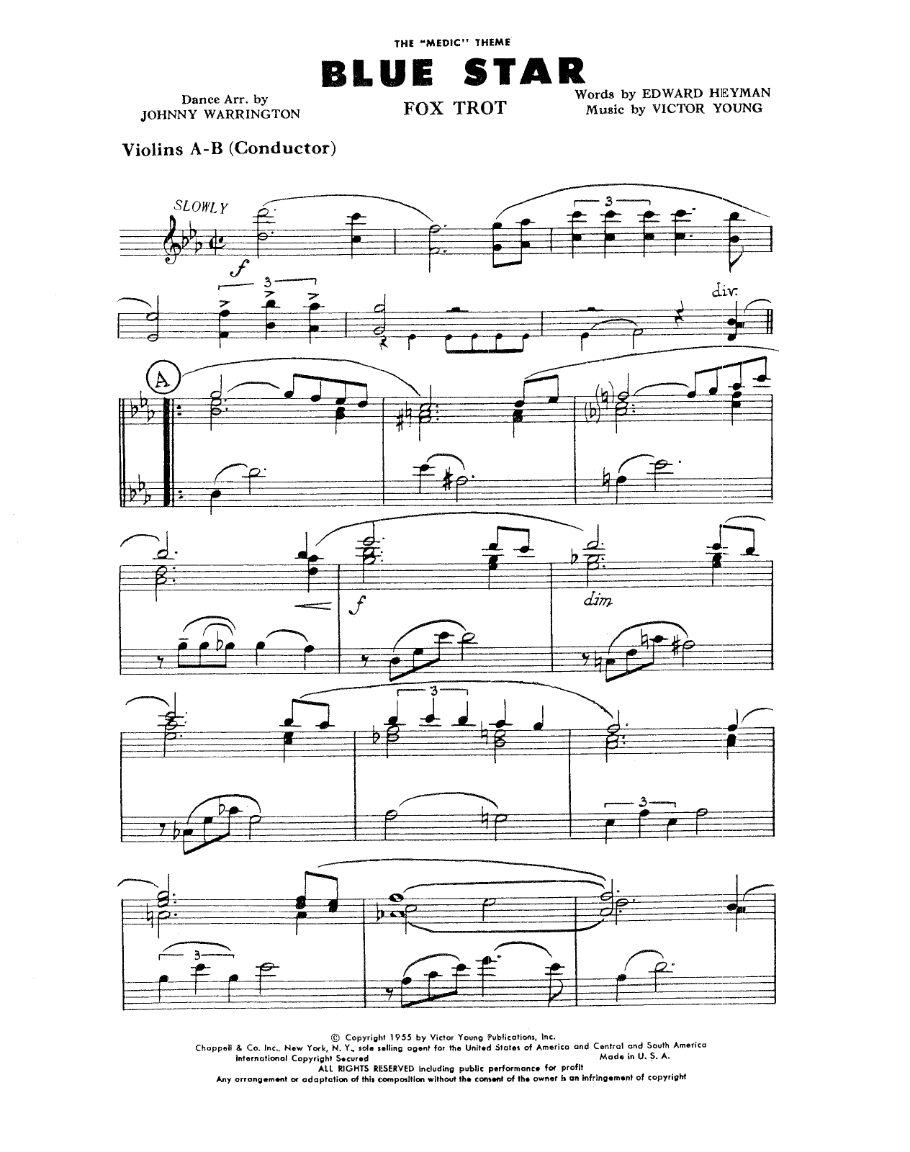
Blue Star (J.Warrington)
Composed by Victor Young, Edward Heyman
Arranged by Johnny Warrington
- Ensemble: Big Band Dance
- Style: Foxtrot
- Pages: 41
- Instruments (17): Alto Saxophone 1, Alto Saxophone 2, Tenor Saxophone 1, Tenor Saxophone 2, Baritone Saxophone, Trumpet 1, Trumpet 2, Trumpet 3, Trumpet 4, Trombone 1, Trombone 2, Trombone 3, Bass Trombone, Piano, Bass, Drums, Guitar
- Difficulty: medium
- Content: Individual Parts
- Format: PDF Download (Instant)
- Price: $24.99
"Blue Star," originally composed by Victor Young and Edward Heyman, emerged during a fertile period for American popular song, embodying the sophisticated melodicism and lyrical sentiment characteristic of the mid-20th century. While not a jazz standard in the improvisational sense, its enduring melody and elegant structure made it a favorite for dance bands and vocalists of the era. This particular arrangement by Johnny Warrington captures the essence of the classic big band dance repertoire, harkening back to the golden age of the foxtrot. It evokes the refined atmosphere of ballrooms and supper clubs where bands like Glenn Miller's or Tommy Dorsey's held sway, providing a nostalgic yet timeless soundscape. Warrington's treatment ensures that the piece retains its original charm while being reimagined for the full power and color of a modern big band. Johnny Warrington’s arrangement of "Blue Star" is a masterclass in crafting a compelling foxtrot. Set in a comfortable medium tempo, likely around 120-130 BPM, the piece maintains a steady, danceable pulse throughout, characterized by a smooth, legato feel rather than a hard-swinging drive. The primary key of F major provides a bright, accessible tonal center, allowing the lush harmonies to unfold with clarity. Warrington's signature can be heard in the rich, often close-voiced saxophone soli sections, which carry much of the melodic and harmonic weight. The arrangement exudes a sense of understated elegance and romance, with soaring brass lines providing counterpoint and punctuation to the flowing saxophone melodies. It's a piece designed to evoke a feeling of gentle sophistication, perfect for setting a refined mood. The arranger's approach to "Blue Star" is characterized by a thoughtful balance of ensemble power and melodic clarity. The melody is predominantly carried by the saxophone section, often in unison or harmonized in rich, four-part voicings, creating a warm, inviting texture. Brass interjections are carefully orchestrated, providing dynamic contrast without overwhelming the primary melodic statements. While this arrangement does not feature extensive improvised solos, there are typically brief, melodic features for lead alto or trumpet that showcase the lyrical qualities of the instrument within the ensemble context. Technical challenges include maintaining precise articulation and blend within the saxophone soli passages, ensuring clean brass attacks, and achieving a unified, sustained legato feel across the entire band. The rewarding aspect lies in the ensemble's ability to create a cohesive, polished sound that transports the listener to a bygone era of elegant dance music. This arrangement is ideally suited for college, community, and professional big bands seeking to expand their repertoire with a timeless foxtrot. High school bands with strong lead players and a commitment to ensemble precision will also find it a valuable and rewarding challenge. It offers an excellent opportunity to develop blend, balance, and expressive phrasing within a classic dance band framework. The arrangement’s well-crafted structure and engaging harmonies make it a standout choice for concerts, dances, or any performance requiring a touch of vintage big band charm. "Blue Star" should be approached with a smooth, legato foxtrot feel, maintaining a consistent medium tempo, ideally between 120-130 BPM. The primary technical challenge lies in achieving seamless blend and precise articulation within the saxophone soli passages, particularly when they carry the main melodic lines. Encourage saxophones to listen across the section for unified phrasing and intonation. Brass players should focus on controlled attacks and releases, ensuring their interjections are crisp but not overbearing, supporting the saxophones rather than competing. There are no extended improvised solos, but any short melodic features should be played with warmth and excellent tone. Pay close attention to dynamic contrasts, allowing the arrangement's inherent elegance to shine through subtle shifts. Rehearsal should prioritize ensemble cohesion, breath support for sustained phrases, and a collective understanding of the piece's romantic, danceable character. No special techniques like plunger mutes or falls are typically required; focus is on pure tone and blend. Q: What instruments and parts are included in this arrangement? A: This arrangement is scored for a standard 17-piece big band: Alto Saxophone 1, Alto Saxophone 2, Tenor Saxophone 1, Tenor Saxophone 2, Baritone Saxophone, Trumpet 1, Trumpet 2, Trumpet 3, Trumpet 4, Trombone 1, Trombone 2, Trombone 3, Trombone 4, Piano, Bass, Drums, and Guitar. Q: What is the difficulty level of Johnny Warrington's "Blue Star" arrangement? A: This arrangement is rated as a medium-difficult (Grade 4) piece. It requires solid ensemble playing, good lead players in the saxophone and trumpet sections, and attention to blend, articulation, and sustained phrasing, making it suitable for college, advanced high school, community, and professional big bands. Q: What musical style and historical context does this arrangement represent? A: This arrangement is a classic foxtrot, characteristic of the big band dance music era of the mid-20th century. It embodies the smooth, elegant, and melodically rich sound popular in ballrooms and supper clubs from the 1940s to 1950s. Q: What makes Johnny Warrington's arrangement of "Blue Star" unique? A: Warrington's signature style is evident in the lush, often close-voiced saxophone soli sections that carry the primary melody, the sophisticated harmonic treatment, and the overall balance of ensemble color designed for a smooth, danceable foxtrot feel. It's a faithful yet vibrant interpretation of a timeless melody. Q: What is the typical performance duration and tempo for this arrangement? A: The typical performance duration for "Blue Star" is approximately 3-4 minutes, depending on the number of repeats. It should be performed at a medium foxtrot tempo, generally between 120-130 beats per minute, emphasizing a smooth, legato feel.
Musicians Also Search For
Blue Star Johnny Warrington PDF • Blue Star Johnny Warrington sheet music • Blue Star arranged by Johnny Warrington • Johnny Warrington big band dance charts • Johnny Warrington jazz arrangements PDF • Blue Star Victor Young, Edward Heyman sheet music • Blue Star Victor Young, Edward Heyman big band dance arrangement • Victor Young, Edward Heyman big band dance charts • Blue Star big band dance arrangement • Blue Star big band dance PDF download • Blue Star jazz ensemble sheet music • big band dance sheet music instant download • Blue Star individual parts download • Blue Star sheet music with parts • Blue Star Foxtrot chart • Foxtrot big band dance arrangements • buy Blue Star sheet music online • download Blue Star PDF • Blue Star jazz chart • best Johnny Warrington big band dance arrangements • Victor Young, Edward Heyman songs arranged by Johnny Warrington • Blue Star printable sheet music • big band dance repertoire PDF