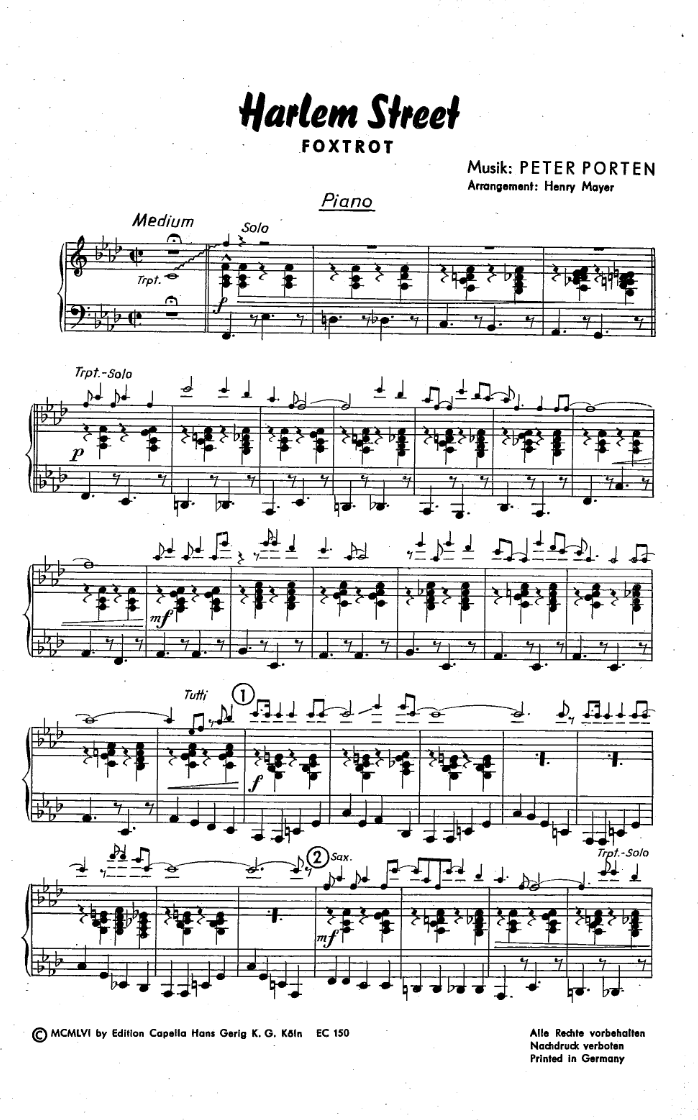
Harlem Street (H.Mayer) sheet music preview

Harlem Street (H.Mayer)

Composed by Peter Porten

Arranged by H. Mayer

  • Ensemble: Big Band Dance
  • Style: Foxtrot
  • Pages: 27
  • Instruments (18): Piano, Violin I, Violin II, Violin III, Accordion, Bass, Tenor Saxophone II, Alto Saxophone I, Alto Saxophone III, Baritone Saxophone V, Drum Set, Tenor Saxophone IV, Trumpet I, Trombone II, Trombone I, Trumpet II, Trumpet III, Guitar
  • Difficulty: medium
  • Content: Individual Parts
  • Format: PDF Download (Instant)
  • Price: $24.99

"Harlem Street," originally composed by Peter Porten, is presented here in a vibrant big band arrangement by H. Mayer, capturing the essence of the classic Foxtrot style. While not a widely recognized jazz standard, Porten's composition provides a sturdy, melodic framework that evokes the dance hall era of the 1920s and 30s, a period when big bands reigned supreme and popular music was designed for social dancing. The Foxtrot, characterized by its moderate tempo and four-beat rhythm, offered a sophisticated yet accessible dance experience, and this arrangement masterfully channels that historical spirit, transporting listeners and performers to a time of elegance and rhythmic vitality. Mayer’s treatment ensures that the piece, though rooted in an earlier era, resonates with the dynamic energy expected of a contemporary big band performance. H. Mayer's arrangement of "Harlem Street" is a masterclass in capturing the authentic Foxtrot feel. The piece is set in a bright, medium-up tempo, typically around 140-160 BPM, maintaining a steady 4/4 meter with a crisp, driving rhythmic pulse that encourages movement. The primary key of C Major provides a bright, accessible harmonic landscape, allowing for clear melodic lines and rich, unencumbered voicings. Mayer’s signature approach to this style involves meticulously crafted ensemble sections that blend traditional big band sonorities with unexpected harmonic twists, adding a layer of sophistication without sacrificing the danceability. The mood is undeniably upbeat and celebratory, evoking the bustling energy and optimism associated with urban nightlife during the interwar period. The arranger's distinctive touch is evident throughout this 17-instrument arrangement. The melody is predominantly carried by the saxophone section, often in unison or tight, harmonized soli passages that showcase the section's blend and precision. Mayer employs classic big band voicings, with particular attention to the interplay between the saxophones and brass, creating a full, resonant sound. There are several well-placed shout choruses that build dynamic intensity, featuring powerful brass figures punctuated by driving saxophone counter-melodies. While specific solo sections are not explicitly notated for improvisation, the arrangement provides ample opportunities for featured instrumentalists to shine within the ensemble's melodic statements, particularly the lead alto saxophone. Technical challenges include maintaining rhythmic precision in the ensemble figures, executing clean articulations, and achieving a balanced blend across the full 17-piece instrumentation. The rewarding aspect lies in the collective power and infectious energy generated by the ensemble, culminating in a truly exhilarating performance. This arrangement is ideally suited for college and advanced high school jazz ensembles, as well as community big bands and semi-professional groups. The demands on rhythmic accuracy, articulation, and ensemble blend are significant, requiring musicians with solid fundamental technique and experience in big band playing. While the harmonic language is approachable, the intricate interplay between sections and the need for dynamic control make it a challenging yet highly rewarding piece. The arrangement's full instrumentation (5 saxes, 4 trumpets, 4 trombones, piano, bass, drums, guitar) ensures a complete and authentic big band sound, making it an excellent choice for concert programs focused on classic dance band repertoire or as an engaging opener/closer. Conductors should emphasize a consistent, driving four-beat Foxtrot feel, avoiding any tendency towards a swing eighth-note interpretation. The tempo should be bright, around 140-160 BPM, maintaining a light but firm rhythmic foundation from the rhythm section. Articulation is paramount: brass figures require crisp, detached attacks, while saxophones should aim for a smooth, connected legato in melodic lines, contrasting with sharp staccatos in rhythmic punches. Pay close attention to dynamic contrasts, especially in the shout choruses, ensuring a powerful build-up and clear releases. Rehearsal should focus on precise ensemble entrances and cutoffs, particularly in the saxophone soli sections, and on balancing the brass and saxophone voicings to achieve a rich, cohesive sound. No special techniques like plunger mutes or doits are explicitly required, but tasteful brass falls at phrase endings can enhance the authentic Foxtrot character. Q: What specific instruments are included in this arrangement? A: This arrangement is scored for a full 17-piece big band: Alto Saxophone 1, Alto Saxophone 2, Tenor Saxophone 1, Tenor Saxophone 2, Baritone Saxophone, Trumpet 1, Trumpet 2, Trumpet 3, Trumpet 4, Trombone 1, Trombone 2, Trombone 3, Trombone 4, Piano, Bass, Drums, and Guitar. Q: What is the difficulty level of "Harlem Street (H. Mayer)"? A: This arrangement is rated as medium-advanced. It requires solid instrumental technique, precise rhythmic execution, and a good understanding of big band ensemble playing, making it suitable for college, advanced high school, or experienced community/professional bands. Q: What musical style and historical period does this arrangement represent? A: This arrangement is a classic Foxtrot, reflecting the popular dance band music of the 1920s and 1930s. It captures the bright, energetic, and sophisticated feel of that era's big band sound. Q: What makes H. Mayer's arrangement of "Harlem Street" unique? A: H. Mayer's unique approach combines authentic Foxtrot rhythmic drive with sophisticated big band voicings and dynamic ensemble interplay. The arrangement features intricate saxophone soli sections and powerful shout choruses that build excitement while maintaining the piece's historical character. Q: What is the typical performance duration and tempo for this piece? A: The typical performance duration for "Harlem Street (H. Mayer)" is approximately 3:00 to 3:30 minutes, depending on the chosen tempo. It is designed to be played at a bright, medium-up Foxtrot tempo, generally between 140-160 beats per minute.

Musicians Also Search For

Harlem Street H. Mayer PDFHarlem Street H. Mayer sheet musicHarlem Street arranged by H. MayerH. Mayer big band dance chartsH. Mayer jazz arrangements PDFHarlem Street Peter Porten sheet musicHarlem Street Peter Porten big band dance arrangementPeter Porten big band dance chartsHarlem Street big band dance arrangementHarlem Street big band dance PDF downloadHarlem Street jazz ensemble sheet musicbig band dance sheet music instant downloadHarlem Street individual parts downloadHarlem Street sheet music with partsHarlem Street Foxtrot chartFoxtrot big band dance arrangementsbuy Harlem Street sheet music onlinedownload Harlem Street PDFHarlem Street jazz chartbest H. Mayer big band dance arrangementsPeter Porten songs arranged by H. MayerHarlem Street printable sheet musicbig band dance repertoire PDF

All arrangements by H. Mayer All Peter Porten sheet music