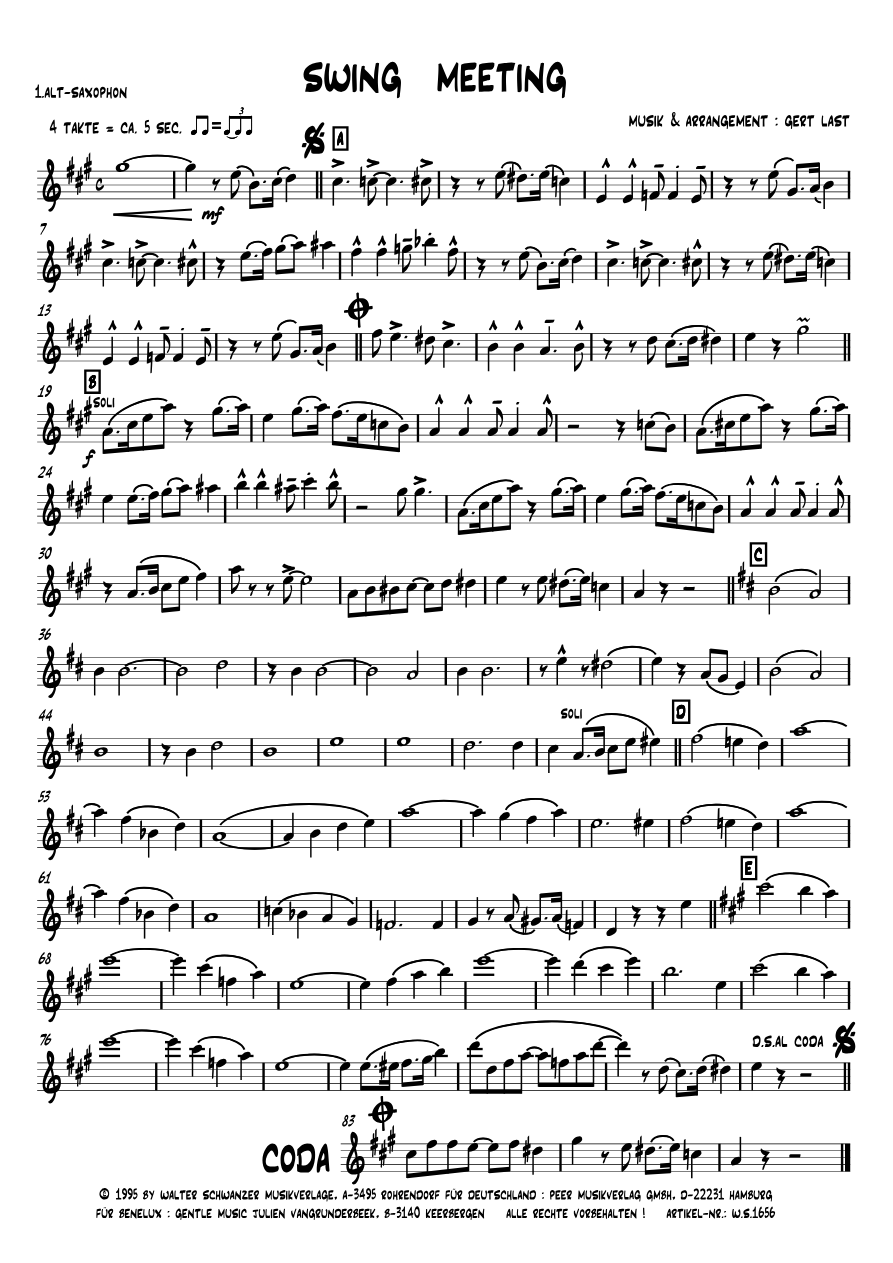
Swing Meeting (G.Last)
Composed by James Last
Arranged by G.Last
- Ensemble: Big Band Dance
- Style: Big Band Dance
- Pages: 20
- Instruments (17): 1. Alt-Saxophon, 2. Alt-Saxophon, 1. Tenor-Saxophon, 2. Tenor-Saxophon, Baritonsaxophon, Trompete 1, Trompete 2, Trompete 3, Trompete 4, Posaune 1, Posaune 2, Posaune 3, Posaune 4, Gitarre, Piano, Bass, Drums
- Difficulty: easy
- Content: Individual Parts
- Format: PDF Download (Instant)
- Price: $24.99
"Swing Meeting," originally composed by the prolific German bandleader James Last, embodies the vibrant and accessible "happy music" style that made him a global phenomenon. James Last, initially a jazz bassist, rose to prominence in the mid-20th century, particularly after his groundbreaking 1965 album, *Non Stop Dancing*, which featured big band arrangements of popular songs with an insistent dance beat and crowd noises. His unique approach carved out a niche in the big band landscape, moving beyond traditional jazz improvisation to focus on meticulously crafted, often brass-heavy arrangements designed for widespread appeal and dancing. While big band music itself emerged in the early 20th century, evolving from smaller jazz and ragtime ensembles to fill larger dance halls, Last’s contribution was to infuse this format with a pop sensibility, making it a staple of European dance floors and earning him the title of the "most commercially successful bandleader" of his era. This particular arrangement by G.Last captures the quintessential medium swing feel characteristic of James Last's big band dance style. Written in a bright, inviting key, it exudes an energetic and joyful mood, perfect for evoking the classic ballroom and dance hall atmosphere. The musical character is defined by its infectious rhythmic drive, featuring a steady, walking bass line from the piano's left hand and a clear, melodic saxophone lead that encourages movement. The piece maintains a consistent tempo, allowing for comfortable and sustained dancing, while its harmonic language is rich yet approachable, employing extended harmonies that add depth without sacrificing accessibility. The overall effect is one of sophisticated cheerfulness, designed to uplift and engage both performers and listeners. G.Last's arrangement of "Swing Meeting" showcases a deep understanding of the original composer's signature sound. The arranger skillfully employs classic big band techniques, including call-and-response patterns between the saxophone and piano, and carefully constructed soli sections that highlight the interplay between the two instruments. While the original James Last Orchestra often featured a full complement of brass, reeds, and a rhythm section, this arrangement cleverly distills the essence of that sound for a more compact, two-instrument configuration (Piano, Saxophone). The saxophone carries the primary melodic statements, often presented with clear articulation and a warm, full tone, while the piano provides a robust harmonic and rhythmic foundation. Technical challenges for the saxophone include maintaining a consistent, flowing legato in melodic lines and executing precise rhythmic figures, while the pianist navigates intricate chord voicings and a driving swing bass line. The rewarding aspect lies in the tight ensemble playing and the sheer joy of delivering such a vibrant, dance-oriented piece. This arrangement is ideally suited for college and community jazz ensembles, as well as professional duos seeking a polished and engaging dance-oriented piece. Its clear structure and well-defined parts make it an excellent vehicle for developing ensemble precision, rhythmic accuracy, and stylistic authenticity in the big band dance tradition. The arrangement’s 20 pages offer ample material for a substantial performance, providing a satisfying challenge that culminates in a highly polished and entertaining musical experience. "Swing Meeting" thrives on a consistent, buoyant medium swing feel, ideally around a tempo of quarter note = 120-130 BPM. The primary technical challenge for the saxophone lies in maintaining a fluid, connected sound throughout the melodic passages, ensuring a warm tone even in higher registers. Articulation should be precise but light, emphasizing the swing eighth-note feel. For the pianist, the left hand must establish a steady, walking bass line with rhythmic integrity, while the right hand executes clear, harmonically rich voicings. Attention to dynamic contrasts is crucial; crescendos and diminuendos should be carefully observed to build and release tension, particularly during soli sections. No special techniques like plunger mutes or falls are explicitly required, allowing the focus to remain on clean execution and stylistic nuance. Rehearsal should prioritize rhythmic alignment between the piano's bass line and the saxophone's melodic phrasing, ensuring a cohesive and driving ensemble sound. **Q: What instruments are included in this arrangement of "Swing Meeting"?** A: This arrangement is specifically scored for two instruments: Piano and Saxophone. It provides complete parts for both instruments across its 20 pages. **Q: What is the difficulty level of this arrangement?** A: This arrangement is considered to be of an intermediate to advanced level. It presents challenges in rhythmic precision, melodic phrasing, and harmonic interpretation suitable for college, community, and professional jazz musicians. **Q: What is the musical style and historical context of "Swing Meeting"?** A: "Swing Meeting" is composed by James Last and arranged by G.Last, falling under the Big Band Dance style. It reflects the "happy music" era popularized by James Last in the mid-20th century, characterized by accessible, dance-friendly big band arrangements. **Q: What makes this arrangement unique compared to other big band charts?** A: This arrangement uniquely adapts the full big band dance sound of James Last into a two-instrument format (Piano, Saxophone), focusing on tight ensemble interplay, clear melodic lines, and a robust rhythmic foundation, while retaining the original's energetic and joyful character. **Q: What is the typical performance duration or recommended tempo for "Swing Meeting"?** A: While exact duration can vary with interpretation, "Swing Meeting" is typically performed at a medium swing tempo, around quarter note = 120-130 BPM. This tempo allows for a lively yet comfortable dance feel.
Questions and answers
- What is included in the Swing Meeting (G.Last) PDF?
- The verified current file contains individual parts across 20 pages.
- How many instruments or parts are listed for Swing Meeting (G.Last)?
- The verified instrumentation list contains 17 entries for this Big Band Dance arrangement.
- Who is credited for Swing Meeting (G.Last)?
- Composer: James Last. Arranger: G.Last.
- What difficulty is listed for Swing Meeting (G.Last)?
- The verified difficulty level is easy.
- What style is listed for Swing Meeting (G.Last)?
- The catalog lists the style as Big Band Dance.
- Can I preview Swing Meeting (G.Last) before buying?
- Yes. The product page provides a preview generated from the current PDF file.
- How is Swing Meeting (G.Last) delivered?
- After successful payment, the digital PDF is made available for download. The displayed price is $24.99.
Musicians Also Search For
Swing Meeting G.Last PDF • Swing Meeting G.Last sheet music • Swing Meeting arranged by G.Last • G.Last big band dance charts • G.Last jazz arrangements PDF • Swing Meeting James Last sheet music • Swing Meeting James Last big band dance arrangements • James Last big band dance charts • Swing Meeting big band dance arrangements • Swing Meeting big band dance PDF download • Swing Meeting jazz sheet music • big band dance sheet music download • Swing Meeting individual parts download • Swing Meeting sheet music PDF • Swing Meeting Big Band Dance charts • Big Band Dance big band dance arrangements • buy Swing Meeting sheet music • download Swing Meeting PDF • Swing Meeting jazz charts • best G.Last big band dance arrangements • James Last arranged by G.Last • Swing Meeting printable sheet music • big band dance repertoire PDF