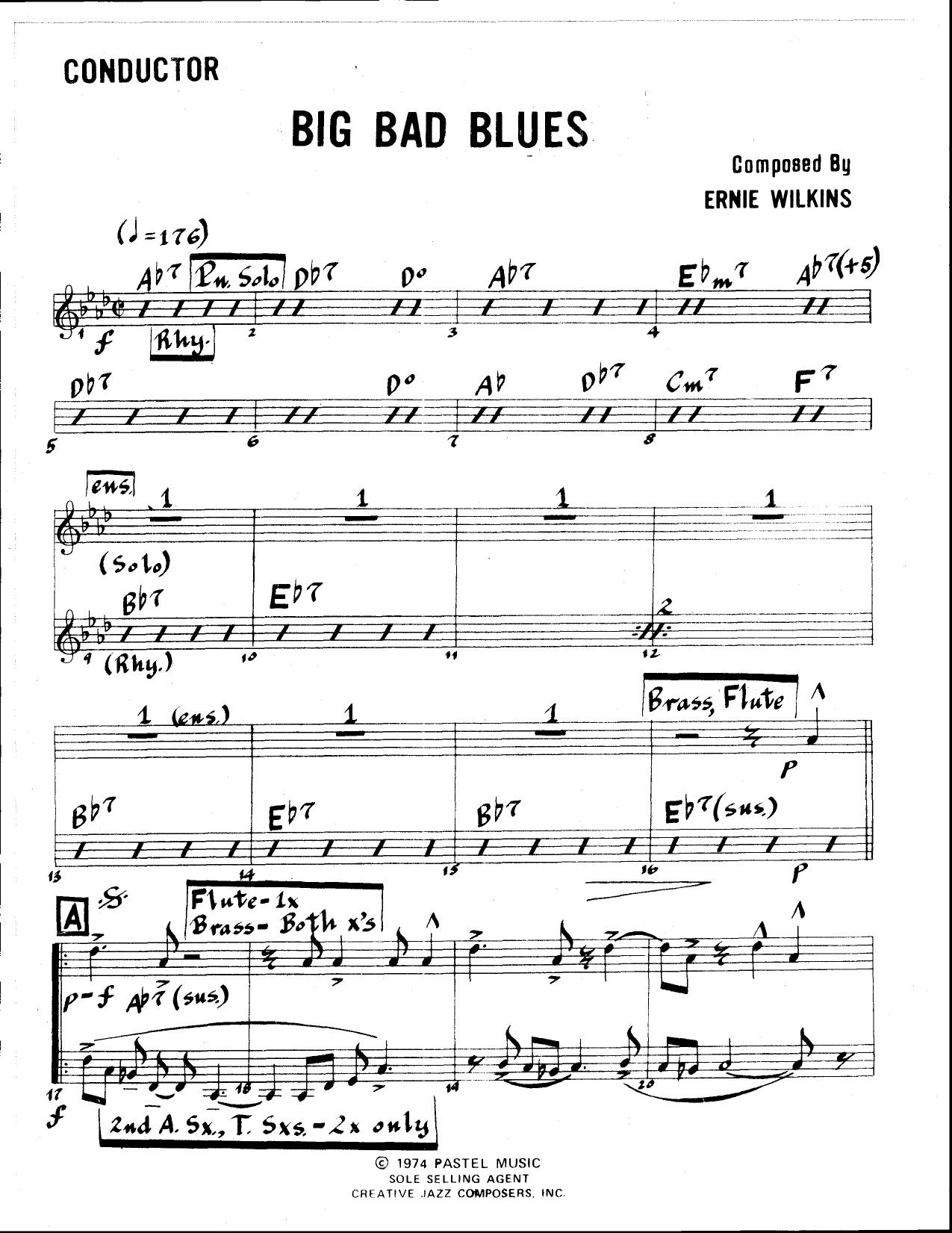
Big Bad Blues (E.Wilkins)
Composed by Ernie Wilkins
Arranged by Ernie Wilkins
- Ensemble: Big Band
- Pages: 58
- Instruments (18): CONDUCTOR, 1st ALTO SAX, 2nd ALTO SAX, 1st TENOR SAX, 2nd TENOR SAX, 5th BARITONE SAX, 1st TRUMPET, 2nd TRUMPET, 3rd TRUMPET, 4th TRUMPET, 1st TROMBONE, 2nd TROMBONE, 3rd TROMBONE, 4th TROMBONE, BASS, DRUMS, PIANO, GUITAR
- Difficulty: advanced
- Content: Individual Parts
- Format: PDF Download (Instant)
- Price: $24.99
Ernie Wilkins stands as one of the most formidable architect-arrangers of the post-war jazz big band era, famously leaving an indelible imprint on the Count Basie Orchestra and later European radio big bands. "Big Bad Blues," composed and arranged by Wilkins, captures the swagger, muscular drive, and sophisticated harmonic palette that defined the mid-century modern big band movement. Emerging from an era where blues forms were continually re-imagined through a modern jazz lens, this composition bridges the gap between traditional Kansas City gut-bucket energy and the refined, punchy voicings of post-bop orchestration. It represents a masterclass in how to sustain high-octane momentum using economic yet devastatingly effective writing. Driven by an infectious, driving medium-tempo swing feel in 4/4 time, "Big Bad Blues" exudes a confident, gritty mood characterized by razor-sharp brass stabs and fluid saxophone counterlines. The piece opens with a signature Wilkins ostinato-like groove that immediately establishes a gritty, blues-drenched atmosphere before expanding into rich, harmonically dense ensemble passages. The emotional trajectory moves from a sultry, low-register thematic statement to an exhilarating, high-register shout chorus that pushes the ensemble to its dynamic peak. Wilkins masterfully exploits the tension between minor-mode blues phrasing and sophisticated extended dominant chords, creating a soundscape that is both nostalgically rooted in the blues tradition and forward-thinking. As an arranger, Wilkins was peerless in his ability to make a smaller or non-standard instrumentation sound like a massive, full-throttle jazz orchestra. In this specific 7-instrument configuration—comprising Alto Saxophone, Tenor Saxophone, Trumpet, Trombone, and a rhythm section anchored by Piano—the writing relies on ingenious cross-section voicing and counterpoint rather than brute force. The horns are utilized as a unified collective, frequently trading dense chordal blocks with linear, bebop-infused solis. Featured solo spaces are structurally integrated into the arrangement, allowing individual improvisers room to stretch out over standard blues changes while the rhythm section maintains an insistent, conversational groove. The technical challenges lie primarily in the articulation; achieving the authentic jazz phrasing, dynamic contrast, and stylistic cohesion required to pull off Wilkins' idiomatic swing feels will demand precision from every player. Advanced high school ensembles, collegiate jazz bands, and professional chamber jazz groups will find this chart to be an exceptionally rewarding addition to their repertoire. Because of its unique 7-instrument scoring, it provides a transparent yet demanding texture where individual players cannot hide, making it a supreme vehicle for developing ensemble listening skills, dynamic control, and stylistic authenticity. The arrangement offers audiences a visceral, high-energy jazz experience while giving serious musicians a textbook example of mid-century arranging genius at work. Conductors and ensemble directors approaching "Big Bad Blues" must prioritize articulation uniformity across the horns. The tempo should sit firmly in a comfortable, driving medium-swing pocket; rushing the tempo will destroy the greasy, relaxed swagger essential to the blues idiom. Pay meticulous attention to the written articulations—short, accented notes must be clipped sharply, while longer notes require a subtle vocal swell to mimic the inflection of a jazz singer. The rhythm section serves as the engine room: the pianist should approach comping with sparse, highly rhythmic rootless voicings that leave plenty of space for the horns, while the bass and drums lock into a relentless, unhurried quarter-note pulse. Brass players should utilize natural, open tones with tasteful use of standard jazz inflections (such as slight falls and controlled doits) only where stylistically appropriate, avoiding over-aggerated effects. Rehearsal should begin section by section, ensuring the inner-voice countermelodies in the saxophones and trombone are balanced cleanly against the primary trumpet and alto melodic lines before integrating the full ensemble. Q: What instruments and parts are included in this arrangement? A: This arrangement is scored for a 7-instrument ensemble featuring Alto Saxophone, Tenor Saxophone, Trumpet, Trombone, and a full rhythm section anchored by Piano (totaling 58 pages of detailed score and parts). Q: What is the difficulty level of this chart? A: This piece is best suited for advanced high school, collegiate, and professional musicians who possess strong swing-feel reading abilities and comfort with mid-century jazz idioms. Q: What is the musical style and historical context of "Big Bad Blues"? A: Composed and arranged by Ernie Wilkins, the piece is a driving medium-tempo jazz blues that reflects the sophisticated, hard-swinging arranging aesthetic of the post-war big band era. Q: What makes this specific Ernie Wilkins arrangement unique? A: It distills the massive, thunderous sound of a full Basie-style big band into a lean 7-instrument configuration through ingenious cross-section voicings and dense, linear counterpoint. Q: What is the performance duration and tempo feel of the piece? A: The arrangement is set in 4/4 time with a confident, driving medium-swing feel, making for a high-energy performance typically lasting around 4 to 5 minutes depending on solo choruses.
Questions and answers
- What is included in the Big Bad Blues (E.Wilkins) PDF?
- The verified current file contains a conductor score and individual parts across 58 pages.
- How many instruments or parts are listed for Big Bad Blues (E.Wilkins)?
- The verified instrumentation list contains 18 entries for this Big Band arrangement.
- Who is credited for Big Bad Blues (E.Wilkins)?
- Composer: Ernie Wilkins. Arranger: Ernie Wilkins.
- What difficulty is listed for Big Bad Blues (E.Wilkins)?
- The verified difficulty level is advanced.
- Can I preview Big Bad Blues (E.Wilkins) before buying?
- Yes. The product page provides a preview generated from the current PDF file.
- How is Big Bad Blues (E.Wilkins) delivered?
- After successful payment, the digital PDF is made available for download. The displayed price is $24.99.
Musicians Also Search For
Big Bad Blues Ernie Wilkins PDF • Big Bad Blues Ernie Wilkins sheet music • Big Bad Blues arranged by Ernie Wilkins • Ernie Wilkins big band charts • Ernie Wilkins jazz arrangements PDF • Big Bad Blues Ernie Wilkins big band arrangements • Big Bad Blues big band arrangements • Big Bad Blues big band PDF download • Big Bad Blues jazz sheet music • big band sheet music download • Big Bad Blues conductor score PDF • Big Bad Blues individual parts download • Big Bad Blues sheet music PDF • buy Big Bad Blues sheet music • download Big Bad Blues PDF • Big Bad Blues jazz charts • best Ernie Wilkins big band arrangements • Big Bad Blues printable sheet music • big band repertoire PDF