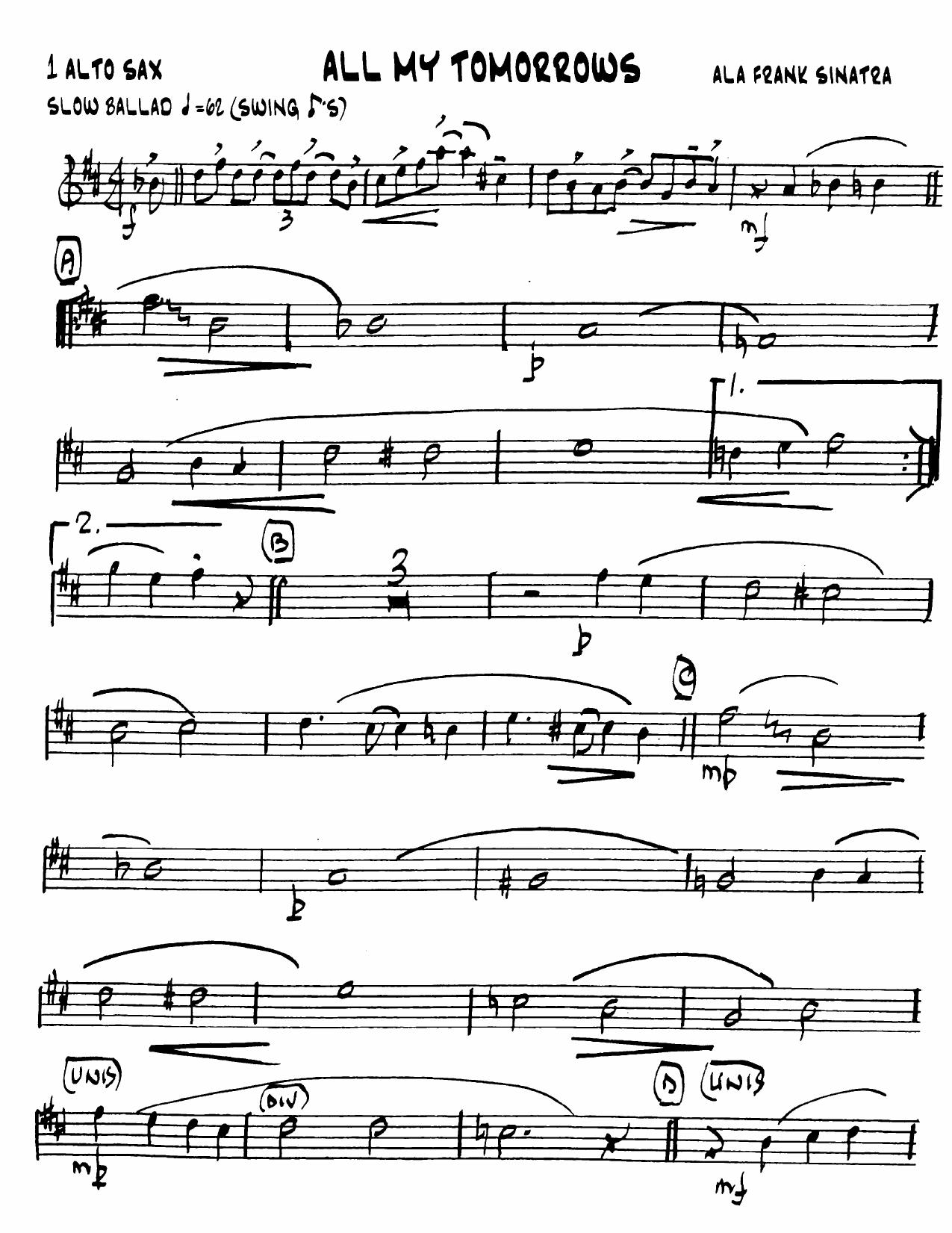
All My Tomorrows F.Sinatra - Don Costa. (F.Riddle)
Composed by Nelson Riddle
Arranged by Frank Sinatra & Nelson Riddle
- Ensemble: Big Band
- Pages: 39
- Instruments (18): 1 Alto Sax, 2 Alto Sax, 1 Tenor Sax, 2 Tenor Sax, Baritone Sax, 1 Trumpet, 2 Trumpet, 3 Trumpet, 4 Trumpet, 1 Trombone, 2 Trombone, 3 Trombone, 4 Trombone, Piano, Bass, Drums, Guitar, Vocal
- Difficulty: medium
- Content: Individual Parts
- Format: PDF Download (Instant)
- Price: $24.99
Originally captured during the golden age of American vocal jazz, "All My Tomorrows" stands as one of the most poignant collaborations between legendary vocalist Frank Sinatra and master arranger Nelson Riddle. Introduced on Sinatra’s 1958 Capitol Records release *Come Dance with Me!*—though distinctly balladic in contrast to that album's upbeat theme—the song embodies the sophisticated melancholy and lush harmonic language of late-1950s sophisticated pop and jazz. Written by Sammy Cahn and Jimmy Van Heusen, the composition blossomed under Riddle’s pen into a masterclass in orchestral storytelling, blending cinematic string-like woodwind voicings with a steady, walking jazz pulse that elevates the tune from a standard torch song into a timeless monument of vocal arrangement. This specific orchestration captures the essence of the classic Sinatra-Riddle aesthetic, draped in a warm, contemplative medium-slow ballad feel in 4/4 time. The emotional landscape shifts gracefully between introspective vulnerability and quiet cinematic grandeur, driven by rich, extended chord voicings in the brass and sliding, sighing chromatic lines in the woodwinds. The arrangement opens with a signature Riddle-esque atmospheric introduction, establishing a reflective mood before the rhythm section settles into a relaxed, forward-moving pocket. Lush chordal textures dominate the accompaniment, utilizing open-horn voicings and velvety low-register baritone sax anchoring to create a profound depth of field behind the melodic statements. Nelson Riddle’s genius shines through the meticulous countermelodies and seamless transitions between sections, ensuring the ensemble acts as a reactive partner to the vocal line. The 10-instrument instrumentation is cleverly utilized to maximize tonal color, balancing the reedy warmth of the Alto, Tenor, and Baritone saxophones against the brass weight of Trumpet and Trombone. While designed primarily to support a vocal soloist in the style of Sinatra’s intimate phrasing, the arrangement features gorgeous instrumental interjections, subtle dynamic swells, and harmonized horn solis that demand exceptional breath control, intonation, and stylistic cohesion. Players must master the art of the micro-dynamic—subtle crescendos and decrescendos that mimic human vocal delivery rather than rigid mechanical reading. Advanced high school, collegiate, and professional jazz ensembles will find this chart immensely rewarding, particularly those seeking to master the nuanced art of vocal accompaniment and mid-century studio jazz styling. Because the tempo is measured, the primary technical hurdles do not lie in fast fingerwork, but rather in rhythmic placement, balance, and maintaining a sustained, velvety legato line across all sections. Conductors will appreciate how effectively this chart teaches mature phrasing, section blending, and stylistic restraint, making it an exceptional centerpiece for any concert program celebrating the apex of the Sinatra-Riddle partnership. Executing this arrangement authentically requires a deep commitment to a relaxed, behind-the-beat feel even at a ballad tempo. The conductor should emphasize that the underlying eighth notes remain even, yet imbued with a heavy, vocal-like swing inflection where appropriate. Balance is the single greatest technical challenge: the 10-instrument texture is lean, meaning every player must carefully monitor their dynamic ceiling so the inner voices and countermelodies can weave through the texture without forcing. Horn players should utilize minimal vibrato, opting instead for a pure, warm tone that darkens in the lower registers. Pay close attention to the breath marks indicated in the woodwind parts to ensure seamless transitions during phrase extensions. Rehearsals should begin with the rhythm section establishing a warm, pillowy foundation, allowing the horns to layer their chromatic suspensions gently on top without ever pinching the sound. Q: What instruments and parts are included in this arrangement? A: This chart is scored for a specialized 10-instrument ensemble featuring Alto Saxophone, Tenor Saxophone, Baritone Saxophone, Trumpet, and Trombone parts, complemented by a full rhythm section. Q: What is the difficulty level of this arrangement? A: It is geared toward advanced high school, collegiate, and professional jazz ensembles due to its heavy demand for mature intonation, subtle dynamic control, and authentic vocal-accompaniment phrasing. Q: What is the historical style and context of this piece? A: It reflects the sophisticated 1958 Capitol Records aesthetic pioneered by Frank Sinatra and arranger Nelson Riddle, capturing the lush, cinematic vocal-jazz style of the mid-century era. Q: What makes this particular Nelson Riddle arrangement unique? A: It distinguishes itself through its rich, extended chord voicings, subtle chromatic countermelodies, and masterful use of a compact 10-instrument texture to create a deeply atmospheric, vocal-driven landscape. Q: What is the performance duration and tempo feel of this arrangement? A: The arrangement is performed at a relaxed, contemplative medium-slow ballad tempo in 4/4 time, typically lasting around 3 to 4 minutes depending on the vocal or instrumental rubato applied.
Questions and answers
- What is included in the All My Tomorrows F.Sinatra - Don Costa. (F.Riddle) PDF?
- The verified current file contains individual parts across 39 pages.
- How many instruments or parts are listed for All My Tomorrows F.Sinatra - Don Costa. (F.Riddle)?
- The verified instrumentation list contains 18 entries for this Big Band arrangement.
- Who is credited for All My Tomorrows F.Sinatra - Don Costa. (F.Riddle)?
- Composer: Nelson Riddle. Arranger: Frank Sinatra & Nelson Riddle.
- What difficulty is listed for All My Tomorrows F.Sinatra - Don Costa. (F.Riddle)?
- The verified difficulty level is medium.
- Can I preview All My Tomorrows F.Sinatra - Don Costa. (F.Riddle) before buying?
- Yes. The product page provides a preview generated from the current PDF file.
- How is All My Tomorrows F.Sinatra - Don Costa. (F.Riddle) delivered?
- After successful payment, the digital PDF is made available for download. The displayed price is $24.99.
Musicians Also Search For
All My Tomorrows F.Sinatra - Don Costa. Frank Sinatra & Nelson Riddle PDF • All My Tomorrows F.Sinatra - Don Costa. Frank Sinatra & Nelson Riddle sheet music • All My Tomorrows F.Sinatra - Don Costa. arranged by Frank Sinatra & Nelson Riddle • Frank Sinatra & Nelson Riddle big band charts • Frank Sinatra & Nelson Riddle jazz arrangements PDF • All My Tomorrows F.Sinatra - Don Costa. Nelson Riddle sheet music • All My Tomorrows F.Sinatra - Don Costa. Nelson Riddle big band arrangements • Nelson Riddle big band charts • All My Tomorrows F.Sinatra - Don Costa. big band arrangements • All My Tomorrows F.Sinatra - Don Costa. big band PDF download • All My Tomorrows F.Sinatra - Don Costa. jazz sheet music • big band sheet music download • All My Tomorrows F.Sinatra - Don Costa. individual parts download • All My Tomorrows F.Sinatra - Don Costa. sheet music PDF • buy All My Tomorrows F.Sinatra - Don Costa. sheet music • download All My Tomorrows F.Sinatra - Don Costa. PDF • All My Tomorrows F.Sinatra - Don Costa. jazz charts • best Frank Sinatra & Nelson Riddle big band arrangements • Nelson Riddle arranged by Frank Sinatra & Nelson Riddle • All My Tomorrows F.Sinatra - Don Costa. printable sheet music • big band repertoire PDF