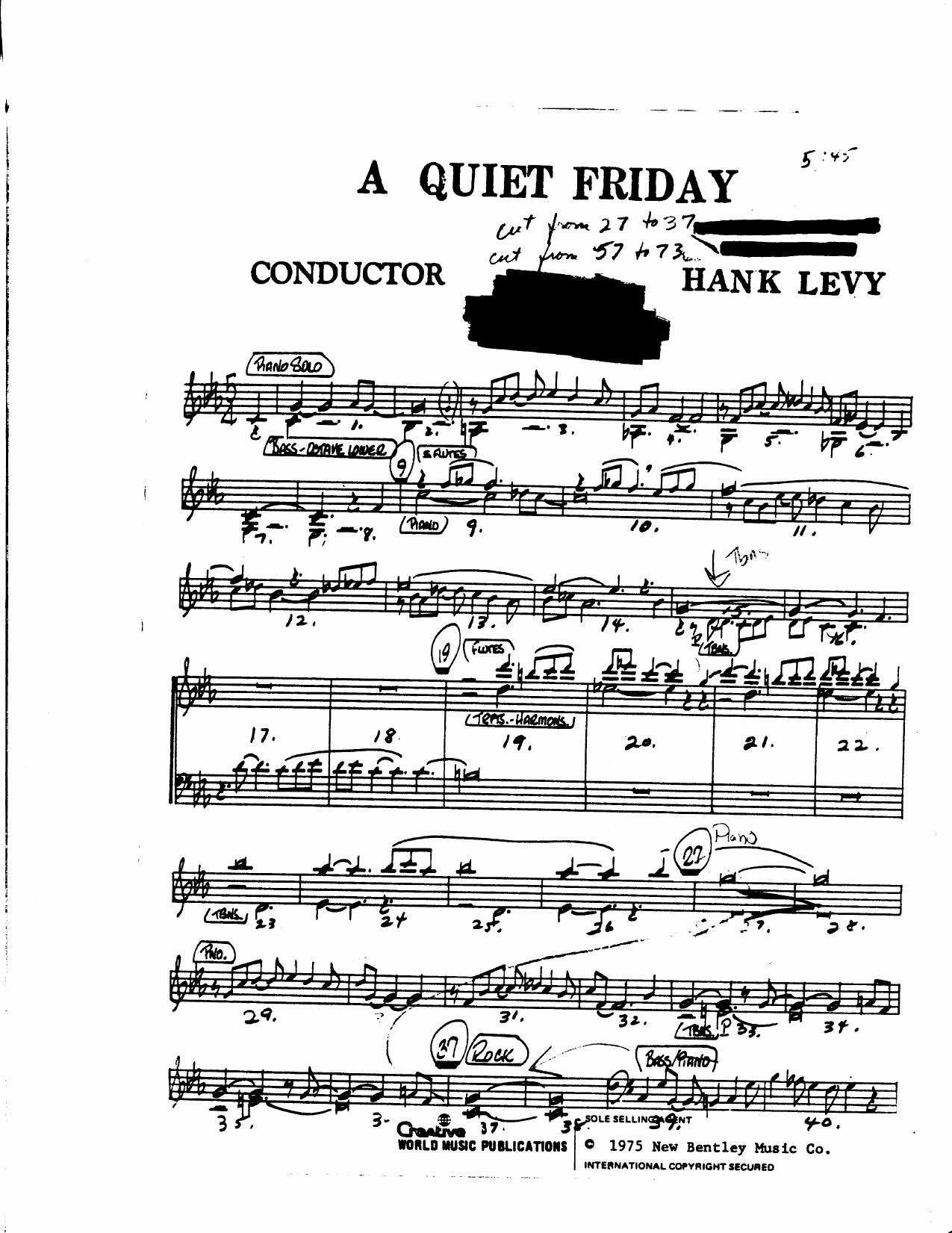
A Quiet Friday (H.Levy)
Composed by Hank Levy
Arranged by Hank Levy
- Ensemble: Big Band
- Pages: 56
- Instruments (19): Conductor, Alto Sax 1, 2nd Alto Sax, Tenor Sax 1 (Tenor II), 4th Tenor Sax, Baritone Sax (Bari I), Trumpet I, Trumpet II, Trumpet III, Trumpet IV, Trumpet V (Flugelhorn), Trombone I, Trombone II, Trombone III, Trombone IV, Bass Trombone V, Piano, Bass, Drums
- Difficulty: advanced
- Content: Individual Parts
- Format: PDF Download (Instant)
- Price: $24.99
Hank Levy’s distinctive compositional voice occupies a rare, highly revered corner of modern big band jazz history, defined by his pioneering exploration of odd meters and asymmetric time signatures. Emerging from the progressive big band movement of the mid-20th century—most famously associated with his work for the Stan Kenton Orchestra—Levy challenged both performers and audiences by transplanting folkloric Balkan and Mediterranean rhythms into the contemporary American jazz idiom. "A Quiet Friday" distills this rhythmic sophistication into a tightly woven, atmospheric canvas that rewards deep ensemble listening and rhythmic precision. Rather than relying on standard 4/4 swing frameworks, Levy constructs a mesmerizing architectural flow where unconventional metric subdivisions dictate the pulse, creating a sense of suspended motion that feels both intellectually stimulating and viscerally compelling. The musical character of "A Quiet Friday" balances an introspective, modal serenity with sudden undercurrents of kinetic tension. Far from the chaotic energy sometimes associated with odd-meter charts, this composition unfolds with an unhurried, contemplative grace reminiscent of a reflective late-evening atmosphere. The harmonic language draws heavily on extended modal voicings, open fourths and fifths, and subtle chromatic colorations that evoke a cool, sophisticated modern jazz aesthetic. The mood shifts fluidly from hushed, crystalline textural passages to surging collective crescendos, showcasing Levy’s masterclass ability to manipulate ensemble density. Woodwind doublings and rich brass stackings create a lush, expansive sonic palette that breathes organically, drawing the listener into an immersive, cinematic world of sound. Levy’s structural approach relies heavily on shifting metric groupings—frequently subdividing bars into unpredictable patterns like 7/8, 9/8, or complex mixed meters—yet he achieves a seamless fluidity that avoids sounding mathematically rigid. The arrangement features intricate counterpoint and interwoven horn lines where the melody is distributed democratically across the sections rather than simply locked in the lead trumpet. Rich saxophone solis and sophisticated ensemble cross-section writing demand absolute rhythmic unison, while designated solo spaces provide ample room for improvisers to stretch out over modal vamps. The tension-and-release dynamics culminate in powerful, texturally dense climaxes that test the band’s collective breath support and dynamic control, offering a masterclass in modern big band architecture. Advanced collegiate, professional, and elite high school jazz ensembles with a strong grasp of contemporary meters will find "A Quiet Friday" an extraordinarily rewarding centerpiece for a concert program. Because the chart relies heavily on internal metric feel rather than a traditional ride-cymbal swing pulse, the ensemble must possess exceptional internal clocks and the ability to subdivide complex bars effortlessly. Conductor and band alike will appreciate how the chart transforms technical challenges into sheer musical expression, offering audiences a rare glimpse into the avant-garde yet deeply lyrical genius of one of big band jazz's most visionary composers. Conquering "A Quiet Friday" begins with establishing a unanimous, internal subdivision of the primary odd-meter pulses rather than relying solely on the conductor's baton. Rehearsals should initially strip away pitch and focus entirely on rhythm: have the entire ensemble vocalize or clap the underlying metric cells until the asymmetric groupings feel as natural as standard common time. Pay meticulous attention to articulation markings; short notes must be crisp and weightless, while sustained modal pads require seamless blending across the saxophone and brass sections to prevent any jagged dynamic spikes. The rhythm section bears a monumental responsibility here—the bass and piano must lock into repetitive ostinatos that anchor the shifting meters without sounding mechanical, while the drum set player should treat the time signatures as melodic grooves rather than mathematical equations. Balance is crucial during the denser ensemble passages, ensuring that inner-voice countermelodies weave cleanly through the texture without obscuring the primary thematic statements. Q: What instruments and parts are included in this 56-page big band arrangement? A: This arrangement is scored for a standard 17-piece big band instrumentation, featuring 5 saxophones (two altos, two tenors, and baritone), 4 trumpets, 4 trombones, and a full four-piece rhythm section consisting of piano, guitar, bass, and drums. Q: What is the appropriate difficulty level for "A Quiet Friday"? A: This piece is designated for advanced college, professional, and elite high school jazz ensembles due to its sophisticated harmonic language and complex, shifting odd-meter time signatures. Q: What is the style and historical context of this composition? A: Composed by Hank Levy, a pioneer of odd-meter jazz writing famously associated with the progressive big band tradition, this piece blends modal jazz harmony with complex Mediterranean and Balkan-inspired rhythmic frameworks. Q: What makes this specific arrangement unique within the big band repertoire? A: Unlike conventional swing charts, this arrangement distinguishes itself through its atmospheric, modal textures and Levy's signature ability to make complex asymmetric meters feel organic, flowing, and deeply lyrical. Q: What is the recommended tempo and performance duration? A: While tempo and pacing can breathe with the ensemble's interpretation, the piece is designed as a moderate, contemplative journey that typically spans between 5 to 7 minutes in performance length.
Questions and answers
- What is included in the A Quiet Friday (H.Levy) PDF?
- The verified current file contains a conductor score and individual parts across 56 pages.
- How many instruments or parts are listed for A Quiet Friday (H.Levy)?
- The verified instrumentation list contains 19 entries for this Big Band arrangement.
- Who is credited for A Quiet Friday (H.Levy)?
- Composer: Hank Levy. Arranger: Hank Levy.
- What difficulty is listed for A Quiet Friday (H.Levy)?
- The verified difficulty level is advanced.
- Can I preview A Quiet Friday (H.Levy) before buying?
- Yes. The product page provides a preview generated from the current PDF file.
- How is A Quiet Friday (H.Levy) delivered?
- After successful payment, the digital PDF is made available for download. The displayed price is $24.99.
Musicians Also Search For
A Quiet Friday Hank Levy PDF • A Quiet Friday Hank Levy sheet music • A Quiet Friday arranged by Hank Levy • Hank Levy big band charts • Hank Levy jazz arrangements PDF • A Quiet Friday Hank Levy big band arrangements • A Quiet Friday big band arrangements • A Quiet Friday big band PDF download • A Quiet Friday jazz sheet music • big band sheet music download • A Quiet Friday conductor score PDF • A Quiet Friday individual parts download • A Quiet Friday sheet music PDF • buy A Quiet Friday sheet music • download A Quiet Friday PDF • A Quiet Friday jazz charts • best Hank Levy big band arrangements • A Quiet Friday printable sheet music • big band repertoire PDF