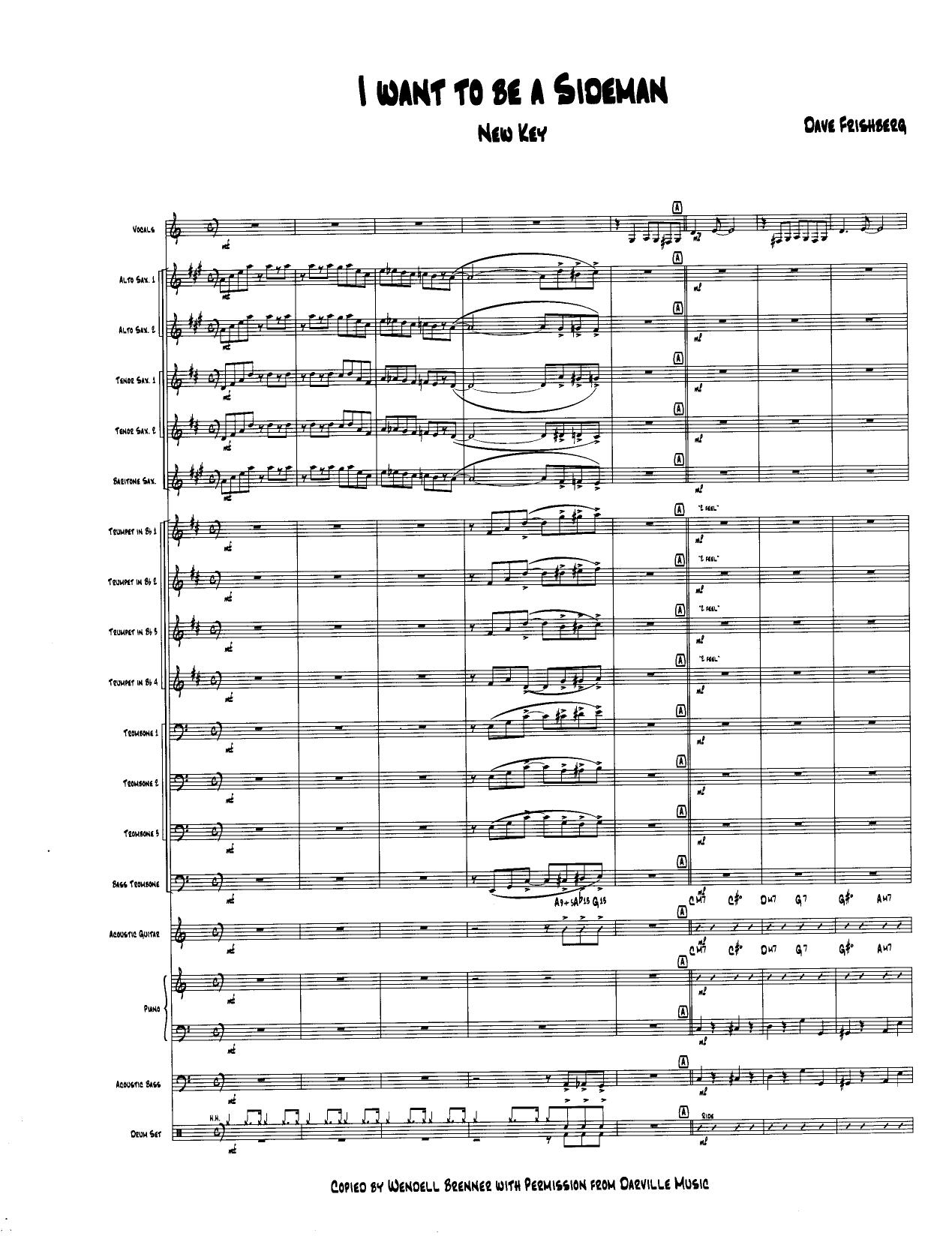
I Want To Be A Sideman (D.Frishberg)
Composed by Dave Frishberg
Arranged by D.Frishberg
- Ensemble: Big Band Vocal
- Style: Jazz Standard
- Pages: 60
- Difficulty: medium
- Content: Sheet Music
- Format: PDF Download (Instant)
- Price: $24.99
Dave Frishberg's "I Want To Be A Sideman" stands as a witty, self-deprecating anthem for the journeyman jazz musician, a cornerstone of his celebrated catalog of original songs that often blend sophisticated harmony with insightful, often humorous, lyrics. Composed and recorded in the mid-to-late 20th century, this piece captures the essence of a particular era in jazz history where the distinction between bandleader and sideman carried significant weight, yet the sideman's craft was deeply revered. It's a testament to the unsung heroes of jazz, those whose artistry supports the stars, making it a beloved standard among musicians who appreciate its candid portrayal of the life on the bandstand. The song's charm lies in its medium swing feel, often delivered with a wry smile, showcasing Frishberg's mastery of melodic invention and lyrical storytelling. This particular arrangement, crafted by D.Frishberg himself, presents "I Want To Be A Sideman" as a sophisticated big band vocal feature, meticulously translating the intimate piano-vocal original into a rich orchestral tapestry. The arrangement maintains the original's buoyant, medium swing tempo in 4/4, typically set around 120-130 BPM, and often resides in a comfortable key for the vocalist, frequently G or F major, allowing the narrative to unfold clearly. D.Frishberg's approach is characterized by his intelligent use of voicings that support the vocal line without overshadowing it, employing lush saxophone pads and brass punctuations to enhance the lyrical nuances. Expect finely articulated ensemble passages, often with intricate inner voice movement that adds harmonic depth, characteristic of Frishberg's own compositional style. The arrangement opens with a foundational ensemble statement, setting the groove before the vocalist enters, typically carrying the main melody through the AABA form. Instrumental soli sections are strategically placed, often featuring the saxophone section with tightly voiced lines that echo the vocal melody or provide a counterpoint. A standout feature is often a well-crafted brass soli, which might include plunger mute work for added character, injecting a classic big band sound. While the primary focus is on the vocal narrative, there is ample opportunity for a featured instrumental soloist—typically tenor saxophone or trumpet—to improvise over a chorus or two, allowing for personal expression within the established harmonic framework. The arrangement culminates in a classic big band shout chorus, building dynamic intensity before a final, often understated, vocal or ensemble tag that reinforces the song's reflective mood. Performing this arrangement is immensely rewarding, offering both technical challenge and profound musical satisfaction. The ensemble writing demands precision in articulation and dynamics, particularly in the brass and saxophone sections, to achieve the desired blend and balance. The rhythm section is tasked with maintaining a consistent, yet flexible, medium swing feel that supports both the vocalist and the ensemble. This arrangement is ideally suited for college-level jazz ensembles and above, including community big bands with strong sight-reading abilities, and professional groups. Its blend of lyrical depth, sophisticated harmony, and classic big band orchestration makes it a compelling choice for concerts, festivals, and educational settings where musical storytelling and ensemble artistry are paramount. Conductors should emphasize a relaxed, yet precise, medium swing feel, ideally between 120-130 BPM, ensuring the rhythm section lays down a solid, unhurried foundation. Articulation is key; encourage brass players to use a light, crisp tonguing for swing eighths, and saxophones to maintain a warm, blended sound in soli sections. Pay close attention to dynamic contrasts, particularly in supporting figures under the vocalist, ensuring the lyrics remain paramount. Any plunger mute sections in the brass should be executed with a consistent, expressive "wah" effect. Rehearsal time should be dedicated to balancing the vocal line with the ensemble, particularly during the more intricate soli passages and the climactic shout chorus, ensuring clarity in all voices. Encourage the rhythm section to listen closely to the vocalist for phrasing cues, and for the ensemble to breathe together, fostering a cohesive, communicative performance. Q: What instruments and parts are included in this arrangement? A: This big band vocal arrangement typically includes parts for Vocalist, 5 Saxophones (AATTB), 4 Trumpets, 4 Trombones, Piano, Bass, Drums, and Guitar. Q: What is the difficulty level of this arrangement? A: This arrangement is rated as Medium-Advanced. It requires experienced musicians comfortable with sophisticated jazz harmonies, precise articulation, and a nuanced understanding of medium swing feel. Q: What is the musical style and historical context of "I Want To Be A Sideman"? A: It's a jazz standard in a medium swing style, originally composed by Dave Frishberg. The song is a witty, satirical commentary on the life of a jazz sideman, reflecting the post-bebop era's professional jazz scene. Q: What makes D.Frishberg's arrangement of "I Want To Be A Sideman" unique? A: This arrangement, by the composer himself, uniquely translates the song's intimate charm into a full big band setting, featuring intelligent voicings, strategic soli sections, and a classic shout chorus that enhances the lyrical narrative without overshadowing the vocalist. Q: What is the typical performance duration and tempo for this piece? A: The typical performance duration is approximately 4-5 minutes, depending on the number of solo choruses. The tempo should be a comfortable medium swing, generally around 120-130 beats per minute.
Musicians Also Search For
I Want To Be A Sideman D.Frishberg PDF • I Want To Be A Sideman D.Frishberg sheet music • I Want To Be A Sideman arranged by D.Frishberg • D.Frishberg big band vocal charts • D.Frishberg jazz arrangements PDF • I Want To Be A Sideman Dave Frishberg sheet music • I Want To Be A Sideman Dave Frishberg big band vocal arrangement • Dave Frishberg big band vocal charts • I Want To Be A Sideman big band vocal arrangement • I Want To Be A Sideman big band vocal PDF download • I Want To Be A Sideman jazz ensemble sheet music • big band vocal sheet music instant download • I Want To Be A Sideman sheet music with parts • I Want To Be A Sideman Jazz Standard chart • Jazz Standard big band vocal arrangements • buy I Want To Be A Sideman sheet music online • download I Want To Be A Sideman PDF • I Want To Be A Sideman jazz chart • best D.Frishberg big band vocal arrangements • Dave Frishberg songs arranged by D.Frishberg • I Want To Be A Sideman printable sheet music • big band vocal repertoire PDF