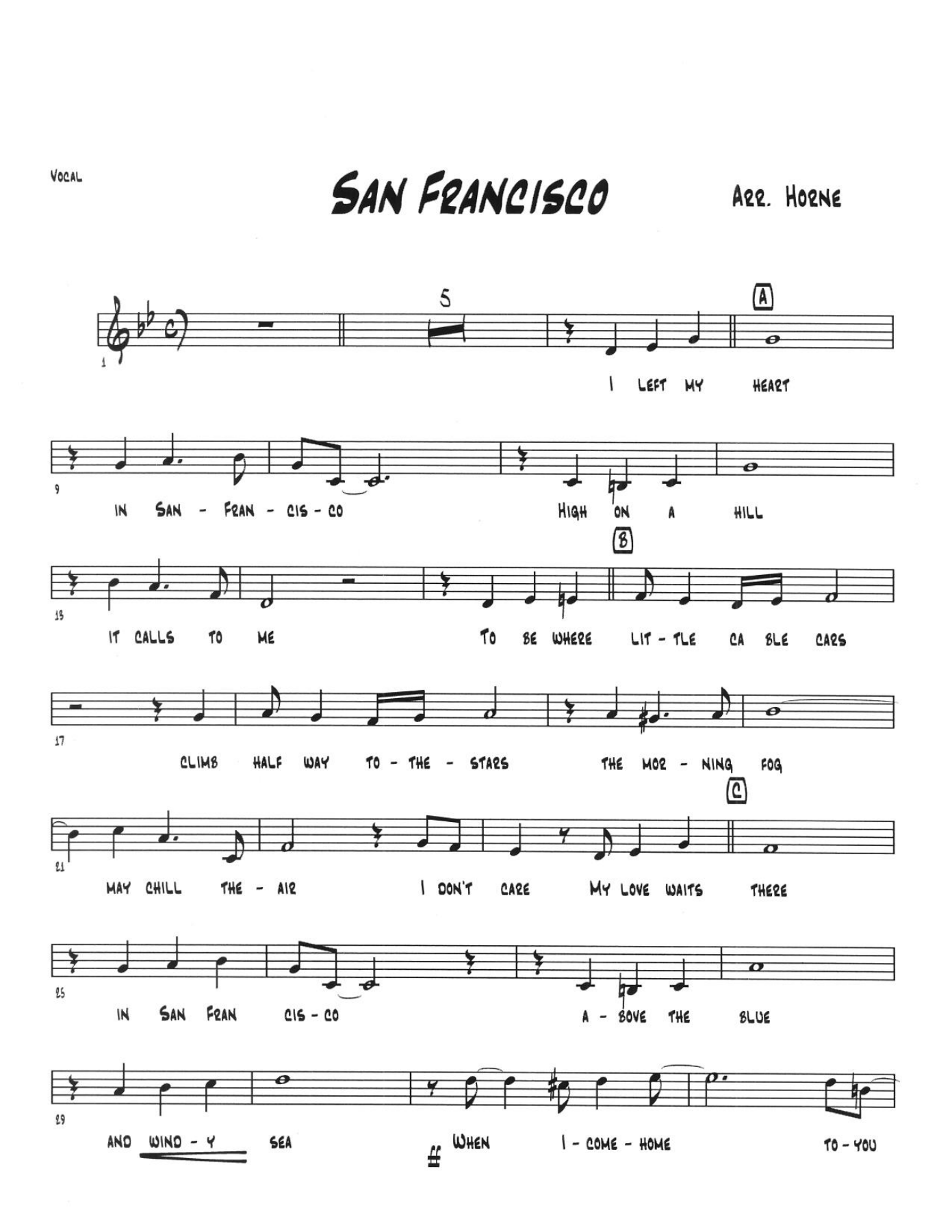
I Left My Heart In San Francisco-Horne-vocal, (H.322)
Composed by George Cory
Arranged by Horne-vocal, 322
- Ensemble: Big Band Vocal
- Style: Jazz Standard
- Pages: 34
- Instruments (17): Vocal, Alto Sax 1, Alto Sax 2, Tenor Sax 1, Baritone Sax, Trumpet 1, Trumpet 2, Trumpet 3, Trumpet 4, Trombone 1, Trombone 2, Trombone 3, Bass Trombone, Piano, Bass, Drums, Vibes
- Difficulty: medium
- Content: Individual Parts
- Format: PDF Download (Instant)
- Price: $24.99
"I Left My Heart in San Francisco" stands as one of the most enduring and beloved American popular songs of the 20th century, forever synonymous with the legendary Tony Bennett. Composed by George Cory with lyrics by Douglass Cross, the song was originally written in 1954 but gained international fame with Bennett's iconic 1962 recording. This rendition, released as a single and featured on his album of the same name, became a global hit, earning him a Grammy Award for Record of the Year and Best Male Solo Vocal Performance. The song's evocative lyrics and soaring melody paint a nostalgic, romantic portrait of the city by the bay, capturing a universal sentiment of longing and affection for a cherished place. Its timeless appeal cemented its status as a jazz standard, frequently performed by vocalists and instrumentalists alike, and remains a staple of the Great American Songbook, representing the sophisticated balladry of the early 1960s. This particular arrangement, "I Left My Heart In San Francisco-Horne-vocal, (H.322)," presents a lush, sophisticated big band setting for a featured vocalist. The musical character is a quintessential slow ballad, typically performed in 4/4 time with a gentle, expressive swing feel. The primary key is likely C or D major, offering a comfortable range for most vocalists while allowing for rich brass and saxophone voicings. The overall mood is one of heartfelt sentimentality and elegant nostalgia, building from a tender opening to a powerful, emotive climax. Horne-vocal, 322’s approach is characterized by a sensitive interplay between the vocal line and the ensemble, emphasizing harmonic depth and dynamic contrast to support the song's emotional arc. Expect carefully crafted woodwind doublings and warm brass pads that create a rich sonic tapestry. The arranger's distinctive treatment shines through in the ensemble's support of the vocal. The melody is carried almost exclusively by the vocalist, allowing for maximum interpretive freedom. However, the arrangement features beautifully voiced saxophone soli sections that echo or complement the vocal phrases, adding harmonic interest and texture. A signature technique of Horne-vocal, 322 in this style is the gradual build of the accompaniment, starting with sparse, delicate figures and expanding into full, resonant brass and saxophone chords as the song progresses towards its emotional peak. There are no extended improvised solos in this arrangement, maintaining focus on the vocal performance and the ensemble's supportive role. The technical challenges lie primarily in achieving a seamless blend and balance within the big band, ensuring that the brass doesn't overpower the vocalist, and in executing the nuanced dynamics required for a truly expressive ballad performance. The rewarding aspect is the opportunity to create a deeply moving and polished rendition of a beloved classic, showcasing both the vocalist's artistry and the band's ability to provide sensitive, sophisticated accompaniment. This arrangement is ideally suited for college, community, and professional big bands. High school ensembles with strong brass and saxophone sections and an advanced vocalist may also find it appropriate, particularly those looking to develop their ballad playing and ensemble sensitivity. The demands on intonation, dynamic control, and rhythmic precision are moderate to high, making it an excellent piece for honing these essential musical skills while delivering a performance that resonates deeply with audiences. To achieve the intended emotional depth and musicality of "I Left My Heart in San Francisco," conductors should emphasize a consistent, gentle swing feel at a slow ballad tempo, typically around quarter note = 60-70 bpm. Prioritize a warm, sustained sound from the entire ensemble, particularly in the brass and saxophone sections, focusing on impeccable intonation within the lush chord voicings. The brass should employ straight mutes sparingly, if at all, to maintain a full, open sound, reserving any specific mute instructions for dramatic effect. Key technical challenges include maintaining precise dynamic control, especially in the softer passages, to ensure the vocalist is always clearly heard without being overshadowed. Rehearse the saxophone soli sections carefully to achieve a unified, blended sound, paying attention to phrasing and articulation consistency. Encourage the rhythm section to provide a supportive, unobtrusive foundation, with the bass offering a walking line that is felt more than heard, and the drums using brushes or light sticks for a delicate touch. The piano should provide sensitive harmonic fills and comping that enhance the vocal line. Stress the importance of listening across sections to achieve a cohesive, expressive performance. Q: What instruments are included in this arrangement? A: This big band vocal arrangement typically includes standard instrumentation: 5 saxophones (2 altos, 2 tenors, 1 baritone, with possible woodwind doubles), 4 trumpets, 4 trombones, piano, bass, drums, and a dedicated vocal lead sheet. Q: What is the difficulty level of "I Left My Heart In San Francisco-Horne-vocal, (H.322)"? A: This arrangement is rated as a Medium-Advanced difficulty. It requires strong ensemble blend, precise intonation, and nuanced dynamic control, making it suitable for college, community, and professional big bands, or advanced high school ensembles. Q: What musical style and historical context does this arrangement represent? A: This arrangement is a classic jazz standard ballad, reflecting the sophisticated big band vocal style popular in the early 1960s, famously associated with Tony Bennett's iconic recording of the song. Q: What makes this specific Horne-vocal, 322 arrangement unique? A: Horne-vocal, 322's approach emphasizes lush, sensitive voicings that support the vocalist, featuring beautifully crafted saxophone soli sections and a dynamic build that enhances the song's emotional arc, rather than relying on extended instrumental solos. Q: What is the typical performance duration and tempo for this piece? A: As a slow ballad, the typical performance duration is approximately 3 to 4 minutes, depending on the vocalist's interpretation. The tempo should be a gentle 4/4 swing, generally ranging from quarter note = 60-70 bpm.
Questions and answers
- What is included in the I Left My Heart In San Francisco-Horne-vocal, (H.322) PDF?
- The verified current file contains individual parts across 34 pages.
- How many instruments or parts are listed for I Left My Heart In San Francisco-Horne-vocal, (H.322)?
- The verified instrumentation list contains 17 entries for this Big Band Vocal arrangement.
- Who is credited for I Left My Heart In San Francisco-Horne-vocal, (H.322)?
- Composer: George Cory. Arranger: Horne-vocal, 322.
- What difficulty is listed for I Left My Heart In San Francisco-Horne-vocal, (H.322)?
- The verified difficulty level is medium.
- What style is listed for I Left My Heart In San Francisco-Horne-vocal, (H.322)?
- The catalog lists the style as Jazz Standard.
- Can I preview I Left My Heart In San Francisco-Horne-vocal, (H.322) before buying?
- Yes. The product page provides a preview generated from the current PDF file.
- How is I Left My Heart In San Francisco-Horne-vocal, (H.322) delivered?
- After successful payment, the digital PDF is made available for download. The displayed price is $24.99.
Musicians Also Search For
I Left My Heart In San Francisco-Horne-vocal, Horne-vocal, 322 PDF • I Left My Heart In San Francisco-Horne-vocal, Horne-vocal, 322 sheet music • I Left My Heart In San Francisco-Horne-vocal, arranged by Horne-vocal, 322 • Horne-vocal, 322 big band vocal charts • Horne-vocal, 322 jazz arrangements PDF • I Left My Heart In San Francisco-Horne-vocal, George Cory sheet music • I Left My Heart In San Francisco-Horne-vocal, George Cory big band vocal arrangements • George Cory big band vocal charts • I Left My Heart In San Francisco-Horne-vocal, big band vocal arrangements • I Left My Heart In San Francisco-Horne-vocal, big band vocal PDF download • I Left My Heart In San Francisco-Horne-vocal, jazz sheet music • big band vocal sheet music download • I Left My Heart In San Francisco-Horne-vocal, individual parts download • I Left My Heart In San Francisco-Horne-vocal, sheet music PDF • I Left My Heart In San Francisco-Horne-vocal, Jazz Standard charts • Jazz Standard big band vocal arrangements • buy I Left My Heart In San Francisco-Horne-vocal, sheet music • download I Left My Heart In San Francisco-Horne-vocal, PDF • I Left My Heart In San Francisco-Horne-vocal, jazz charts • best Horne-vocal, 322 big band vocal arrangements • George Cory arranged by Horne-vocal, 322 • I Left My Heart In San Francisco-Horne-vocal, printable sheet music • big band vocal repertoire PDF