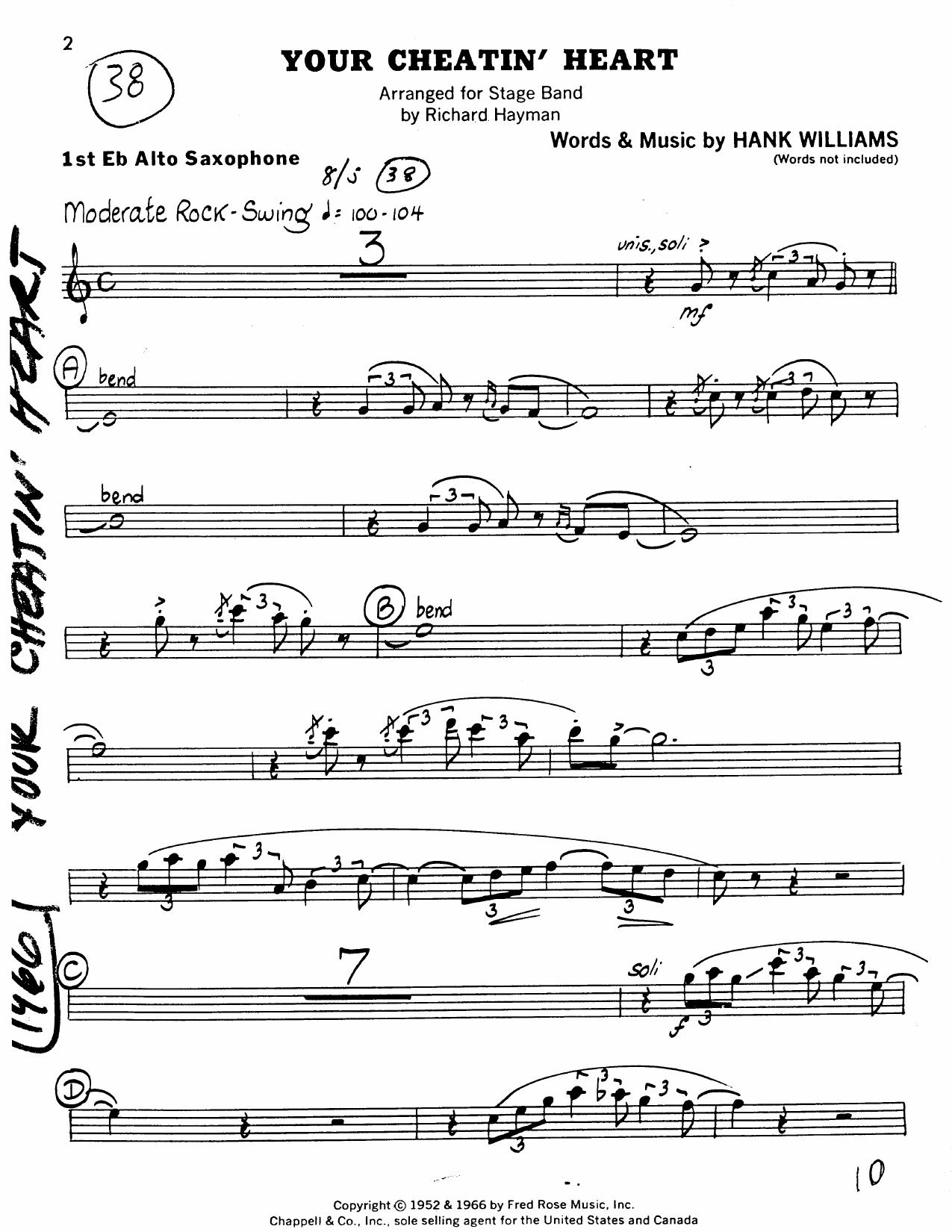
Your Cheatin' Heart (R.Hayman)
Composed by Hank Williams
Arranged by R.Hayman
- Ensemble: Big Band
- Style: Jazz Standard
- Pages: 38
- Instruments (18): 1st Eb Alto Saxophone, 2nd Eb Alto Saxophone, 1st Bb Tenor Saxophone, 2nd Bb Tenor Saxophone, Eb Baritone Saxophone, 1st Bb Trumpet, 2nd Bb Trumpet, 3rd Bb Trumpet, 4th Bb Trumpet, 1st Trombone, 2nd Trombone, 3rd Trombone, 4th Trombone, Piano, String Bass, Drums, Guitar, Conductor
- Difficulty: medium
- Content: Individual Parts
- Format: PDF Download (Instant)
- Price: $24.99
Hank Williams forever altered the landscape of American popular song when he recorded "Your Cheatin' Heart" in 1953, turning a heartbroken country lament into an enduring vehicle for jazz and pop interpreters. Though conceived in the deep traditions of honky-tonk, the song’s inherent blues-inflected melody, symmetrical AABA form, and gut-wrenching lyrical hook made it an instant crossover favorite for vocalists and instrumentalists alike, eventually entering the standard jazz repertoire through covers by artists such as Ray Charles, Fats Domino, and Chet Baker. Its transition from country standard to jazz vehicle highlights the fluid boundaries of mid-century American music, proving that great melodic writing transcends genre limitations. Richard Hayman’s masterwork big band arrangement reimagines Williams' classic through a sophisticated, swinging lens that bridges traditional jazz orchestration with subtle, expressive harmonic coloring. Written in a comfortable medium tempo swing feel, the chart opens with a smoky, laid-back groove that immediately establishes a reflective yet buoyant mood. Hayman avoids treating the melody as a simple novelty, instead infusing the chart with lush, Ellingtonian reed voicings, warm brass pads, and clever counter-melodies that elevate the rustic source material into a sophisticated orchestral statement. The arrangement carefully balances moments of intimate, small-group-style dialogue with rich, full-ensemble textures that evoke the golden age of swing-era balladry and medium-tempo groove charts. Throughout the 38-page score and 17-instrument parts, the lead alto saxophone and first trumpet share primary thematic duties, delivering the iconic melody with expressive phrasing, subtle bends, and authentic stylistic articulation. Hayman builds dramatic tension through a gorgeous, harmonically rich saxophone soli that reinterprets the secondary bridge material before opening up into a tastefully constructed solo section tailored for a featured tenor saxophone or trumpet. The ensemble writing demands crisp sectional unity, particularly in the handling of syncopated background figures and dynamic swells that support the soloists without overpowering them. A restrained, tasteful shout chorus builds the emotional peak of the chart before subsiding into a gentle, lingering coda that resolves on a warm, extended major chord. Advanced high school ensembles with strong section leaders, as well as collegiate and professional community big bands, will find this arrangement an ideal centerpiece for a concert program. It offers an exceptional vehicle for teaching stylistic versatility, requiring players to pivot seamlessly from swing-era rhythmic feel to lyrical, rubato-leaning phrasing. While the technical demands on individual players are moderate, the true challenge and reward lie in achieving a unified ensemble blend, precise dynamic control, and an authentic, blues-drenched interpretation that honors both Williams' country roots and Hayman's sophisticated big band craftsmanship. Achieving the authentic, relaxed drive of this arrangement requires careful attention from the rhythm section. The drummer should maintain a steady, unhurried ride cymbal pattern with a soft "chick" on beats two and four, avoiding any tendency to rush the medium swing tempo. Piano and guitar comping ought to remain sparse and transparent, utilizing rootless seventh chords that leave ample sonic space for the horns. For the wind sections, precision in articulation is paramount. Ensure that all eighth-note lines are swung naturally in the traditional late-swing style, with tongue-slurred accents on the off-beats rather than aggressive staccato marks. During the saxophone soli, the section must lock air streams to achieve a unified, vocal-like tone quality, paying close attention to dynamic crescendos written into the phrase peaks. Brass players should utilize warm, open tones with minimal vibrato for the background pads, reserving mutes only where specific contrast is desired by the conductor. Rehearsals should initially focus on sectional balance during the harmonic shifts in the bridge, ensuring the inner voice movements remain audible beneath the lead melody. Q: What instruments and parts are included in this arrangement? A: The 17-instrument big band instrumentation includes two alto saxophones, two tenor saxophones, one baritone saxophone, standard brass sections, and a full rhythm section, accompanied by a comprehensive 38-page conductor score. Q: What is the difficulty level of this chart? A: This arrangement is graded as medium, making it ideally suited for advanced high school, collegiate, and professional community big bands seeking to balance accessibility with sophisticated harmonic writing. Q: What is the musical style and historical context of this piece? A: The chart transforms Hank Williams' 1953 country masterpiece into a sophisticated jazz standard, drawing inspiration from mid-century swing and blues-inflected vocal arranging traditions. Q: What makes Richard Hayman's arrangement unique? A: Hayman elevates a rustic country melody through lush Ellingtonian reed voicings, clever counter-melodies, and a gorgeous saxophone soli that reimagines the bridge without losing the soulful essence of the original tune. Q: What is the recommended performance tempo and duration? A: The arrangement is designed for a comfortable medium swing tempo (approximately 116 to 124 BPM) and typically runs between three and a half to four minutes in performance duration.
Questions and answers
- What is included in the Your Cheatin' Heart (R.Hayman) PDF?
- The verified current file contains a conductor score and individual parts across 38 pages.
- How many instruments or parts are listed for Your Cheatin' Heart (R.Hayman)?
- The verified instrumentation list contains 18 entries for this Big Band arrangement.
- Who is credited for Your Cheatin' Heart (R.Hayman)?
- Composer: Hank Williams. Arranger: R.Hayman.
- What difficulty is listed for Your Cheatin' Heart (R.Hayman)?
- The verified difficulty level is medium.
- What style is listed for Your Cheatin' Heart (R.Hayman)?
- The catalog lists the style as Jazz Standard.
- Can I preview Your Cheatin' Heart (R.Hayman) before buying?
- Yes. The product page provides a preview generated from the current PDF file.
- How is Your Cheatin' Heart (R.Hayman) delivered?
- After successful payment, the digital PDF is made available for download. The displayed price is $24.99.
Musicians Also Search For
Your Cheatin' Heart R.Hayman PDF • Your Cheatin' Heart R.Hayman sheet music • Your Cheatin' Heart arranged by R.Hayman • R.Hayman big band charts • R.Hayman jazz arrangements PDF • Your Cheatin' Heart Hank Williams sheet music • Your Cheatin' Heart Hank Williams big band arrangements • Hank Williams big band charts • Your Cheatin' Heart big band arrangements • Your Cheatin' Heart big band PDF download • Your Cheatin' Heart jazz sheet music • big band sheet music download • Your Cheatin' Heart conductor score PDF • Your Cheatin' Heart individual parts download • Your Cheatin' Heart sheet music PDF • Your Cheatin' Heart Jazz Standard charts • Jazz Standard big band arrangements • buy Your Cheatin' Heart sheet music • download Your Cheatin' Heart PDF • Your Cheatin' Heart jazz charts • best R.Hayman big band arrangements • Hank Williams arranged by R.Hayman • Your Cheatin' Heart printable sheet music • big band repertoire PDF