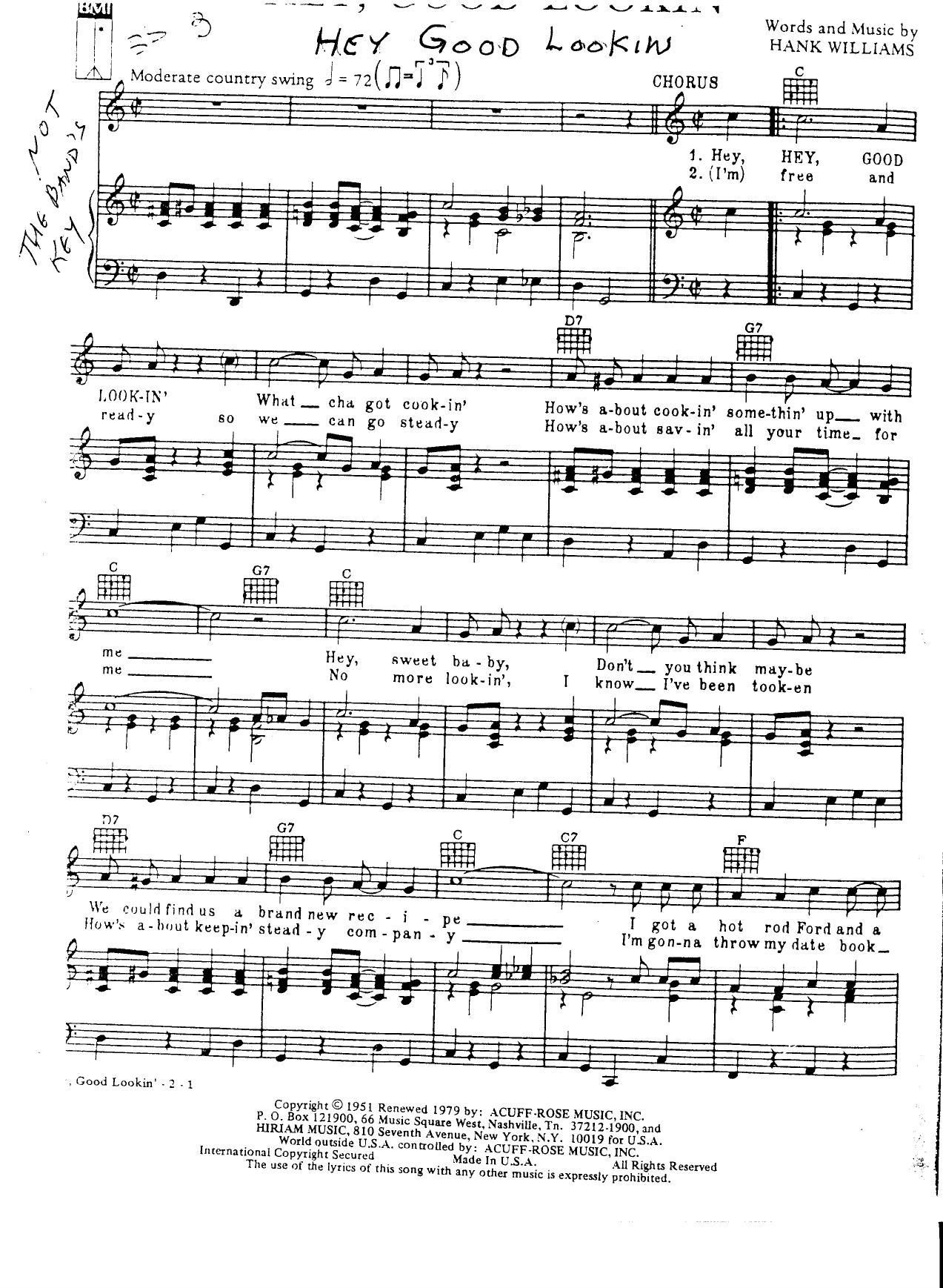
Hey Good Lookin' (D.Wolpe)
Composed by Hank Williams
Arranged by Dave Wolpe
- Ensemble: Big Band
- Pages: 52
- Instruments (22): Vocal, Piano, 1st Eb Alto Saxophone, 2nd Eb Alto Saxophone, 1st Bb Tenor Saxophone, 2nd Bb Tenor Saxophone, Eb Baritone Saxophone, 1st Bb Trumpet, 2nd Bb Trumpet, 3rd Bb Trumpet, 4th Bb Trumpet, 1st Trombone, 2nd Trombone, 3rd Trombone, 4th Trombone, Guitar, Bass, Drums, Tuba, Baritone T.C., Horn in F, C Flute
- Difficulty: advanced
- Content: Individual Parts
- Format: PDF Download (Instant)
- Price: $24.99
Hank Williams originally penned and recorded "Hey Good Lookin'" in 1951, transforming a clever, uptempo slice of honky-tonk country into an inescapable American classic that crossed over into pop and jazz consciousness almost immediately. While born from the postwar country-and-western boom, the infectious melody, blues-infused phrasing, and buoyant AABA form made it an irresistible vehicle for jazz, western swing, and mainstream vocal interpretations alike. Over the decades, the tune has been reinterpreted by everyone from Ray Charles to Ella Fitzgerald, proving that great melodic writing transcends strict genre boundaries and adapts fluidly to an idiomatic jazz makeover. Dave Wolpe’s dynamic big band chart brilliantly bridges the gap between classic country-swing roots and straight-ahead jazz vernacular, setting a bright, driving medium-swing groove (around 132 BPM) that immediately lifts the ensemble. The mood is irrepressibly upbeat, playful, and high-energy, evoking a dancehall atmosphere infused with sophisticated horn voicings and swinging counterlines. Wolpe captures the jovial, swaggering persona of the original composition while injecting rich, modern harmonic extensions, clever chromatic passing chords, and crisp rhythmic kicks that keep the rhythm section and horns tightly locked in a pocket of infectious enthusiasm. Known for his masterful, highly idiomatic writing for commercial and educational big bands, Wolpe crafts an arrangement where the melody is initially stated cleanly by the saxes or a small ensemble grouping before being tossed engagingly across the sections. The chart features robust soli passages for the saxophones and brass, punctuated by a roaring shout chorus that builds maximum vertical power without sacrificing transparency. Dynamic contrast is a key structural tool here; muted brass effects and sparse rhythm section backing give way to full-ensemble tutti explosions, providing plenty of textural variety across the 52-page master score and parts set. Advanced high school, collegiate, and community jazz orchestras will find this chart to be an absolute crowd-pleaser that also offers genuine educational value. It demands strong ensemble articulation, precise section blending on snappy swing eighth notes, and a confident rhythmic drive from the drummer, who must maintain a propitious ride-cymbal pulse. While the technical demands on individual players are approachable for intermediate-to-advanced musicians, the collective execution requires tight stylistic cohesion, making it an exceptional showcase piece for festival programming, spring concerts, or celebratory community dances. Success with this chart hinges on maintaining a relaxed yet driving medium-swing feel; avoid rushing the tempo, as the groove relies heavily on a settled, behind-the-beat quarter-note pulse. The rhythm section is the engine room here: the pianist should use sparse, comping chord shells that leave space, while the bassist walks a steady, acoustic-style line that locks tightly with the drummer's hi-hat on beats two and four. Pay meticulous attention to articulation markings, ensuring that all short accented notes are crisp and clipped, while slurred lines maintain a smooth, vocal quality echoing Hank Williams' original phrasing. Brass players should utilize cup or bucket mutes where indicated to achieve that classic, warm transitional texture before open-horn shout sections. Directors should rehearse the dynamic contrasts separately, ensuring the ensemble drops down cleanly to background volume levels behind any featured soloist or section soli, allowing the witty counter-melodies to project clearly through the texture. Q: What instruments and parts are included in this 21-instrument big band arrangement? A: The instrumentation comprises a standard 21-piece big band setup: 5 saxophones (2 altos, 2 tenors, 1 baritone), 4 trumpets, 4 trombones, guitar, piano, bass, drums, and full conductor score, spanning 52 total pages of music. Q: What is the difficulty level of this Dave Wolpe chart? A: This arrangement is graded as medium-advanced, making it an ideal fit for accomplished high school groups, collegiate jazz bands, and active community big bands looking for accessible yet sophisticated charts. Q: How does this arrangement bridge country music and jazz? A: Arranger Dave Wolpe takes Hank Williams' 1951 honky-tonk melody and reimagines it through a traditional medium-swing lens, incorporating clever brass voicings, walking basslines, and a high-energy shout chorus while preserving the catchy, upbeat character of the original tune. Q: What makes this specific arrangement unique compared to other big band charts? A: Wolpe’s signature writing style shines through clever section interplay, dynamic shifts, and sophisticated harmonic twists that elevate a simple country tune into a legitimate, swinging jazz arrangement without losing its immediate audience appeal. Q: What is the recommended tempo and performance duration for this piece? A: The chart is designed to be played at a bright medium-swing tempo of approximately 132 BPM, yielding a performance duration of around 3 to 4 minutes depending on solo extensions and vamp repetitions.
Questions and answers
- What is included in the Hey Good Lookin' (D.Wolpe) PDF?
- The verified current file contains individual parts across 52 pages.
- How many instruments or parts are listed for Hey Good Lookin' (D.Wolpe)?
- The verified instrumentation list contains 22 entries for this Big Band arrangement.
- Who is credited for Hey Good Lookin' (D.Wolpe)?
- Composer: Hank Williams. Arranger: Dave Wolpe.
- What difficulty is listed for Hey Good Lookin' (D.Wolpe)?
- The verified difficulty level is advanced.
- Can I preview Hey Good Lookin' (D.Wolpe) before buying?
- Yes. The product page provides a preview generated from the current PDF file.
- How is Hey Good Lookin' (D.Wolpe) delivered?
- After successful payment, the digital PDF is made available for download. The displayed price is $24.99.
Musicians Also Search For
Hey Good Lookin' Dave Wolpe PDF • Hey Good Lookin' Dave Wolpe sheet music • Hey Good Lookin' arranged by Dave Wolpe • Dave Wolpe big band charts • Dave Wolpe jazz arrangements PDF • Hey Good Lookin' Hank Williams sheet music • Hey Good Lookin' Hank Williams big band arrangements • Hank Williams big band charts • Hey Good Lookin' big band arrangements • Hey Good Lookin' big band PDF download • Hey Good Lookin' jazz sheet music • big band sheet music download • Hey Good Lookin' individual parts download • Hey Good Lookin' sheet music PDF • buy Hey Good Lookin' sheet music • download Hey Good Lookin' PDF • Hey Good Lookin' jazz charts • best Dave Wolpe big band arrangements • Hank Williams arranged by Dave Wolpe • Hey Good Lookin' printable sheet music • big band repertoire PDF