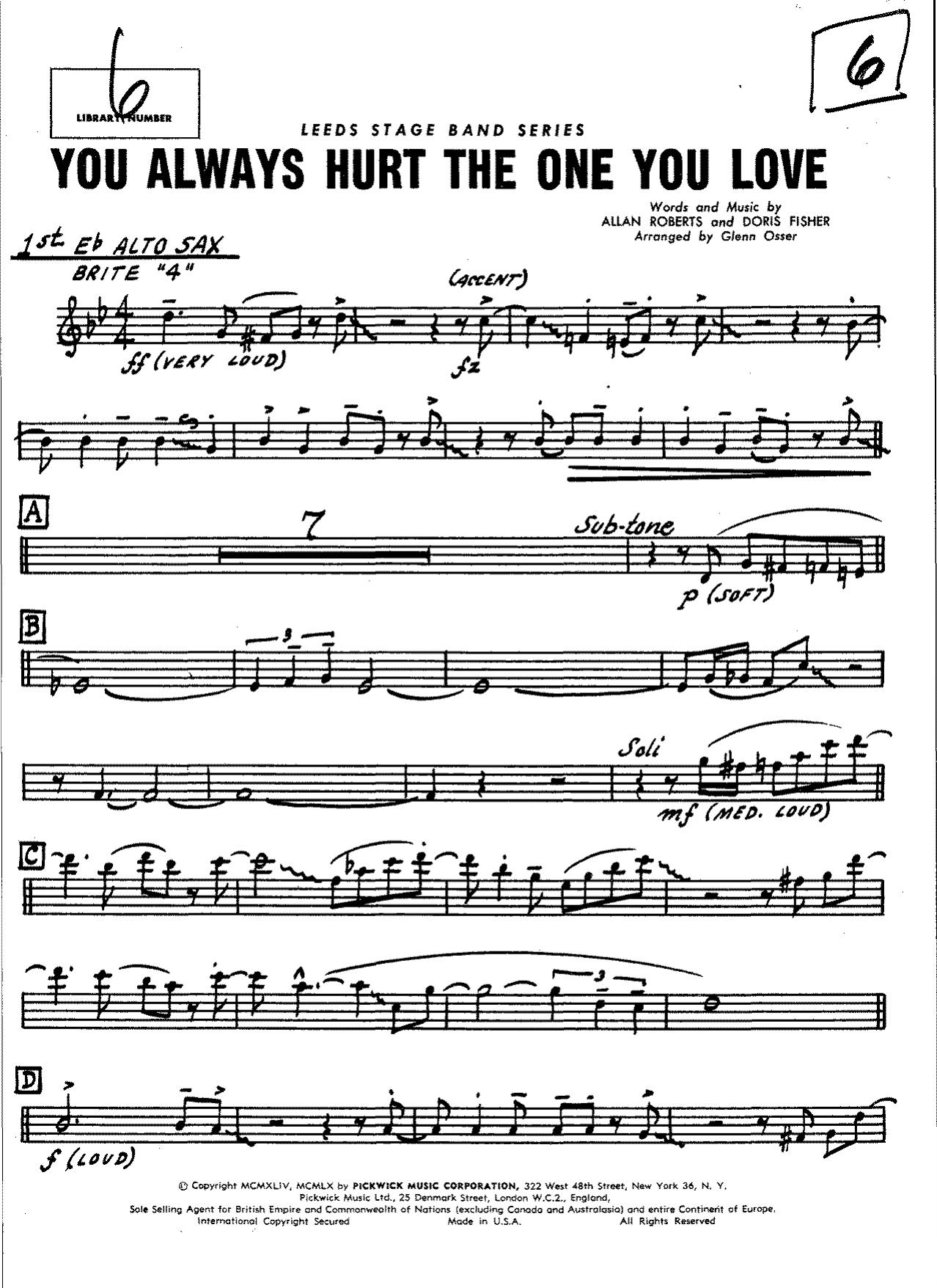
You Always Hurt The One You Love (G.Osser)
Composed by Allan Roberts
Arranged by Glenn Osser
- Ensemble: Big Band
- Pages: 38
- Instruments (18): 1st Eb Alto Sax, 3rd Eb Alto Sax, 2nd Bb Tenor Sax, 4th Bb Tenor Sax, 5th Eb Baritone Sax, 1st Trombone, 2nd Trombone, 3rd Trombone, 4th Trombone, 1st Bb Trumpet, 2nd Bb Trumpet, 3rd Bb Trumpet, 4th Bb Trumpet, Piano (Accordion), Guitar, String Bass, Drums, Conductor
- Difficulty: medium
- Content: Individual Parts
- Format: PDF Download (Instant)
- Price: $24.99
Written by Allan Roberts and Doris Fisher, "You Always Hurt The One You Love" entered the American songbook in 1944, quickly becoming a melancholy pop and jazz standard famously interpreted by artists like The Mills Brothers and Dinah Washington. This enduring classic captures a poignant paradox of human relationships, balancing a deceptively catchy, minor-tinged melody with lyrics steeped in regret and bittersweet irony. Within the jazz idiom, the song transitioned seamlessly from a vocal vehicle into a malleable canvas for instrumental small groups and big bands alike, prized for its cyclical chord progression and inherent emotional depth. Glenn Osser’s masterful big band arrangement breathes sophisticated life into the composition, setting it in a polished, medium-tempo swing feel that alternates between introspective lyricism and driving rhythmic momentum. Osser—widely celebrated for his lush, highly idiomatic writing for radio orchestras and studio big bands—approaches the chart with a signature cinematic clarity. The arrangement opens with an inviting, harmonically rich introduction that establishes a smoky, late-night atmosphere before settling into an effortless 4/4 groove. Throughout the chart, Osser employs warm, block-voiced brass and flowing reed counterlines that evoke the golden age of 1950s broadcast jazz, maintaining a delicate balance between transparent texture and full-ensemble warmth. The melodic narrative is shared thoughtfully across the ensemble, giving both the saxophones and brass sections prominent moments to shape the phrase with expressive phrasing and nuanced dynamics. Osser builds structural tension through clever re-harmonizations and a dynamic development section that leads naturally into a tightly wound, harmonically adventurous shout chorus. While avoiding overly breakneck tempos, the arrangement demands crisp articulation, excellent section blending, and precise intonation, particularly when navigating Osser’s nuanced chromatic passing tones and lush chord extensions. Featured solo space allows a featured horn player to stretch out over familiar changes, making it an ideal showcase for a musical soloist with a strong sense of lyricism. Tailored ideally for advanced high school, collegiate, and accomplished community big bands, this 38-page manuscript for a 9-instrument ensemble provides a masterclass in economy of scoring and stylistic elegance. Directors will find it an exceptional vehicle for teaching swing subdivision, dynamic control, and stylistic restraint, proving that a big band does not need to play at fortissimo volume to command an audience's complete attention. Conductors should approach Glenn Osser’s arrangement with a primary focus on horizontal line, stylistic cohesion, and dynamic subtlety. The tempo should remain a steady, relaxed medium swing; pushing the metronome too far forward strips the chart of its inherent blues-inflected melancholy. The rhythm section is the heartbeat here—the drummer should maintain a feather-light ride cymbal pattern with a crisp hi-hat bark on beats two and four, while the bass player walks a quarter-note line with minimal clutter. For the horn sections, achieving a unified articulation is paramount. Ensure that all eighth-note lines are swung naturally in a relaxed, horn-style phrasing rather than a rigid triplet feel. Watch out for the dynamic swells written into the brass backgrounds; these must emerge organically without overpowering the lead melodic voices. Mutes are optional depending on the hall acoustics, but subtle use of cup mutes in the trumpets during the intro can enhance the authentic mid-century broadcast texture. Rehearsals should isolate the inner-voice harmonies in the saxophones to ensure clean intonation on Osser’s dense chord clusters before putting the full ensemble sections together. Q: What instruments and parts are included in this arrangement? A: This 38-page publication is scored for a 9-instrument big band instrumentation, featuring parts for Alto Saxophone, Tenor Saxophone, Baritone Saxophone, Trumpet, Trombone, and rhythm section support. Q: What is the difficulty level of this Glenn Osser chart? A: This arrangement is best suited for advanced high school, collegiate, and professional community big bands due to its sophisticated harmonic language, required blend, and demand for precise swing articulation. Q: What style and historical era does this piece represent? A: It represents the classic mid-20th-century big band and jazz standard tradition, transforming a 1944 Tin Pan Alley composition into a sophisticated instrumental swing chart. Q: What makes this specific arrangement by Glenn Osser unique? A: Osser’s arrangement stands out for its cinematic, lush voicing techniques, transparent textures, and a masterfully crafted developmental build that avoids loud cliches in favor of understated elegance. Q: What is the performance duration and recommended tempo feel? A: The piece is written in a relaxed 4/4 meter with a medium swing feel, yielding a performance duration of approximately 3 to 4 minutes depending on the length of the improvised solos.
Questions and answers
- What is included in the You Always Hurt The One You Love (G.Osser) PDF?
- The verified current file contains a conductor score and individual parts across 38 pages.
- How many instruments or parts are listed for You Always Hurt The One You Love (G.Osser)?
- The verified instrumentation list contains 18 entries for this Big Band arrangement.
- Who is credited for You Always Hurt The One You Love (G.Osser)?
- Composer: Allan Roberts. Arranger: Glenn Osser.
- What difficulty is listed for You Always Hurt The One You Love (G.Osser)?
- The verified difficulty level is medium.
- Can I preview You Always Hurt The One You Love (G.Osser) before buying?
- Yes. The product page provides a preview generated from the current PDF file.
- How is You Always Hurt The One You Love (G.Osser) delivered?
- After successful payment, the digital PDF is made available for download. The displayed price is $24.99.
Musicians Also Search For
You Always Hurt The One You Love Glenn Osser PDF • You Always Hurt The One You Love Glenn Osser sheet music • You Always Hurt The One You Love arranged by Glenn Osser • Glenn Osser big band charts • Glenn Osser jazz arrangements PDF • You Always Hurt The One You Love Allan Roberts sheet music • You Always Hurt The One You Love Allan Roberts big band arrangements • Allan Roberts big band charts • You Always Hurt The One You Love big band arrangements • You Always Hurt The One You Love big band PDF download • You Always Hurt The One You Love jazz sheet music • big band sheet music download • You Always Hurt The One You Love conductor score PDF • You Always Hurt The One You Love individual parts download • You Always Hurt The One You Love sheet music PDF • buy You Always Hurt The One You Love sheet music • download You Always Hurt The One You Love PDF • You Always Hurt The One You Love jazz charts • best Glenn Osser big band arrangements • Allan Roberts arranged by Glenn Osser • You Always Hurt The One You Love printable sheet music • big band repertoire PDF