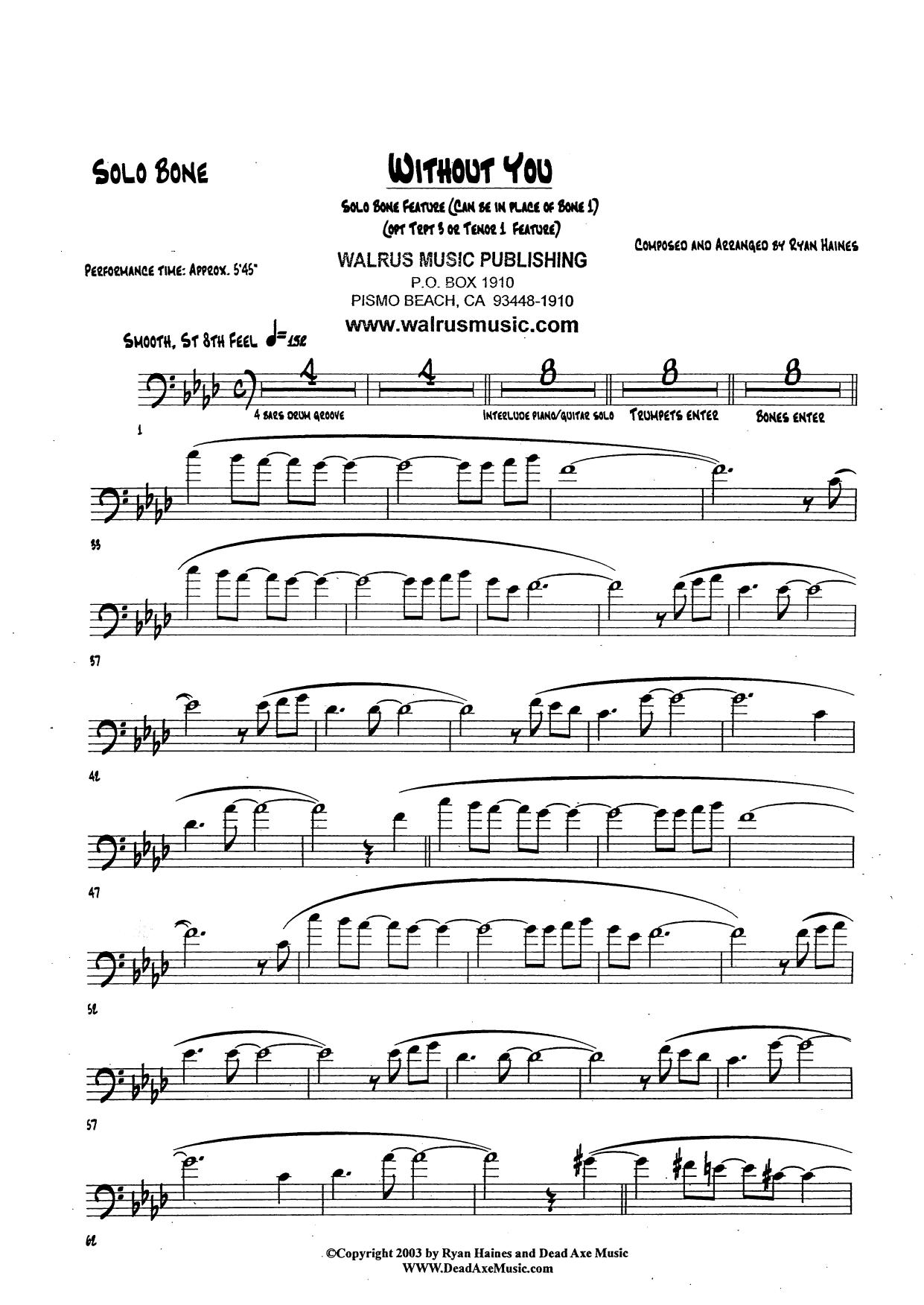
Without You (R.Haines)
Composed by R. Haines
Arranged by R.Haines
- Ensemble: Big Band
- Style: Jazz Standard
- Pages: 94
- Instruments (20): Solo Trombone, Optional Solo Flugelhorn, Optional Solo Tenor Saxophone, Alto Saxophone 1, Alto Saxophone 2, Tenor Saxophone 1, Tenor Saxophone 2, Baritone Saxophone, Trombone 1, Trombone 2, Trombone 3, Trombone 4, Trumpet 1, Trumpet 2, Trumpet 3, Trumpet 4, Drum Set, Bass, Piano, Guitar
- Difficulty: advanced
- Content: Individual Parts
- Format: PDF Download (Instant)
- Price: $24.99
"Without You," composed and arranged by R.Haines, stands as a sophisticated contribution to the contemporary big band jazz repertoire. Drawing deep inspiration from the mid-century modern jazz era and the lyrical ballad tradition popularized by masters like Billy Strayhorn and Thad Jones, this composition bridges the gap between traditional swing-era sentimentality and modern harmonic exploration. While building upon the structural framework of the classic 32-bar American popular song form, Haines injects a fresh, contemporary sensibility that elevates the tune beyond a standard-issue head arrangement, transforming it into a substantive vehicle for large-ensemble storytelling. At a measured, contemplative ballad tempo with a subtle, flowing underlying pulse, the arrangement establishes an atmosphere of introspective melancholy balanced by moments of sweeping, cinematic warmth. The piece opens with a delicate, rubato-leaning introduction featuring lush, extended chord voicings in the saxophone section that immediately establish a bittersweet emotional landscape. As the chart settles into its primary groove, the harmonic language introduces chromatic mediants, upper-structure triads, and rich minor-seventh extensions that challenge the ensemble to listen closely to internal voice-leading. The primary melody is delivered with haunting lyrical grace by a featured Solo Trombone, whose warm, vocalistic timbre cuts cleanly through the dense, cascading brass pads beneath it. Haines’s arranging approach relies heavily on contrasting textures, shifting seamlessly from transparent, sparse trio-and-rhythm-section accompaniment to massive, wall-of-sound tutti passages. The arrangement avoids predictable scoring clichés by utilizing non-traditional section mixings—such as pairing muted trumpets with low clarinets or alto saxophones—to create unique tone colors. A standout feature of the chart is a harmonically adventurous development section that builds tension through sequential modulation before cresting into a powerful, emotionally charged shout chorus. Unlike high-energy swingers that rely on sheer volume, this climax achieves its impact through dynamic restraint, soaring brass lines, and rich, polyphonic interplay between the saxophones and the rhythm section. Advanced high school ensembles with mature lead players, as well as collegiate and professional big bands, will find this arrangement an exceptional vehicle for developing ensemble blend, intonation, and expressive phrasing. The technical demands are moderate in terms of raw velocity, but high in terms of musicianship: players must navigate subtle rubato transitions, maintain pristine balance during dense chord clusters, and project deep emotional resonance. The included 94-page conductor score provides exhaustive dynamic and articulative markings, making it an invaluable study in modern big band orchestration that rewards deep rehearsal and refined execution. Achieving success with this arrangement requires an acute focus on vertical tuning, balance, and dynamic control. The conductor should emphasize that the tempo must breathe; avoid a rigid, metronomic feel, allowing the rubato sections to ebb and flow organically with the Solo Trombone lead. In the ensemble tuttis, the saxophone section must lock in their intonation on the upper-structure extensions, ensuring that the 9ths and 13ths do not distort the core triad voicings. Brass players should utilize warm, dark mutes where indicated, avoiding a harsh edge even during the peak of the shout chorus. The rhythm section acts as the primary anchor: the pianist should voice chords sparingly, leaving ample sonic space for the horns, while the bassist provides a melodic, half-note and walking pulse that never overpowers the soloist. Rehearsals should initially isolate the dynamic swells to ensure the ensemble peaks precisely at the designated structural climaxes without forcing the tone. Q: What instruments and parts are included in this publication? A: The 94-page package includes a comprehensive conductor score and standard 18-instrument big band parts, comprising Alto Saxophone 1, Alto Saxophone 2, Tenor Saxophone 1, Tenor Saxophone 2, Baritone Saxophone, 4 Trumpets, 4 Trombones (including a prominent Solo Trombone part), and a full rhythm section (Piano, Bass, Drums, and Guitar). Q: What is the difficulty level of this arrangement? A: This chart is graded as advanced (suitable for collegiate, professional, and top-tier high school jazz bands) primarily due to its sophisticated harmonic language, requirement for mature blend and intonation, and nuanced dynamic control rather than extreme technical velocity. Q: What is the musical style and historical context of "Without You"? A: Written in the style of a modern jazz ballad, the piece draws heavily from the rich compositional traditions of the mid-20th-century arranging masters, blending traditional 32-bar form with contemporary harmonic extensions and expressive, cinematic orchestration. Q: What makes R.Haines's arrangement of "Without You" unique? A: The arrangement stands out through its innovative cross-section voicing, non-traditional instrumental pairings, and an emotionally gripping development section that utilizes harmonic tension and dynamic restraint rather than sheer volume to build a powerful shout chorus. Q: What is the performance duration and tempo feel of the piece? A: The arrangement is designed as a substantial feature piece lasting approximately 5 to 6 minutes, anchored by a slow, contemplative ballad tempo that features a flowing, rubato-infused pulse beneath a featured Solo Trombone.
Questions and answers
- What is included in the Without You (R.Haines) PDF?
- The verified current file contains a conductor score and individual parts across 94 pages.
- How many instruments or parts are listed for Without You (R.Haines)?
- The verified instrumentation list contains 20 entries for this Big Band arrangement.
- Who is credited for Without You (R.Haines)?
- Composer: R. Haines. Arranger: R.Haines.
- What difficulty is listed for Without You (R.Haines)?
- The verified difficulty level is advanced.
- What style is listed for Without You (R.Haines)?
- The catalog lists the style as Jazz Standard.
- Can I preview Without You (R.Haines) before buying?
- Yes. The product page provides a preview generated from the current PDF file.
- How is Without You (R.Haines) delivered?
- After successful payment, the digital PDF is made available for download. The displayed price is $24.99.
Musicians Also Search For
Without You R.Haines PDF • Without You R.Haines sheet music • Without You arranged by R.Haines • R.Haines big band charts • R.Haines jazz arrangements PDF • Without You R. Haines sheet music • Without You R. Haines big band arrangements • R. Haines big band charts • Without You big band arrangements • Without You big band PDF download • Without You jazz sheet music • big band sheet music download • Without You conductor score PDF • Without You individual parts download • Without You sheet music PDF • Without You Jazz Standard charts • Jazz Standard big band arrangements • buy Without You sheet music • download Without You PDF • Without You jazz charts • best R.Haines big band arrangements • R. Haines arranged by R.Haines • Without You printable sheet music • big band repertoire PDF