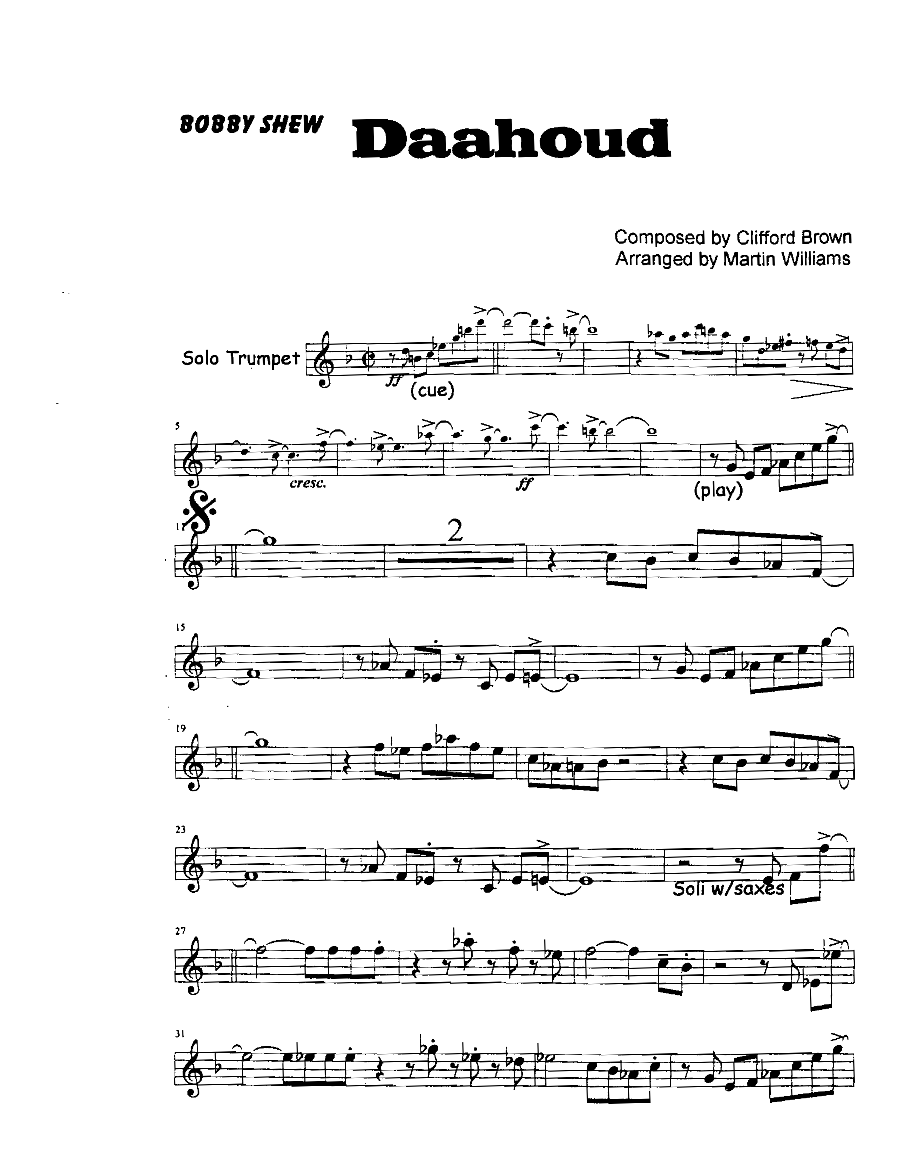
Daahoud (M.Williams)
Composed by Clifford Brown
Arranged by Bobby Shew
- Ensemble: Big Band
- Style: Jazz Standard
- Pages: 70
- Instruments (17): Solo Trumpet, 1st Alto Saxophone, 2nd Alto Saxophone, 1st Tenor Saxophone, 2nd Tenor Saxophone, Baritone Saxophone, Trumpet 1, Trumpet 2, Trumpet 3, Trumpet 4, 1st Trombone, 2nd Trombone, 3rd Trombone, 4th Trombone, Piano, Bass, Drums
- Difficulty: advanced
- Content: Individual Parts
- Format: PDF Download (Instant)
- Price: $24.99
Clifford Brown's iconic composition, "Daahoud," stands as a cornerstone of the hard bop era, a vibrant testament to the trumpeter's prodigious talent and lasting influence on jazz. Penned and first recorded in 1954, when Brown was just 23, the tune quickly became a staple, enshrined in the jazz canon and widely performed by countless artists. Its original recording with the Clifford Brown and Max Roach Quintet, featured on their seminal album *Study in Brown*, showcased a lyrical yet buoyant melody set against sophisticated harmonic changes. The title itself pays homage to Wardell "Daahoud" Dawud, a Philadelphia trumpeter who was an early mentor to Brown. "Daahoud" is a 32-bar AABA form composition, predominantly in E-flat major, characterized by its medium-swing feel and inventive harmonic progressions, including distinctive major II chord substitutions and a bridge that navigates a circle-of-fourths sequence, injecting a clear bebop sensibility. These elements combine to create a piece that is both intellectually stimulating and irresistibly swinging, a hallmark of mid-1950s jazz. Bobby Shew’s big band arrangement of "Daahoud" masterfully translates the intimacy and energetic drive of Brown's quintet original into a powerful large ensemble setting. Shew, renowned for his exceptional trumpet playing and extensive experience with legendary big bands such as Woody Herman and Buddy Rich, approaches this standard with a deep understanding of both the source material and the capabilities of a modern jazz orchestra. His arrangements are celebrated for their clarity, musicality, and ability to challenge musicians while remaining accessible and rewarding. Expect Shew's signature touch in the voicings, which are likely to be bright and articulate, showcasing the brass and saxophone sections in dynamic interplay. Soli sections will undoubtedly feature intricate lines passed between sections, demanding precision and blend, while the shout choruses will build with an intensity that honors the original's hard-driving spirit. This arrangement features the trumpet section prominently, particularly the solo trumpet, which carries the initial melodic statement, echoing Brown's original performance. Opportunities for improvisation are central, providing a platform for a featured trumpet soloist to navigate the challenging yet rewarding harmonic landscape. The technical demands are considerable, requiring strong command of articulation, dynamic control, and rhythmic accuracy across all sections. The ensemble writing pushes players to engage with complex harmonies and rapid melodic passages, making it an exhilarating experience for both performers and listeners. The reward lies in performing a definitive big band interpretation of a jazz classic, filled with moments of collective power and individual brilliance. This big band arrangement is ideally suited for advanced high school, collegiate, community, and professional jazz ensembles. Its demands on individual musicianship and ensemble cohesion make it an excellent vehicle for developing sophisticated big band performance skills. Bands seeking to engage with authentic hard bop repertoire, interpreted by an arranger with a profound connection to the style, will find this chart an invaluable addition to their library. It offers a comprehensive musical workout, fostering growth in improvisation, section playing, and stylistic understanding. Conductors should establish a firm, medium-up swing tempo, emphasizing a buoyant and relentless forward motion without rushing. The original recording by Clifford Brown and Max Roach often clocks in around 240 BPM, providing a good reference for the desired energy. Key technical challenges include precise articulation in the fast-moving melodic lines, particularly in the saxophone and trumpet soli sections. Encourage a light, crisp attack from the brass, avoiding overly heavy accents that can impede the swing feel. The rhythm section must maintain a strong, interactive groove, with the bass providing a walking line that propels the ensemble and the drums offering tasteful, driving accompaniment. Special attention should be paid to dynamic contrasts, building intensity gradually into the shout choruses and providing clear, supportive backgrounds for soloists. Rehearsal time should focus on intonation within the dense voicings, ensuring clean entrances and releases, and developing a unified ensemble sound that balances power with transparency. Q: What instruments are included in this arrangement? A: This big band arrangement is scored for 17 instruments, including solo trumpet, Alto Saxophone 1 & 2, Tenor Saxophone 1 & 2, Baritone Saxophone, Trumpet 1-4, Trombone 1-4, Piano, Bass, and Drums. Q: What is the difficulty level of this arrangement? A: This arrangement is considered advanced, appropriate for experienced high school, collegiate, community, and professional jazz ensembles due to its technical demands and sophisticated musical content. Q: What is the musical style and historical context of "Daahoud"? A: "Daahoud" is a jazz standard composed by Clifford Brown in 1954, representing the hard bop era. It is characterized by its medium-swing feel, intricate harmonies, and energetic improvisational opportunities. Q: What makes Bobby Shew's arrangement of "Daahoud" unique? A: Bobby Shew's arrangement stands out for its authentic translation of the original quintet's energy into a big band format, utilizing his signature bright voicings, dynamic soli sections, and powerful shout choruses, all while providing a prominent feature for a trumpet soloist. Q: What is the approximate performance duration or tempo for this piece? A: While performance duration can vary with improvised solos, the piece is typically performed at a medium-up swing tempo, often around 240 beats per minute, reflecting the energetic nature of the original.
Questions and answers
- What is included in the Daahoud (M.Williams) PDF?
- The verified current file contains individual parts across 70 pages.
- How many instruments or parts are listed for Daahoud (M.Williams)?
- The verified instrumentation list contains 17 entries for this Big Band arrangement.
- Who is credited for Daahoud (M.Williams)?
- Composer: Clifford Brown. Arranger: Bobby Shew.
- What difficulty is listed for Daahoud (M.Williams)?
- The verified difficulty level is advanced.
- What style is listed for Daahoud (M.Williams)?
- The catalog lists the style as Jazz Standard.
- Can I preview Daahoud (M.Williams) before buying?
- Yes. The product page provides a preview generated from the current PDF file.
- How is Daahoud (M.Williams) delivered?
- After successful payment, the digital PDF is made available for download. The displayed price is $24.99.
Musicians Also Search For
Daahoud Bobby Shew PDF • Daahoud Bobby Shew sheet music • Daahoud arranged by Bobby Shew • Bobby Shew big band charts • Bobby Shew jazz arrangements PDF • Daahoud Clifford Brown sheet music • Daahoud Clifford Brown big band arrangements • Clifford Brown big band charts • Daahoud big band arrangements • Daahoud big band PDF download • Daahoud jazz sheet music • big band sheet music download • Daahoud individual parts download • Daahoud sheet music PDF • Daahoud Jazz Standard charts • Jazz Standard big band arrangements • buy Daahoud sheet music • download Daahoud PDF • Daahoud jazz charts • best Bobby Shew big band arrangements • Clifford Brown arranged by Bobby Shew • Daahoud printable sheet music • big band repertoire PDF