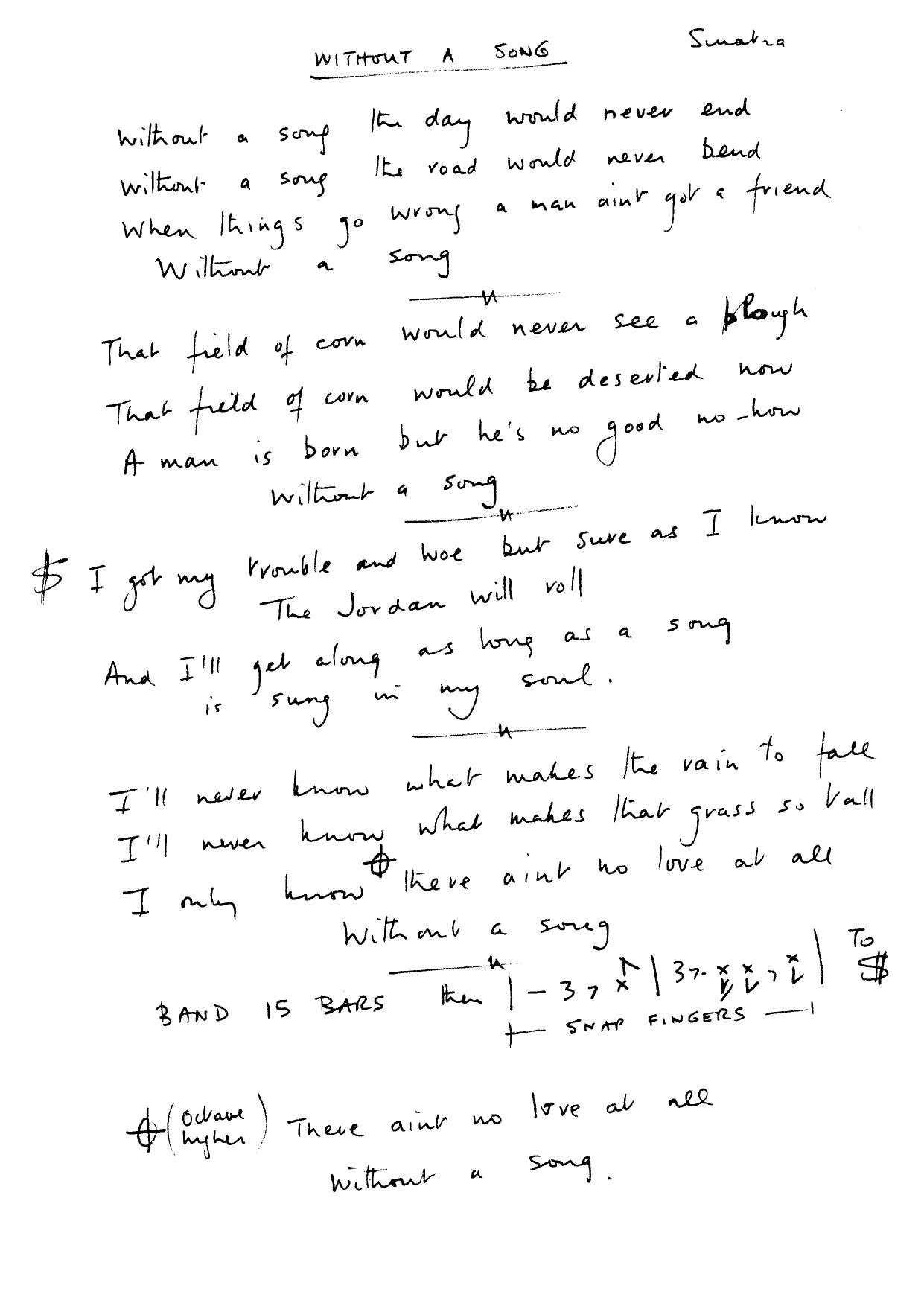
Without A Song (F.Sinatra)
Composed by Vincent Youmans
Arranged by Frank Sinatra & Nelson Riddle
- Ensemble: Big Band
- Pages: 18
- Instruments (17): Vocal (Lyrics Sheet), Tenor Saxophone 1, Tenor Saxophone 2, Alto Saxophone 1, Alto Saxophone 2, Baritone Saxophone, Trumpet 1, Trumpet 2, Trumpet 3, Trumpet 4, Trombone 1, Trombone 2, Trombone 3, Trombone 4, Piano, Bass, Drums
- Difficulty: easy
- Content: Individual Parts
- Format: PDF Download (Instant)
- Price: $24.99
Vincent Youmans and lyricists Edward Eliscu and Billy Rose originally crafted "Without a Song" for the 1929 Broadway musical *Great Day*, but it quickly transcended the stage to become an enduring cornerstone of the American songbook. Its transformation into a definitive jazz and vocal standard reached its zenith through iconic interpretations, most notably the legendary artistic partnership between Frank Sinatra and master arranger Nelson Riddle. Representing the pinnacle of the 1950s Capitol Records era, this collaboration redefined the relationship between the vocalist and the traditional big band, merging lush, cinematic string-inspired orchestrations with driving, sophisticated swing. The composition itself carries a poignant, resilient narrative—asserting that life lacks meaning without music—which is mirrored in its sweeping melodic contours and dramatic harmonic architecture. Pulsing with a driving, confident medium-up swing feel in 4/4 time, this arrangement balances underlying melancholy with an uplifting, triumphant momentum. Nelson Riddle’s signature scoring style is immediately evident through his brilliant use of chromatic voicings, soaring woodwind counterlines, and rich, brass-heavy textures that build an atmosphere of sophisticated grandeur. The arrangement opens with an expansive, evocative introduction before settling into a robust groove that propels the ensemble forward. Low brass and reed sections weave intricate harmonic suspensions underneath the vocal line, creating a dense, colorful sonic palette. As the chart progresses, the energy escalates through clever modulation and dynamic contrast, evoking a sense of theatrical triumph and emotional catharsis that never fails to captivate an audience. Riddle’s ingenious orchestration distributes melodic and harmonic interest dynamically across the entire 10-instrument ensemble. The saxophone section—comprising alto, tenor, and baritone—frequently operates as a tight, interwoven unit delivering velvety solis, while the trumpet and trombone sections provide both punchy rhythmic punctuation and warm, sustained pads. Rather than serving as mere accompaniment, the instrumental voices converse directly with the lead vocal line, answering phrases with witty brass stabs or lush harmonic cushions. Technical demands center on precision swing articulation, clean dynamic control, and a deep understanding of mid-century phrasing styles. Performers must execute sharp syncopations and balanced chordal voicings with utmost clarity, making the chart deeply rewarding for musicians who revel in subtle stylistic nuances and rich harmonic interplay. Advanced high school, collegiate, community, and professional jazz orchestras will find this chart an exceptional centerpiece for concert programming. Because it requires a mature sense of swing, excellent sectional blend, and refined dynamic sensitivity, it serves as an ideal vehicle for developing authentic big band literacy beyond standard contemporary charts. Ensembles with strong lead players and a cohesive rhythm section will particularly shine, bringing out the sophisticated color contrasts and theatrical flair that define the golden age of vocal jazz arrangement. Conductors approaching this Nelson Riddle masterpiece must prioritize stylistic cohesion and rhythmic precision, particularly within the rhythm section where a steady, driving medium swing is paramount. The underlying groove should feel conversational yet anchored, avoiding any tendency to rush during dynamic swells. Key technical challenges include executing clean, synchronized articulations across the saxophone and brass sections, especially during rapid turnaround figures and chromatic transitional passages. Horn players should carefully balance their tones to allow the intricate inner-voices to bloom without covering the principal melodic lines. Pay close attention to dynamic markings: Riddle’s dramatic contrasts rely heavily on sudden shifts from a lush piano to a commanding, brass-led forte. Rehearsal should begin by isolating the rhythm section to lock in the foundational bounce before layering in the horns section by section. Emphasize the importance of a unified "dah-dit" articulation style on eighth-note passages to achieve that unmistakable Capitol Records sheen. Finally, ensure that all players listen horizontally across the ensemble to blend the rich suspended and altered chords into a seamless, cohesive wall of sound. Q: What instruments and parts are included in this arrangement? A: This arrangement is scored for a 10-instrument big band ensemble, featuring standard sections including alto saxophone, tenor saxophone, baritone saxophone, trumpet, and trombone parts, alongside a full rhythm section. Q: What is the difficulty level of this chart? A: This arrangement is best suited for advanced high school, collegiate, and professional jazz ensembles that possess strong reading skills, mature swing phrasing, and a refined sense of sectional balance. Q: What is the historical context and style of this piece? A: Styled as a sophisticated medium-up swing chart, it reflects the legendary mid-1950s collaboration between Frank Sinatra and arranger Nelson Riddle, capturing the golden age of Capitol Records vocal jazz orchestration. Q: What makes this specific arrangement unique? A: It features Nelson Riddle's signature arranging hallmarks, including rich chromatic voicings, clever inner-voice counterlines, and dramatic dynamic contrasts that elevate the accompaniment far beyond a standard stock chart. Q: What is the approximate performance duration and tempo? A: The arrangement is performed at a confident, driving medium swing tempo, typically lasting around 3 to 4 minutes depending on the chosen vocal or instrumental pacing.
Questions and answers
- What is included in the Without A Song (F.Sinatra) PDF?
- The verified current file contains individual parts across 18 pages.
- How many instruments or parts are listed for Without A Song (F.Sinatra)?
- The verified instrumentation list contains 17 entries for this Big Band arrangement.
- Who is credited for Without A Song (F.Sinatra)?
- Composer: Vincent Youmans. Arranger: Frank Sinatra & Nelson Riddle.
- What difficulty is listed for Without A Song (F.Sinatra)?
- The verified difficulty level is easy.
- Can I preview Without A Song (F.Sinatra) before buying?
- Yes. The product page provides a preview generated from the current PDF file.
- How is Without A Song (F.Sinatra) delivered?
- After successful payment, the digital PDF is made available for download. The displayed price is $24.99.
Musicians Also Search For
Without A Song Frank Sinatra & Nelson Riddle PDF • Without A Song Frank Sinatra & Nelson Riddle sheet music • Without A Song arranged by Frank Sinatra & Nelson Riddle • Frank Sinatra & Nelson Riddle big band charts • Frank Sinatra & Nelson Riddle jazz arrangements PDF • Without A Song Vincent Youmans sheet music • Without A Song Vincent Youmans big band arrangements • Vincent Youmans big band charts • Without A Song big band arrangements • Without A Song big band PDF download • Without A Song jazz sheet music • big band sheet music download • Without A Song individual parts download • Without A Song sheet music PDF • buy Without A Song sheet music • download Without A Song PDF • Without A Song jazz charts • best Frank Sinatra & Nelson Riddle big band arrangements • Vincent Youmans arranged by Frank Sinatra & Nelson Riddle • Without A Song printable sheet music • big band repertoire PDF