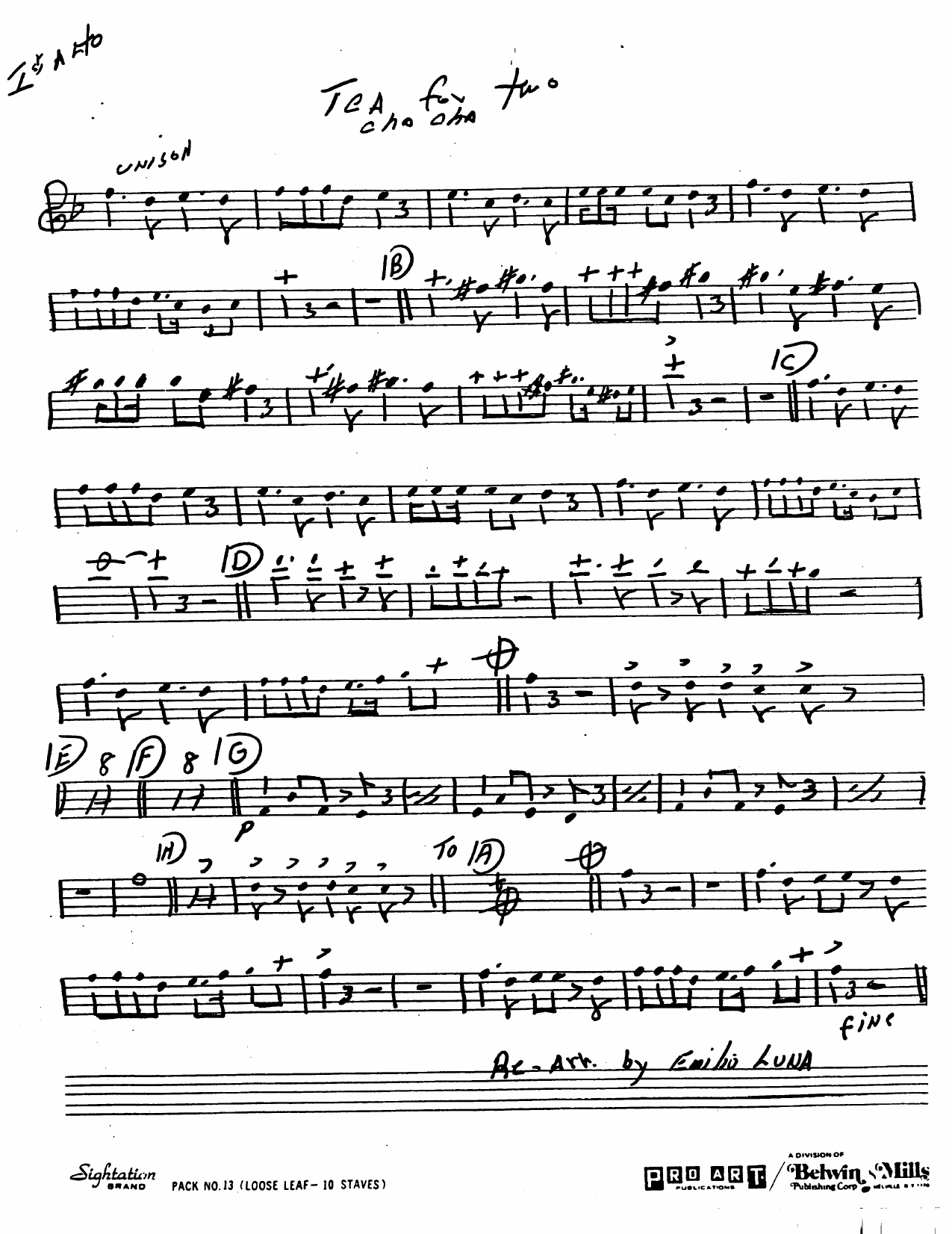
Tea For Two (T.Dorsey)
Composed by Vincent Youmans
Arranged by Tommy Dorsey-Jimmy Dorsey
- Ensemble: Big Band
- Pages: 20
- Instruments (17): 1st Alto Saxophone, 3rd Alto Saxophone, 2nd Tenor Saxophone, 4th Tenor Saxophone, Baritone Saxophone, 1st Trumpet, 2nd Trumpet, 3rd Trumpet, 4th Trumpet, 1st Trombone, 2nd Trombone, 3rd Trombone, 4th Trombone, Piano, Guitar, Bass, Drums
- Difficulty: easy
- Content: Individual Parts
- Format: PDF Download (Instant)
- Price: $24.99
Vincent Youmans and Irving Caesar originally penned "Tea for Two" for the 1924 Broadway musical *No, No, Nanette*, but it rapidly transcended its theatrical origins to become one of the most enduring and malleable jazz standards of the twentieth century. Through the decades, the tune attracted the attention of every major jazz stylist, though few interpretations achieved the definitive, high-energy brilliance associated with the Dorsey brothers. As titans of the swing era, Tommy and Jimmy Dorsey bridged the gap between sweet dance band styling and driving, soloist-driven hot jazz. This classic big band iteration captures the sophisticated yet accessible aesthetic of the 1930s and 1940s American dance orchestrations, balancing meticulous section writing with irrepressible rhythmic momentum. Driving forward with an infectious, buoyant medium-up swing feel in 4/4 time, the chart radiates a bright, celebratory mood characterized by crisp articulation and sparkling harmonic interplay. The arrangement opens with a familiar, inviting motif before expanding into rich, harmonically dense section writing that showcases the classic swing era palette. The brass and reed sections engage in witty call-and-response figures, maintaining a buoyant energy that evokes the sophisticated ballrooms and radio broadcasts of the late swing era. The emotional trajectory shifts seamlessly from playful intimacy during the thematic statements to an exhilarating, high-voltage release of tension during the climatic ensemble passages, keeping both the performers and the audience thoroughly engaged from the first downbeat to the final chord. The Dorsey brothers' signature approach is immediately evident in the seamless integration of smooth, lyrical reed voicings—a nod to Jimmy Dorsey’s virtuosic saxophone and clarinet styling—contrasted against Tommy’s penchant for warm, singing trombone textures and punchy brass counterlines. The arrangement features meticulously crafted soli sections where the saxophones or brass share the spotlight, executing interwoven lines that demand absolute rhythmic unison and stylistic cohesion. The harmonic structure respects Youmans’ brilliant original changes while infusing them with classic swing-era passing chords and secondary dominants. A dynamic shout chorus builds organically, layering section upon section until the full 17-piece ensemble is firing on all cylinders, driven by a relentless walking bass line and crisp ride-cymbal pulse. Advanced high school, collegiate, and professional big bands will find this arrangement an ideal centerpiece for standard concert programs, festival performances, or historic tribute sets. While the individual wind parts do not demand extreme avant-garde techniques, the chart requires mature time-feel, exceptional section blending, and stylistic authenticity to truly swing. Lead trumpet players will encounter comfortable yet bright upper-register writing, while the rhythm section must maintain an unwavering, buoyant pocket to support the shifting textures. Accomplished improvisers in the band will relish the structured solo spaces provided over standard chord changes, making this a deeply rewarding selection that highlights both ensemble discipline and individual expression. Success with this arrangement hinges on achieving an authentic swing feel with light, transparent articulation on eighth notes. The tempo should be kept moderate enough to allow the complex interplay between sections to breathe, avoiding any tendency to rush the bridge sections. Conductors should pay close attention to the dynamic balance between the brass and reeds; during the soli passages, the accompanying section must drop significantly to let the melody-carrying voices project naturally without forcing their tone. Section leaders need to coordinate closely regarding stylistic markings, ensuring uniform use of short accents, controlled falls, and subtle vibrato characteristic of the period. The rhythm section should anchor the groove with a steady, unforced quarter-note pulse on the ride cymbal and a crisp two-feel or walking bass line that propels the arrangement forward. Utilize regular sectionals to isolate the intricate counterpoint lines before running the full chart at tempo. Q: What instrumentation and parts are included in this arrangement? A: This chart is scored for a standard 17-instrument big band lineup, featuring four trumpets, four trombones, five saxophones (with standard reed doubling capability), and a full four-piece rhythm section comprising piano, guitar, bass, and drums. Q: What is the difficulty level of this "Tea For Two" arrangement? A: It is graded as advanced intermediate to advanced, making it best suited for high school varsity bands, collegiate ensembles, and professional community big bands with strong section players and confident soloists. Q: What is the historical and stylistic context of this chart? A: Written in the classic swing era style associated with Tommy and Jimmy Dorsey, this arrangement transforms Vincent Youmans' 1924 Broadway tune into a driving, polished big band vehicle complete with signature 1930s-era section voicings. Q: What makes this specific arrangement unique? A: It uniquely balances the sweet, lyrical phrasing popularized by Jimmy Dorsey's reed section with the bold, punchy brass counterlines and high-energy momentum characteristic of Tommy Dorsey's celebrated orchestra. Q: What is the recommended performance duration and tempo feel? A: The arrangement is designed to be performed at a bright, buoyant medium-swing tempo that typically yields a duration of approximately three to four minutes, depending on the length of improvised solo choruses taken.
Questions and answers
- What is included in the Tea For Two (T.Dorsey) PDF?
- The verified current file contains individual parts across 20 pages.
- How many instruments or parts are listed for Tea For Two (T.Dorsey)?
- The verified instrumentation list contains 17 entries for this Big Band arrangement.
- Who is credited for Tea For Two (T.Dorsey)?
- Composer: Vincent Youmans. Arranger: Tommy Dorsey-Jimmy Dorsey.
- What difficulty is listed for Tea For Two (T.Dorsey)?
- The verified difficulty level is easy.
- Can I preview Tea For Two (T.Dorsey) before buying?
- Yes. The product page provides a preview generated from the current PDF file.
- How is Tea For Two (T.Dorsey) delivered?
- After successful payment, the digital PDF is made available for download. The displayed price is $24.99.
Musicians Also Search For
Tea For Two Tommy Dorsey-Jimmy Dorsey PDF • Tea For Two Tommy Dorsey-Jimmy Dorsey sheet music • Tea For Two arranged by Tommy Dorsey-Jimmy Dorsey • Tommy Dorsey-Jimmy Dorsey big band charts • Tommy Dorsey-Jimmy Dorsey jazz arrangements PDF • Tea For Two Vincent Youmans sheet music • Tea For Two Vincent Youmans big band arrangements • Vincent Youmans big band charts • Tea For Two big band arrangements • Tea For Two big band PDF download • Tea For Two jazz sheet music • big band sheet music download • Tea For Two individual parts download • Tea For Two sheet music PDF • buy Tea For Two sheet music • download Tea For Two PDF • Tea For Two jazz charts • best Tommy Dorsey-Jimmy Dorsey big band arrangements • Vincent Youmans arranged by Tommy Dorsey-Jimmy Dorsey • Tea For Two printable sheet music • big band repertoire PDF