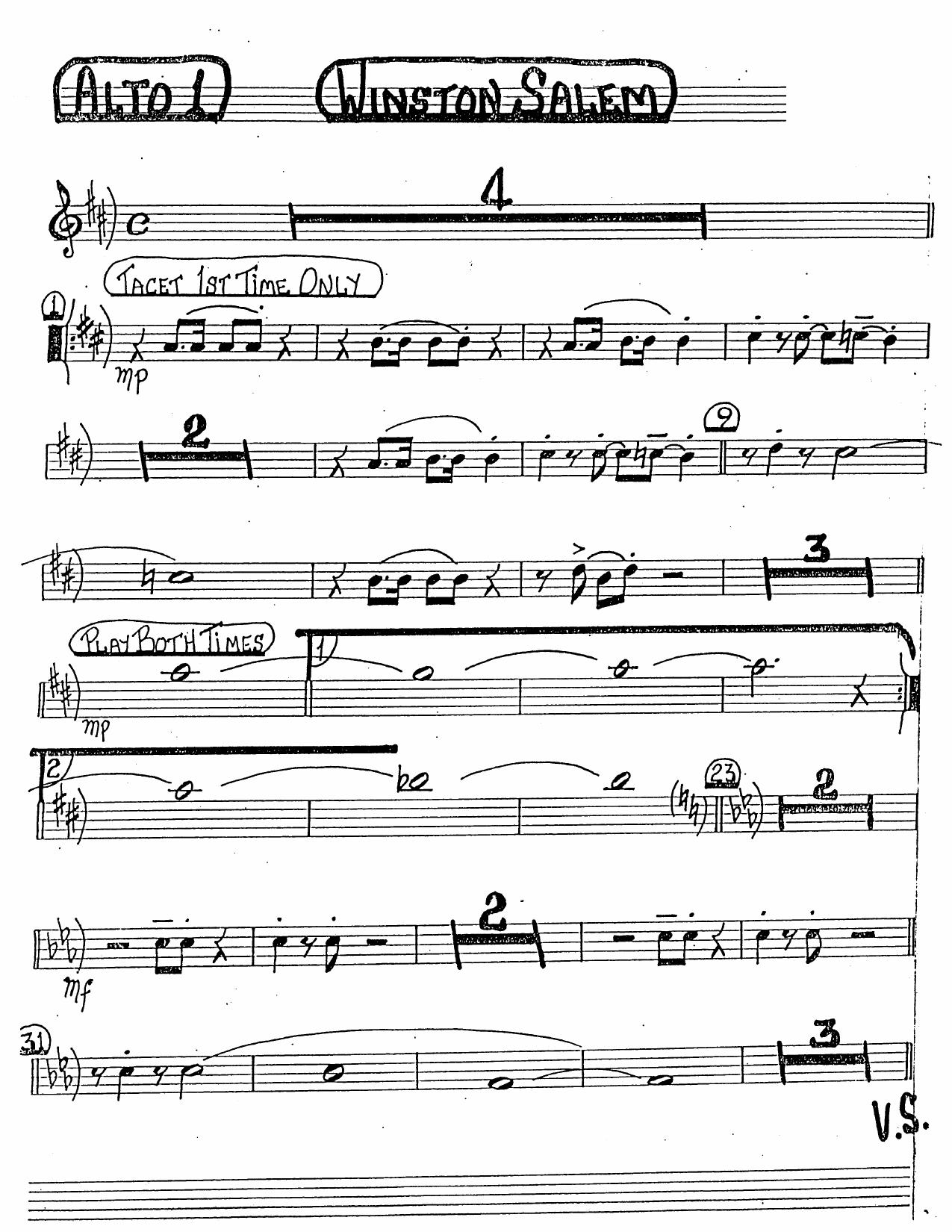
Winston Salem (F.Henderson) sheet music preview

Winston Salem (F.Henderson)

Composed by Fletcher Henderson

Arranged by Fletcher Henderson

  • Ensemble: Big Band
  • Pages: 31
  • Instruments (16): Alto 1, Alto 2, Tenor Sax, 2nd Tenor Sax, Baritone, Trumpet 1, Trumpet 2, Trumpet 3, Trumpet 4, Trombone 1, Trombone 2, Trombone 3, Bass, Guitar, Drums, Keyboard
  • Difficulty: medium
  • Content: Individual Parts
  • Format: PDF Download (Instant)
  • Price: $24.99

The seminal sounds of the 1920s and 1930s Harlem jazz scene resonate profoundly through Fletcher Henderson’s timeless compositions, which fundamentally established the blueprint for the swing big band era. Recorded and performed by the pioneering Fletcher Henderson Orchestra—the very ensemble that famously launched the career of a young Benny Goodman as an arranger—this repertoire captures the vital transition from early New Orleans collective polyphony to the sophisticated, section-based arranging style that defined large-ensemble jazz. "Winston Salem" stands as a brilliant testament to Henderson’s genius for balancing driving rhythm with rich, textural counterpoint, serving as an essential historical artifact of the era when big bands began capturing the nation's cultural imagination. Propelled by an infectious, driving medium-tempo swing feel in 4/4 time, the arrangement exudes an effervescent, high-spirited mood characterized by buoyant rhythmic syncopation and vibrant call-and-response patterns between the brass and reed sections. The harmonic language is firmly rooted in classic swing idioms, utilizing traditional chord extensions, rich block-voicing for the saxophones, and punchy, articulate brass interjections that create an immediate sense of forward momentum. The emotional landscape shifts gracefully between exuberant, foot-tapping joy and sophisticated, tightly-knit ensemble sophistication, evoking the smoky, electric atmosphere of a classic Harlem ballroom at the height of the jazz age. True to Henderson’s signature compositional style, this chart relies heavily on sectional interplay rather than static accompaniment, utilizing harmonized reed solis and dynamic shout choruses that build organic tension across the form. The scoring distributes melodic responsibility fluidly across the 12-instrument ensemble, allowing the saxophone section to handle intricate, harmonized linear passages while the trumpets interject with sharp, stinging accents and rhythmic stabs. The arrangement features designated solo spaces that invite improvisers to stretch out within authentic period style, challenging soloists to maintain the relaxed yet driving pulse characteristic of 1930s swing performance practice. Advanced high school, collegiate, and professional big bands will find this 31-page arrangement an immensely rewarding challenge that hones foundational swing articulation, section blend, and stylistic authenticity. Because the chart relies heavily on precise rhythmic execution and stylistic stylistic nuances—such as the proper placement of lightweight eighth notes and controlled vibrato—it serves as an exceptional pedagogical tool for teaching students how to swing behind a historically significant arrangement. Performing this piece demands careful attention to dynamic contrast and stylistic uniformity, offering audiences an authentic taste of the orchestra that forever changed the course of American music. Achieving an authentic performance of this Fletcher Henderson arrangement requires meticulous attention to the stylistic conventions of the early swing era. The tempo should remain steady and buoyant, avoiding a rushed feel; a comfortable medium-swing groove is essential to let the intricate counterlines breathe. The primary technical challenge lies in the execution of unaccented off-beat eighth notes and the seamless blending of the 12-player instrumentation. Saxophones should focus on a lightweight, dry articulation style with minimal modern vibrato, ensuring that fast scalar passages and harmonized solis speak with absolute clarity. Brass players must utilize controlled, punchy articulations for staccato figures, employing cup or straight mutes where indicated to achieve the characteristic timbral contrast of the 1930s big band sound. Conductors should rehearse the sections independently first, paying strict attention to the dynamic balance between the accompanying brass stabs and the moving lines in the reeds. Ensure that the rhythm section locks into a steady, four-to-the-bar bass feel with crisp ride cymbal punctuation, laying down a relaxed yet driving carpet of sound that allows the ensemble figures to pop effortlessly off the page. Q: What instruments and parts are included in this arrangement? A: This 31-page arrangement is scored for a 12-instrument big band ensemble, specifically featuring three saxophone parts (Saxophone 1, Saxophone 2, Saxophone 3) and two trumpet parts (Trumpet 1, Trumpet 2), alongside a complete rhythm section and supporting horns to fulfill the historic Fletcher Henderson instrumentation. Q: What is the difficulty level of this arrangement? A: This piece is best suited for advanced high school, collegiate, and professional big bands due to its demand for precise stylistic swing articulation, historical awareness, and tight sectional blend across 31 pages of detailed manuscript. Q: What is the historical context and musical style of "Winston Salem"? A: Written and recorded during the formative years of the big band era, this piece reflects Fletcher Henderson's pioneering approach to swing, utilizing classic 1930s Harlem jazz idioms, call-and-response textures, and buoyant medium-tempo grooves. Q: What makes this specific Fletcher Henderson arrangement unique? A: The arrangement stands out for its masterful distribution of melodic material across a streamlined 12-player ensemble, showcasing Henderson’s signature block-voicing for saxophones and dynamic conversational writing between the brass and reed sections. Q: What is the performance duration and tempo feel of this arrangement? A: This arrangement is built around a driving, medium-tempo swing feel in 4/4 time, typically clocking in at around 3 to 4 minutes depending on the length of the improvised solo choruses taken within the form.

Questions and answers

What is included in the Winston Salem (F.Henderson) PDF?
The verified current file contains individual parts across 31 pages.
How many instruments or parts are listed for Winston Salem (F.Henderson)?
The verified instrumentation list contains 16 entries for this Big Band arrangement.
Who is credited for Winston Salem (F.Henderson)?
Composer: Fletcher Henderson. Arranger: Fletcher Henderson.
What difficulty is listed for Winston Salem (F.Henderson)?
The verified difficulty level is medium.
Can I preview Winston Salem (F.Henderson) before buying?
Yes. The product page provides a preview generated from the current PDF file.
How is Winston Salem (F.Henderson) delivered?
After successful payment, the digital PDF is made available for download. The displayed price is $24.99.

Musicians Also Search For

Winston Salem Fletcher Henderson PDFWinston Salem Fletcher Henderson sheet musicWinston Salem arranged by Fletcher HendersonFletcher Henderson big band chartsFletcher Henderson jazz arrangements PDFWinston Salem Fletcher Henderson big band arrangementsWinston Salem big band arrangementsWinston Salem big band PDF downloadWinston Salem jazz sheet musicbig band sheet music downloadWinston Salem individual parts downloadWinston Salem sheet music PDFbuy Winston Salem sheet musicdownload Winston Salem PDFWinston Salem jazz chartsbest Fletcher Henderson big band arrangementsWinston Salem printable sheet musicbig band repertoire PDF

All arrangements by Fletcher Henderson All Fletcher Henderson sheet music