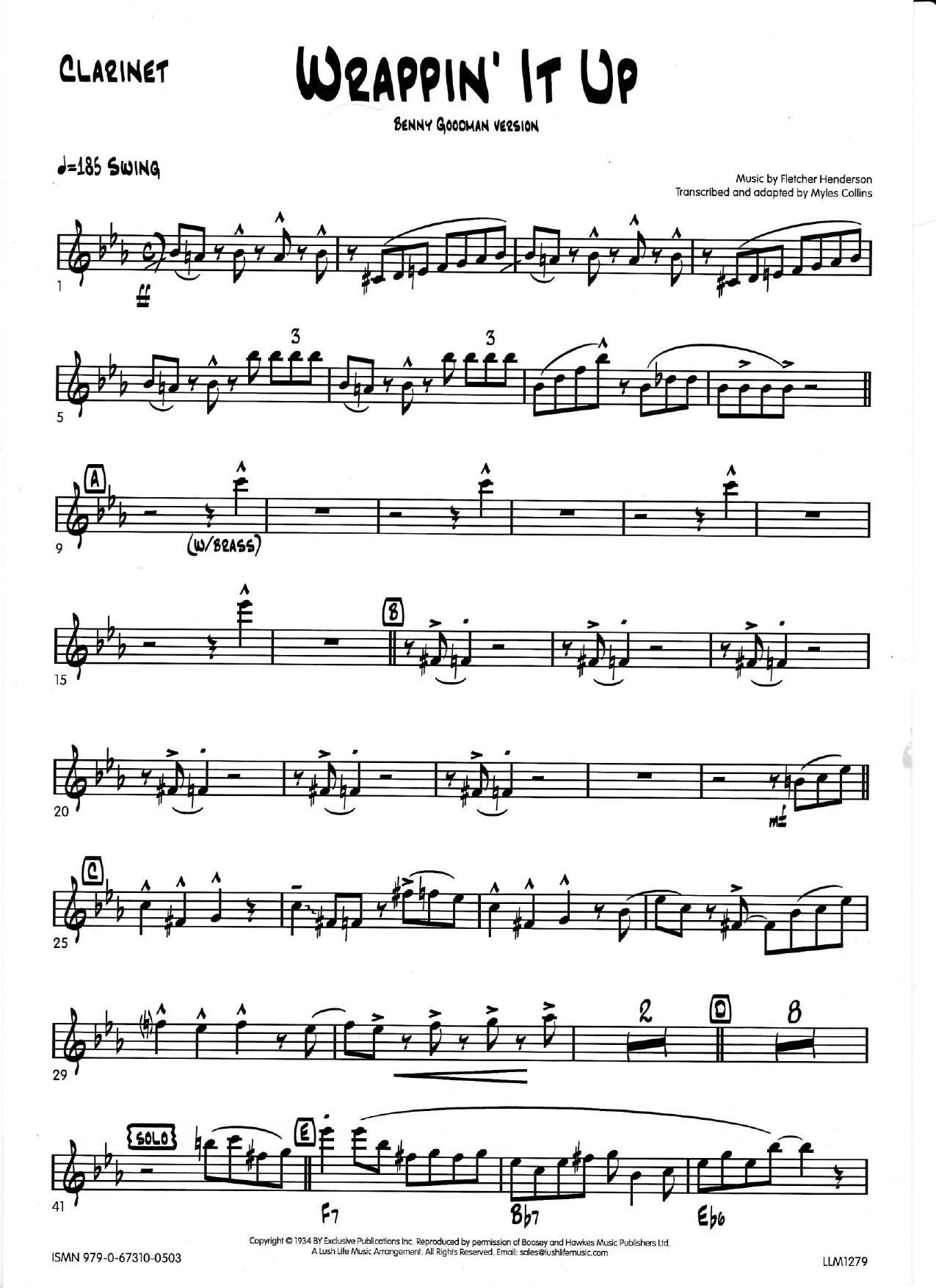
Wrappin' It Up (M.Collins) sheet music preview

Wrappin' It Up (M.Collins)

Composed by Fletcher Henderson

Arranged by Fletcher Henderson

  • Ensemble: Big Band
  • Pages: 80
  • Instruments (17): Clarinet, Alto 1, Alto 2, Tenor 1, Tenor 2, Trumpet 1, Trumpet 2, Trumpet 3, Trumpet 4, Trombone 1, Trombone 2, Trombone 3, Trombone 4, Guitar, Piano, Bass, Drums
  • Difficulty: advanced
  • Content: Individual Parts
  • Format: PDF Download (Instant)
  • Price: $24.99

Fletcher Henderson’s iconic 1934 composition "Wrappin' It Up (The Wrigley Smash)" stands as a towering masterwork of the mid-1930s swing era, recorded during a golden period when the Henderson orchestra served as the premier hit-making engine of Black dance orchestras. Originally crafted for his celebrated mid-1930s band—which famously supplied the arrangements that fueled Benny Goodman's sudden rise to national stardom—this tune epitomizes the transition from loose, New Orleans-derived polyphony to the tightly integrated, powerhouse section writing that defined the big band idiom. The composition captures the electrifying, high-stakes atmosphere of Harlem's vibrant ballroom scene, translating the unstoppable momentum of the urban nightlife into razor-sharp call-and-response figures and infectious, propulsive rhythms. Driving forward with a jubilant, breakneck medium-up swing feel in 4/4 time, the arrangement radiates an infectious, unbridled energy. The mood is celebratory, sophisticated, and relentlessly swinging, propelled by walking basslines and crisp cymbal work that demand absolute rhythmic precision from the rhythm section. Brass and reed sections trade punchy, syncopated motifs that create an exhilarating sense of musical conversation, evoking the dizzying excitement of a packed Savoy Ballroom floor. The harmonic language relies on crisp, block-chord voicings, bright major-seventh colorations, and blues-infused passing tones that give the chart its distinctly buoyant, optimistic 1930s character. Henderson approaches the ensemble texture with his signature architectural brilliance, treating the 8-instrument lineup not merely as a small combo, but as a miniature powerhouse that mimics the dynamic range of a full fifteen-piece orchestra. The arrangement utilizes tight, interlocking horn voicings where the alto and tenor saxophones lock in rhythmic unison with the trumpet and trombone, creating a streamlined yet dense harmonic wall of sound. Soli sections showcase masterful counterpoint, while the structural architecture builds organically toward a triumphant, driving shout chorus that tests the ensemble's stamina, articulation, and stamina. Every voice in the texture is assigned an active, melodic function, avoiding static padding in favor of continuous linear momentum. Melodic duties are shared fluidly across the entire ensemble, passing rapidly from the cutting edge of the trumpet to the warm, reedy embrace of the saxophones and the punchy counter-melodies of the trombone. Ample room is carved out for improvised solo segments, allowing featured horn players to stretch out over classic rhythm changes and blues forms within a historically informed vocabulary. Technical challenges center primarily on maintaining absolute rhythmic alignment during rapid-fire, sixteenth-note scalar passages and executing clean, articulate swing eighths at high tempos. Performers will find immense satisfaction in unlocking the buoyant, dance-oriented phrasing required to make the chart breathe naturally, particularly during the intricate dynamic shifts of the secondary themes. Advanced high school ensembles, collegiate jazz bands, and professional repertory groups will find this 80-page publication exceptionally well-suited for festival performance and historical programming. Because the writing exposes individual players within a lean, exposed 8-instrument texture, it requires a high degree of listening maturity and ensemble cohesion. Directors seeking to teach the foundational language of swing-era arrangement—where precision, lightness of touch, and aggressive forward-time feel are paramount—will discover an invaluable, rewarding centerpiece for their concert repertoire. Conductors should approach "Wrappin' It Up" with a strict, energetic tempo centered around quarter note equals 208 to 220 BPM, ensuring the swing eighth notes remain light, buoyant, and never rushed or heavy-handed. The primary technical hurdle lies in the precise synchronization of rapid unison passages between the saxophone and brass sections; light, articulate tonguing is essential to keep the lines transparent. Pay close attention to dynamic markings: sudden drop-offs to piano following aggressive ensemble hits create the characteristic 1930s "bounce." Drummers should emulate Sid Catlett or Jo Jones, favoring a feather-light bass drum pulse and crisp hi-hat closure on beats two and four. Horn players must utilize natural, unexaggerated vibrato typical of the period and execute accidental falls and doits with stylistic restraint, keeping the overall tone bright and swinging. Q: What instruments and parts are included in this arrangement? A: This 80-page publication includes charted parts for an 8-instrument ensemble comprising Alto Saxophone, Tenor Saxophone, Trumpet, Trombone, Piano, and rhythm section support. Q: What is the difficulty level of this chart? A: This arrangement is tailored for advanced high school, collegiate, and professional jazz ensembles due to its exposed 8-voice texture and demanding medium-up tempo. Q: What style and historical era does this piece represent? A: It represents the classic 1934 swing era, composed and arranged by Fletcher Henderson during the foundational years of big band jazz innovation. Q: What makes this specific Fletcher Henderson arrangement unique? A: It compresses the massive, high-energy wall of sound from Henderson's legendary 15-piece orchestra into a lean 8-instrument framework without losing its intricate call-and-response and shout chorus power. Q: What is the performance duration and tempo feel of the piece? A: The arrangement runs approximately 3 to 4 minutes and is driven by a fast, jubilant medium-up swing feel at roughly 210 BPM.

Questions and answers

What is included in the Wrappin' It Up (M.Collins) PDF?
The verified current file contains a conductor score and individual parts across 80 pages.
How many instruments or parts are listed for Wrappin' It Up (M.Collins)?
The verified instrumentation list contains 17 entries for this Big Band arrangement.
Who is credited for Wrappin' It Up (M.Collins)?
Composer: Fletcher Henderson. Arranger: Fletcher Henderson.
What difficulty is listed for Wrappin' It Up (M.Collins)?
The verified difficulty level is advanced.
Can I preview Wrappin' It Up (M.Collins) before buying?
Yes. The product page provides a preview generated from the current PDF file.
How is Wrappin' It Up (M.Collins) delivered?
After successful payment, the digital PDF is made available for download. The displayed price is $24.99.

Musicians Also Search For

Wrappin' It Up Fletcher Henderson PDFWrappin' It Up Fletcher Henderson sheet musicWrappin' It Up arranged by Fletcher HendersonFletcher Henderson big band chartsFletcher Henderson jazz arrangements PDFWrappin' It Up Fletcher Henderson big band arrangementsWrappin' It Up big band arrangementsWrappin' It Up big band PDF downloadWrappin' It Up jazz sheet musicbig band sheet music downloadWrappin' It Up conductor score PDFWrappin' It Up individual parts downloadWrappin' It Up sheet music PDFbuy Wrappin' It Up sheet musicdownload Wrappin' It Up PDFWrappin' It Up jazz chartsbest Fletcher Henderson big band arrangementsWrappin' It Up printable sheet musicbig band repertoire PDF

All arrangements by Fletcher Henderson All Fletcher Henderson sheet music