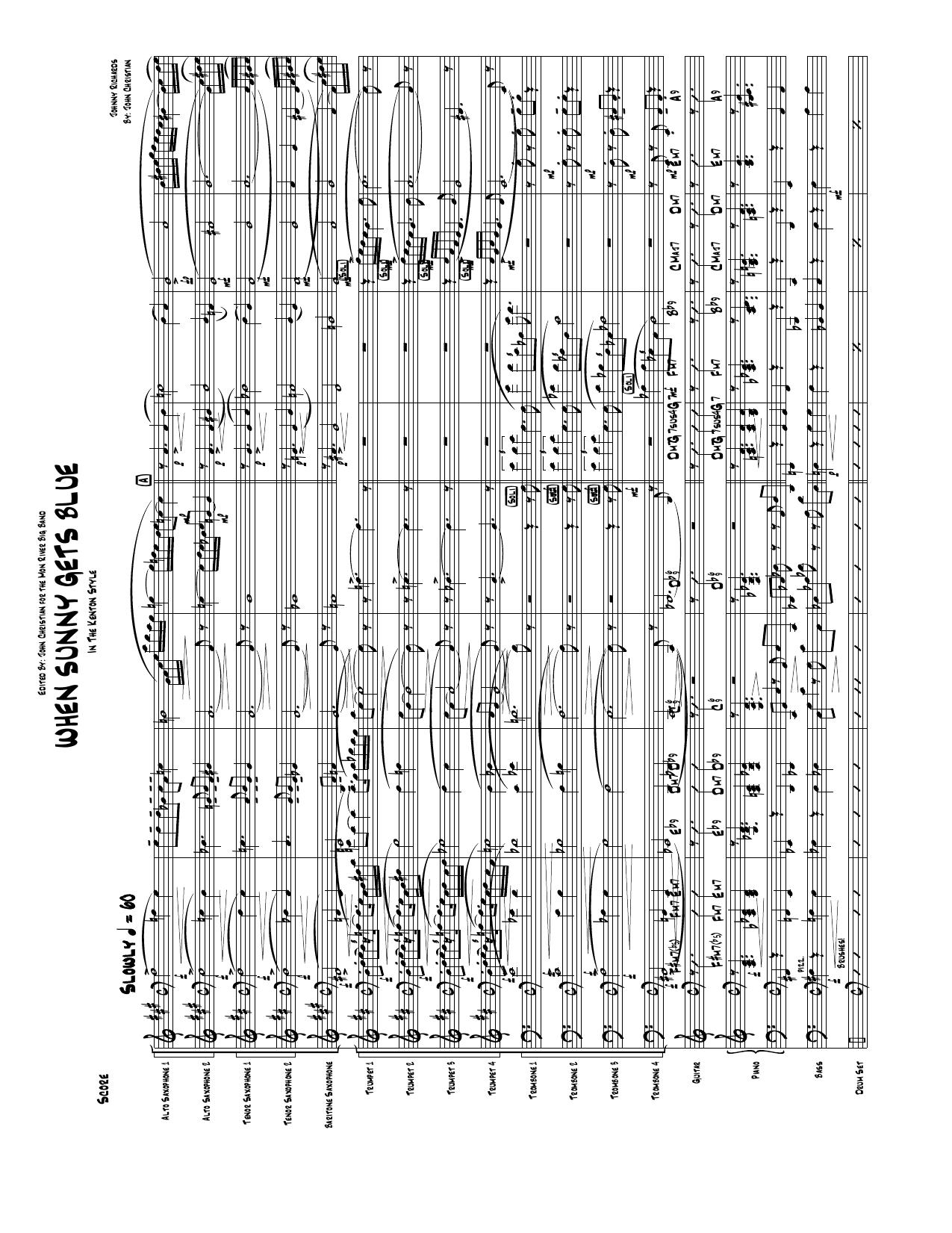
When Sunny Gets Blue (J.Christian-J.Richards)
Composed by Jack Segal
Arranged by J.Christian
- Ensemble: Big Band
- Pages: 45
- Instruments (17): Alto Saxophone 1, Alto Saxophone 2, Tenor Saxophone 1, Tenor Saxophone 2, Baritone Saxophone, Trumpet 1, Trumpet 2, Trumpet 3, Trumpet 4, Trombone 1, Trombone 2, Trombone 3, Trombone 4, Guitar, Piano, Bass, Drum Set
- Difficulty: medium
- Content: Individual Parts
- Format: PDF Download (Instant)
- Price: $24.99
Written by Jack Segal and Marvin Fisher in 1956, "When Sunny Gets Blue" remains one of the most poignant and enduring minor-ballad standards in the American Songbook, forever linked to the smoky, emotive vocal interpretations of Johnny Mathis and the cool-jazz explorations of artists like McCoy Tyner and Bill Evans. This timeless composition captures a deep, bittersweet melancholy, balancing a weeping minor-key melody with moments of unexpected harmonic brightness. Its rich emotional architecture makes it a supreme vehicle for jazz ensemble arranging, demanding exceptional sensitivity, dynamic control, and a sophisticated command of rubato and tempo pacing from both soloists and ensemble members alike. Conceived as a smoldering, slow-to-medium jazz ballad with a pervasive, late-night groove, this big band adaptation by J.Christian reimagines the classic tune through a lush, contemporary harmonic lens. The arrangement opens with a haunting, atmospheric introduction featuring suspended chord voicings in the brass and a delicate preamble in the rhythm section, immediately establishing an intimate, contemplative mood. As the chart unfolds, J.Christian utilizes rich, extended chord structures—frequently employing chromatic inner-voice movement and voicing-in-fourths—to give the saxophones a velvety, modern-jazz texture reminiscent of the Bob Mintzer or Thad Jones writing traditions. The emotional arc moves from fragile introspection to a soaring, dynamically rich climax before settling back into a quiet, unresolved peace. The primary melodic weight is shared between a featured flugelhorn or alto saxophone soloist and lush, full-ensemble soli passages that highlight the rich blend of the five-man saxophone section. The technical demands of the chart lie not in breakneck velocity, but in endurance, intonation, advanced reading skills, and breath control required for extended slow-tempo phrases. Brass players must navigate subtle sub-tone entrances and precise plunger or cup-mute coloring, while the rhythm section must maintain an elastic, breathing pulse that pushes and pulls naturally against the soloist's phrasing. A standout structural moment arrives at the bridge of the second chorus, where a sudden key color shift and a dense, four-part trombone soli drive the emotional intensity upward before gracefully receding. Advanced high school ensembles with mature lead players, as well as collegiate, community, and professional big bands, will find this arrangement an ideal centerpiece for a ballad or mood-piece rotation in a concert set. Because it places a premium on ensemble listening, blend, and mature phrasing rather than sheer technical flash, it serves as an exceptional pedagogical tool for developing a modern jazz concept. It rewards an ambitious band with a sophisticated, emotionally resonant performance that never fails to captivate an audience looking for depth, nuance, and genuine artistic expression. Success with this arrangement hinges entirely on restraint, dynamic awareness, and a shared internal pulse. The conductor should establish a relaxed, breathing 12/8 or triplet-feel underlying the 4/4 meter, avoiding any mechanical stiffness in the swing eighth notes. Key technical challenges include maintaining pristine intonation during the dense, slow-moving cluster voicings in the saxophones and keeping the brass blend warm and unforced in the upper-middle registers. Mutes should be utilized strictly as indicated (predominantly cup and harmon, with specific plunger effects in the trombones) to achieve the characteristic smoky texture of the arrangement. Rehearsal should begin by isolating the rhythm section and the featured soloist to build the underlying groove before layering in the horn pads. Pay meticulous attention to the dynamic markings: the soft sections must breathe with absolute quietude to make the swelling climaxes truly impactful. Ensure the lead trumpet and lead alto maintain a seamless balance during the unison and octave-doubled soli lines. Q: What instruments and parts are included in this big band arrangement? A: The 16-instrument instrumentation includes Alto Sax 1, Alto Sax 2, Tenor Sax 1, Tenor Sax 2, Baritone Sax, 4 Trumpets, 4 Trombones, Piano, Guitar, Bass, and Drums, spanning a comprehensive 45-page score and parts set. Q: What is the difficulty level of this chart? A: This arrangement is graded as advanced (Level 4-5), best suited for collegiate, professional, and advanced high school big bands that possess strong section blend and mature ballad-playing sensibilities. Q: What is the style and historical context of this piece? A: Based on the 1956 Jack Segal and Marvin Fisher jazz standard made famous by vocalists like Johnny Mathis, this chart treats the material as a lush, contemporary minor ballad infused with modern jazz harmonic colorations. Q: What makes J.Christian's arrangement unique? A: It stands out through its sophisticated extended voicings, a striking trombone soli section, and a dynamic formal arc that transitions from intimate, muted textures to sweeping, emotionally charged ensemble climaxes. Q: What is the performance duration and tempo guideline? A: The arrangement runs approximately 4.5 to 5.5 minutes depending on solo extensions, and should be performed at a relaxed, smoldering slow-swing ballad tempo of approximately 68-74 beats per minute.
Questions and answers
- What is included in the When Sunny Gets Blue (J.Christian-J.Richards) PDF?
- The verified current file contains a conductor score and individual parts across 45 pages.
- How many instruments or parts are listed for When Sunny Gets Blue (J.Christian-J.Richards)?
- The verified instrumentation list contains 17 entries for this Big Band arrangement.
- Who is credited for When Sunny Gets Blue (J.Christian-J.Richards)?
- Composer: Jack Segal. Arranger: J.Christian.
- What difficulty is listed for When Sunny Gets Blue (J.Christian-J.Richards)?
- The verified difficulty level is medium.
- Can I preview When Sunny Gets Blue (J.Christian-J.Richards) before buying?
- Yes. The product page provides a preview generated from the current PDF file.
- How is When Sunny Gets Blue (J.Christian-J.Richards) delivered?
- After successful payment, the digital PDF is made available for download. The displayed price is $24.99.
Musicians Also Search For
When Sunny Gets Blue J.Christian PDF • When Sunny Gets Blue J.Christian sheet music • When Sunny Gets Blue arranged by J.Christian • J.Christian big band charts • J.Christian jazz arrangements PDF • When Sunny Gets Blue Jack Segal sheet music • When Sunny Gets Blue Jack Segal big band arrangements • Jack Segal big band charts • When Sunny Gets Blue big band arrangements • When Sunny Gets Blue big band PDF download • When Sunny Gets Blue jazz sheet music • big band sheet music download • When Sunny Gets Blue conductor score PDF • When Sunny Gets Blue individual parts download • When Sunny Gets Blue sheet music PDF • buy When Sunny Gets Blue sheet music • download When Sunny Gets Blue PDF • When Sunny Gets Blue jazz charts • best J.Christian big band arrangements • Jack Segal arranged by J.Christian • When Sunny Gets Blue printable sheet music • big band repertoire PDF