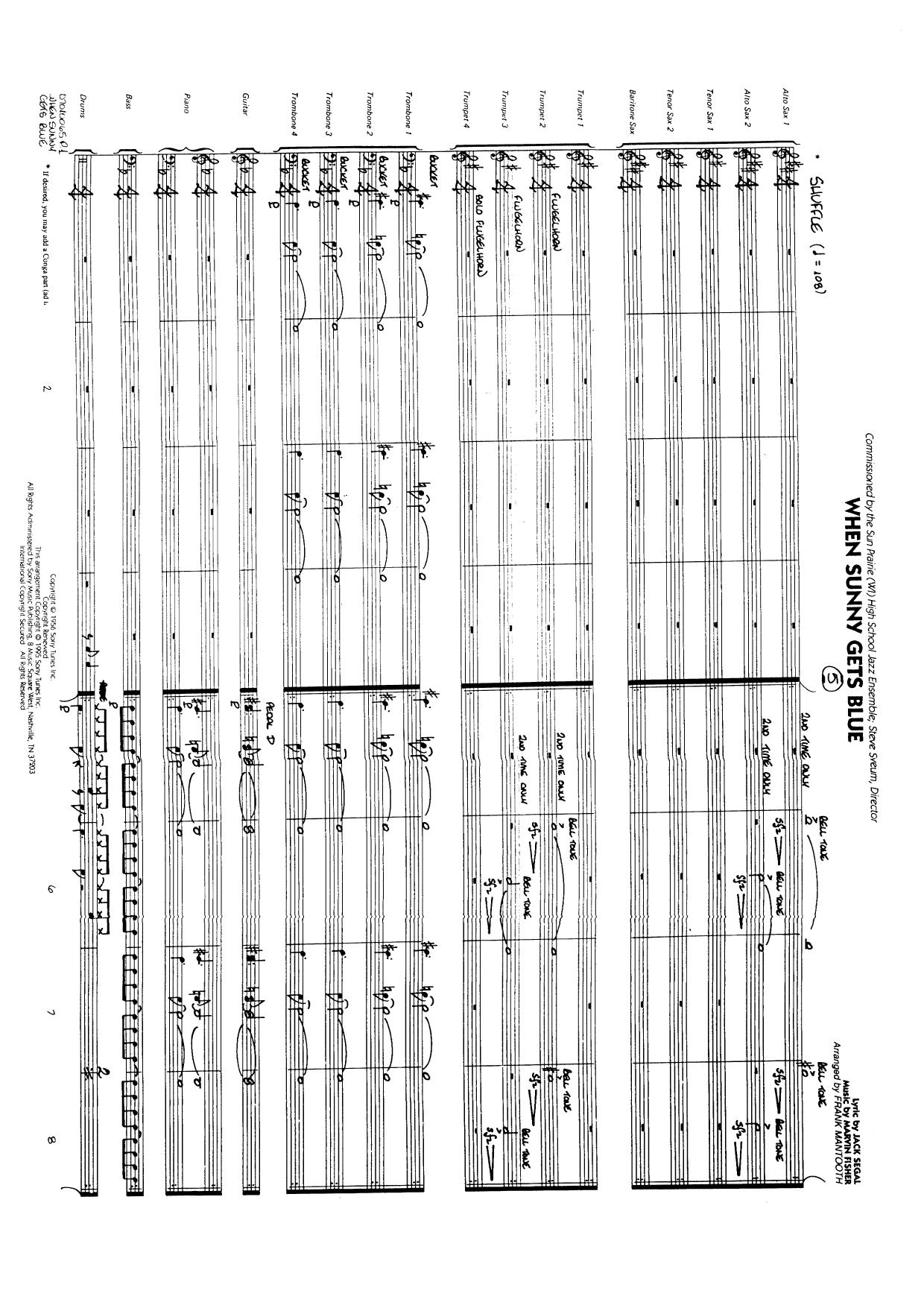
When Sunny Gets Blue (F.Mantooth)
Composed by Jack Segal
Arranged by Frank Mantooth
- Ensemble: Big Band
- Pages: 90
- Instruments (18): 1st Alto Sax, Alto Sax 2, Tenor Sax 1, Tenor Sax 2, Baritone Sax, Trumpet 1, Trumpet 2, Trumpet 3, Trumpet 4, Trombone 1, Trombone 2, Trombone 3, Trombone 4, Guitar, Piano, Bass, Drums, Solo Trumpet in Bb
- Difficulty: advanced
- Content: Individual Parts
- Format: PDF Download (Instant)
- Price: $24.99
Written by Jack Segal and Marvin Fisher in 1946, "When Sunny Gets Blue" became an enduring vocal and instrumental jazz standard permanently etched into the Great American Songbook, largely cemented by Johnny Mathis’s definitive 1956 recording. This timeless lament captures the bittersweet transition from heartbreak to resilience, embodying a late-night, melancholic intimacy that has fascinated jazz artists for decades. The composition relies on a sophisticated harmonic framework characterized by unexpected chromatic descents and poignant modal shifts, making it a natural vehicle for expressive jazz interpretation. Frank Mantooth’s masterful big band arrangement elevates this standard from a simple vocal torch song into a masterclass of modern contemporary jazz orchestration. Crafted with Mantooth’s signature lush, contemporary harmonic palette—frequently featuring stacked fourths, dense upper-structure triads, and rich chromatic inner-voice movement—this setting transforms the ballad into a deeply atmospheric journey. The tempo is a relaxed, contemplative slow swing (around 68-72 BPM), establishing a spacious, lingering groove that demands absolute precision in time-feel. Rather than rushing through the changes, the chart utilizes suspended rhythmic figures and subtle rubato-esque phrasing within a steady underlying pulse to maximize emotional tension. The emotional weight of the chart is carried primarily by rich, sophisticated saxophone solis and lush brass block voicings that evoke the cool-school modernism of the 1970s and 80s big band renaissance. Mantooth brilliantly balances transparent ensemble textures with dense, harmonically advanced shout sections that swell dynamically without ever destroying the intimate mood of the original melody. Featured solo space allows a mature lead alto or flugelhorn soloist to step forward, navigating sophisticated modulations that breathe new life into Segal's classic chord progression. The technical challenges lie less in high-note endurance and far more in blend, intonation, and maintaining a cohesive, languid swing feel across all 17 voices during extended sustained chords. Advanced high school ensembles with strong section players, as well as collegiate, community, and professional jazz orchestras, will find this 90-page publication a rewarding centerpiece for a concert program. Because the chart relies heavily on subtle dynamic control, precise articulation, and mature harmonic awareness, it serves as an exceptional educational tool for teaching contemporary big band literacy. Audiences and performers alike will appreciate how Mantooth respects the classic melancholy of the melody while injecting a sophisticated, modern harmonic language that keeps the listener spellbound from the first chord to the final fading whisper. Navigating Frank Mantooth’s sophisticated voicings requires meticulous attention to balance, intonation, and dynamic control. The primary technical challenge rests in the execution of rich, extended chord structures where minor seconds and upper extensions must speak clearly without any single voice sticking out. The tempo should remain a steady, unhurried slow swing, avoiding any tendency to drag while resisting the urge to push ahead during busier harmonic passages. Conductors should emphasize a relaxed, behind-the-beat eighth-note feel in the rhythm section, ensuring the bass provides a warm, pulsating foundation rather than an aggressive walk. Brass players should approach muted sections with a warm, dark tone, utilizing cup or harmon mutes where indicated to blend seamlessly with the woodwind textures. Rehearsals should begin with slow, sectional tuning of the chord clusters before integrating the rhythm section, ensuring the band locks in on Mantooth's signature harmonic shifts. Q: What instruments and parts are included in this arrangement? A: This 90-page publication is scored for a standard 17-piece big band instrumentation, including 2 alto saxophones, 2 tenor saxophones, 1 baritone saxophone, 4 trumpets, 4 trombones, piano, guitar, bass, and drums. Q: What is the difficulty level of this chart? A: This arrangement is graded as advanced (appropriate for advanced high school, collegiate, and professional big bands) due to its demanding contemporary chord voicings, intonation requirements, and need for mature stylistic restraint. Q: What is the musical style and historical context of this piece? A: It is a contemporary jazz big band treatment of Jack Segal and Marvin Fisher’s 1946 standard, reimagined through the lens of arranger Frank Mantooth's sophisticated, lush harmonic language. Q: What makes this specific arrangement unique? A: Mantooth’s distinct approach infuses the classic torch-song ballad with modern upper-structure triads, fourth-interval voicings, and subtle harmonic reharmonizations that create an unusually rich, atmospheric texture. Q: What is the performance duration and tempo feel? A: The chart plays out over a relaxed, contemplative slow swing tempo (approximately 68–72 BPM), typically lasting around 4 to 5 minutes depending on the length of the featured solo sections.
Questions and answers
- What is included in the When Sunny Gets Blue (F.Mantooth) PDF?
- The verified current file contains a conductor score and individual parts across 90 pages.
- How many instruments or parts are listed for When Sunny Gets Blue (F.Mantooth)?
- The verified instrumentation list contains 18 entries for this Big Band arrangement.
- Who is credited for When Sunny Gets Blue (F.Mantooth)?
- Composer: Jack Segal. Arranger: Frank Mantooth.
- What difficulty is listed for When Sunny Gets Blue (F.Mantooth)?
- The verified difficulty level is advanced.
- Can I preview When Sunny Gets Blue (F.Mantooth) before buying?
- Yes. The product page provides a preview generated from the current PDF file.
- How is When Sunny Gets Blue (F.Mantooth) delivered?
- After successful payment, the digital PDF is made available for download. The displayed price is $24.99.
Musicians Also Search For
When Sunny Gets Blue Frank Mantooth PDF • When Sunny Gets Blue Frank Mantooth sheet music • When Sunny Gets Blue arranged by Frank Mantooth • Frank Mantooth big band charts • Frank Mantooth jazz arrangements PDF • When Sunny Gets Blue Jack Segal sheet music • When Sunny Gets Blue Jack Segal big band arrangements • Jack Segal big band charts • When Sunny Gets Blue big band arrangements • When Sunny Gets Blue big band PDF download • When Sunny Gets Blue jazz sheet music • big band sheet music download • When Sunny Gets Blue conductor score PDF • When Sunny Gets Blue individual parts download • When Sunny Gets Blue sheet music PDF • buy When Sunny Gets Blue sheet music • download When Sunny Gets Blue PDF • When Sunny Gets Blue jazz charts • best Frank Mantooth big band arrangements • Jack Segal arranged by Frank Mantooth • When Sunny Gets Blue printable sheet music • big band repertoire PDF