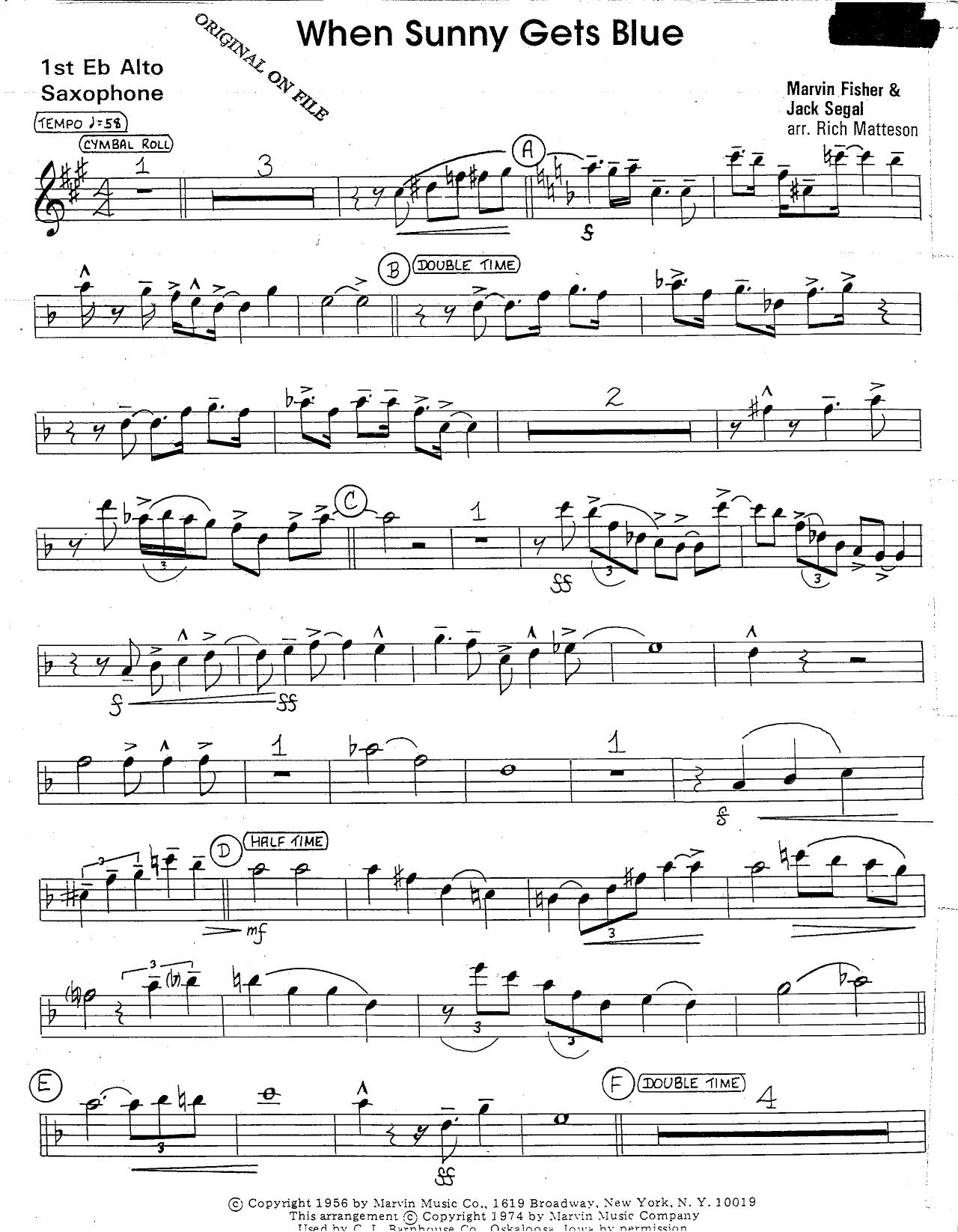
When Sunny Gets Blue (R.Matteson)
Composed by Marvin Fisher
Arranged by R.Matteson
- Ensemble: Big Band
- Style: Jazz Standard
- Pages: 35
- Instruments (19): 1st Eb Alto Saxophone, 2nd Eb Alto Saxophone, 3rd Eb Alto Saxophone, 1st Bb Tenor Saxophone, 2nd Bb Tenor Saxophone, 4th Bb Tenor Saxophone, Eb Baritone Saxophone, 1st Bb Trumpet, 2nd Bb Trumpet, 3rd Bb Trumpet, 4th Bb Trumpet, 1st Trombone, 2nd Trombone, 3rd Trombone, 4th Trombone, Piano, Guitar, Bass, Drums
- Difficulty: medium
- Content: Individual Parts
- Format: PDF Download (Instant)
- Price: $24.99
Composed by Marvin Fisher with lyrics by Jack Segal, "When Sunny Gets Blue" entered the Great American Songbook after becoming a definitive vocal vehicle for Johnny Mathis on his 1957 album *Wonderful, Wonderful*. Over the subsequent decades, this melancholy masterpiece transitioned seamlessly into the instrumental jazz canon, recorded by legendary artists including Bill Evans, McCoy Tyner, and Wynton Kelly. The composition represents the quintessential mid-century jazz ballad, defined by its bittersweet harmonic progression, yearning melody lines, and an introspective atmosphere that captures the complex transition from heartbreak to hopeful resilience. This masterful big band interpretation by R.Matteson transforms the intimate vocal standard into a rich, texturally nuanced ballad governed by a languid, floating 12/8 swing feel (or slow 4/4 rubato-to-tempo framework). The harmonic landscape is lush and expansive, utilizing extended upper-structure chords, subtle chromatic voice-leading, and dense woodwind solidifying that evoke the sophisticated arranging traditions of the Gil Evans and Thad Jones schools. The emotional arc moves from cool, solitary reflection in the opening horn statements to a deeply expressive, soaring middle section before subsiding into a tender, whispered coda. Matteson’s chart places heavy emphasis on dynamic contrast and sectional interplay. The melody is initially introduced by a featured lead alto saxophone or flugelhorn over a velvety, muted brass bed, allowing the soloist maximum expressive freedom. A tightly knit saxophone soli highlights the rich lower registers of the section, leading into a dynamic, flowing ensemble chorus that builds tension without sacrificing the underlying fragility of the tune. Technical demands center less on raw velocity and much more on breath control, intonation in extreme voicings, ensemble balance, and the precise execution of rubato phrasing. Performers must navigate delicate dynamic shifts, ranging from fragile *pianissimos* to warm, resonant *mezzo-forte* climaxes. Advanced high school ensembles with mature lead players, collegiate jazz orchestras, and professional big bands will find this chart an exceptional vehicle for developing ensemble sensitivity and lyrical maturity. While the rhythm section maintains an understated, conversational pulse, the horn sections are challenged to execute transparent, vulnerable voicings that expose any lapse in intonation. It serves as an ideal centerpiece for a concert program requiring a sophisticated, emotionally resonant contrast to high-energy swinger charts. Conductors should approach this arrangement with a strict focus on breath support and horizontal phrasing. The tempo should remain relaxed and fluid, avoiding a rigid mechanical click; encourage the rhythm section to play behind the beat to establish a heavy, laid-back groove. Brass players should utilize warm, dark tonal concepts, employing cup mutes or harmon mutes (stem in/out as indicated) where specified to create a moody, nocturnal timbre. A primary technical challenge lies in maintaining pristine intonation during the dense, harmonically complex chord clusters in the saxes and muted brass. Rehearsal should begin by isolating the chordal voicings without rhythm section accompaniment, ensuring that every inner voice resolves smoothly. Pay close attention to the dynamic swells; the peak of the chart requires a full-ensemble warmth rather than aggressive volume. Ensure the featured soloist has ample room to rubato freely over the rhythm section's supportive, transparent pedal points. Q: What instruments and parts are included in this big band arrangement? A: The 35-page score and parts set is scored for a standard 17-instrument big band lineup, comprising 5 saxophones (Alto 1, Alto 2, Tenor 1, Tenor 2, Baritone), 4 trumpets, 4 trombones, and a standard 4-piece rhythm section (piano, guitar, bass, and drums). Q: What is the overall difficulty level of this chart? A: This arrangement is graded as advanced (appropriate for collegiate, advanced high school, and professional jazz ensembles), primarily due to the intense demands placed on breath control, long lyrical phrasing, subtle dynamic control, and maintaining intonation across dense chord clusters. Q: What is the historical style and context of this piece? A: It is a jazz ballad adaptation of Marvin Fisher and Jack Segal’s 1956 standard, famously popularized by Johnny Mathis and later embraced by modal and post-bop instrumentalists as a vehicle for deep emotional expression. Q: What makes R.Matteson's arrangement unique compared to other versions? A: Matteson utilizes lush, extended upper-structure voicings and a spacious 12/8 ballad feel that emphasizes transparent ensemble textures, rich woodwind soli writing, and sophisticated harmonic reharmonizations rather than standard block-chord writing. Q: What is the performance duration and recommended tempo feel? A: The arrangement runs approximately 4 to 5 minutes and is performed at a slow, expressive tempo with a relaxed, floating ballad swing feel that requires both strict time discipline and expressive rubato freedom.
Questions and answers
- What is included in the When Sunny Gets Blue (R.Matteson) PDF?
- The verified current file contains individual parts across 35 pages.
- How many instruments or parts are listed for When Sunny Gets Blue (R.Matteson)?
- The verified instrumentation list contains 19 entries for this Big Band arrangement.
- Who is credited for When Sunny Gets Blue (R.Matteson)?
- Composer: Marvin Fisher. Arranger: R.Matteson.
- What difficulty is listed for When Sunny Gets Blue (R.Matteson)?
- The verified difficulty level is medium.
- What style is listed for When Sunny Gets Blue (R.Matteson)?
- The catalog lists the style as Jazz Standard.
- Can I preview When Sunny Gets Blue (R.Matteson) before buying?
- Yes. The product page provides a preview generated from the current PDF file.
- How is When Sunny Gets Blue (R.Matteson) delivered?
- After successful payment, the digital PDF is made available for download. The displayed price is $24.99.
Musicians Also Search For
When Sunny Gets Blue R.Matteson PDF • When Sunny Gets Blue R.Matteson sheet music • When Sunny Gets Blue arranged by R.Matteson • R.Matteson big band charts • R.Matteson jazz arrangements PDF • When Sunny Gets Blue Marvin Fisher sheet music • When Sunny Gets Blue Marvin Fisher big band arrangements • Marvin Fisher big band charts • When Sunny Gets Blue big band arrangements • When Sunny Gets Blue big band PDF download • When Sunny Gets Blue jazz sheet music • big band sheet music download • When Sunny Gets Blue individual parts download • When Sunny Gets Blue sheet music PDF • When Sunny Gets Blue Jazz Standard charts • Jazz Standard big band arrangements • buy When Sunny Gets Blue sheet music • download When Sunny Gets Blue PDF • When Sunny Gets Blue jazz charts • best R.Matteson big band arrangements • Marvin Fisher arranged by R.Matteson • When Sunny Gets Blue printable sheet music • big band repertoire PDF