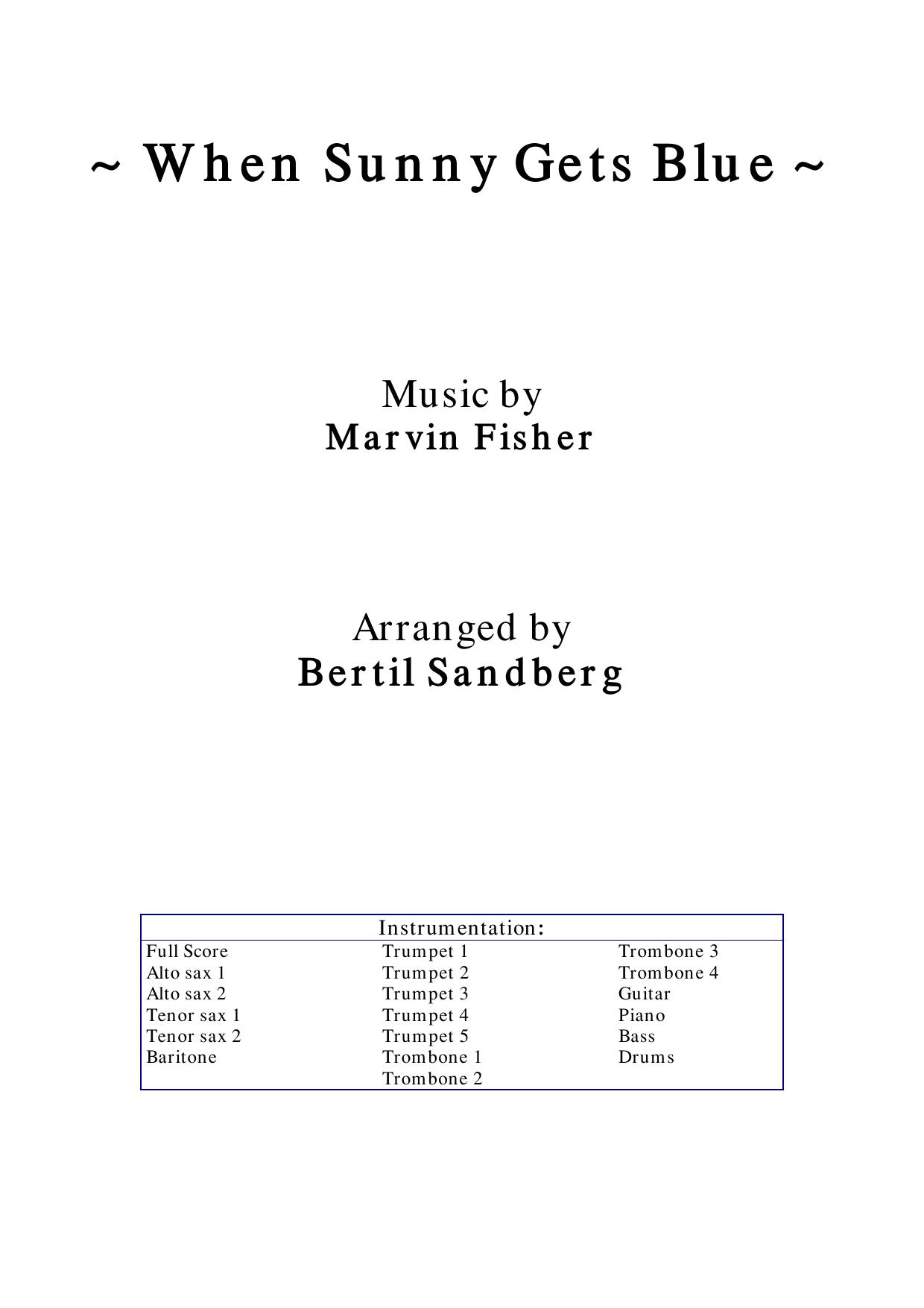
When Sunny Gets Blue (B.Sandberg)
Composed by Marvin Fisher
Arranged by B.Sandberg
- Ensemble: Big Band
- Style: Jazz Standard
- Pages: 28
- Instruments (24): Alto Saxophone 1, Alto Saxophone 2, Tenor Saxophone 1, Tenor Saxophone 2, Baritone Saxophone, Trumpet 1, Trumpet 2, Trumpet 3, Trumpet 4, Trumpet 5, Flugelhorn 1, Flugelhorn 2, Flugelhorn 3, Flugelhorn 4, Flugelhorn 5, Trombone 1, Trombone 2, Trombone 3, Trombone 4, Guitar, Piano, Bass, Drums, Vocals
- Difficulty: medium
- Content: Individual Parts
- Format: PDF Download (Instant)
- Price: $24.99
Composed by Marvin Fisher with lyrics by Jack Segal, "When Sunny Gets Blue" entered the Great American Songbook following its introduction in 1956 and subsequent immortalization by Johnny Mathis on his breakthrough 1957 album *Wonderful, Wonderful*. Representative of the sophisticated, emotionally resonant vocal ballad tradition of the 1950s, this melancholic masterpiece quickly transcended its pop-chart origins to become a staple of jazz repertoire. Its enduring appeal lies in its sophisticated harmonic structure, which moves fluidly between major and minor tonalities, offering jazz artists a rich canvas for expressive rubato phrasing and deep emotional storytelling. Conceived as a sublime, late-night atmospheric ballad, this arrangement anchors itself in a slow, expressive 12/8 or triplet-weighted 4/4 ballad feel that emphasizes breath, space, and lush harmonic suspension. The mood is introspective, smoky, and deeply reflective, transitioning from a vulnerable opening state into a sweeping, cinematic emotional climax. The harmonic landscape utilizes extended and altered chords—ninths, elevenths, and sharp-elevenths—to evoke a quintessential post-war jazz club ambiance, capturing both the heartache of the lyric and the sophisticated cool of the modernist jazz era. B.Sandberg approaches this classic standard with a masterclass in textural orchestration, balancing dense, impressionistic saxophone voicings with warm, muted brass backgrounds. Eschewing a heavy-handed treatment, Sandberg treats the ensemble like a living, breathing vocal accompanist. The chart features a gorgeous full-ensemble soli section that reharmonizes the secondary bridge, utilizing rich open-horn voicings that maximize acoustic resonance. Rather than relying on a bombastic shout chorus, Sandberg builds intensity through dynamic expansion and rising counter-lines, allowing the tension in the harmony to do the heavy lifting before resolving into a tender, whispered final cadence. Melodic duties are shared primarily between a featured lead alto saxophone and a strong flugelhorn or muted trumpet voice, creating an intimate dialogue before opening up to rich sectional interplay. The technical demands of this 44-page chart center on control: sustained intonation in extreme quiet dynamics, precise ensemble balance during rubato-to-tempo transitions, and mature stylistic maturity rather than sheer digital velocity. Advanced high school bands with exceptional section leaders, as well as collegiate and professional ensembles, will find this arrangement an ideal centerpiece for a ballad slot in a concert program, offering audiences a profound emotional journey and players an exercise in sublime ensemble blending. Success with this chart depends entirely on restraint, dynamic control, and a unified concept of time. The conductor must establish a fluid, breathing tempo that avoids feeling stagnant; the underlying subdivision should remain warm and triplet-based even during rubato stretches. Trumpets and trombones should utilize cup mutes or harmon mutes (stem out where indicated) during the first half of the chart to achieve the necessary dry, intimate tone color before opening up for the climactic unmuted choruses. Saxophone sections must focus heavily on blend and intonation during the dense chord clusters in the second chorus, matching the vibrato width of the lead alto. Rehearsal should begin by isolating the breath support on long tones, ensuring that the pianissimo entrances do not sag in pitch. Pay careful attention to the dynamic swells; the transition from the soft, introductory textures to the full-ensemble statement must be handled as a gradual, rolling wave rather than an abrupt shift. Q: What instruments and parts are included in this big band arrangement? A: The 44-page complete set includes the full conductor score plus parts for a standard 18-piece big band instrumentation: 2 alto saxophones, 2 tenor saxophones, 1 baritone saxophone, 4 trumpets, 4 trombones, guitar, piano, bass, drums, and auxiliary parts. Q: What is the difficulty level of this arrangement? A: This arrangement is rated at an advanced intermediate to advanced level (Grade 4-5), primarily due to the high demands placed on intonation, dynamic control, and subtle stylistic interpretation rather than fast technical passages. Q: What is the style and historical context of "When Sunny Gets Blue" in this setting? A: This is a classic jazz ballad arrangement modeled after the sophisticated, moody vocal and instrumental interpretations popularized during the 1950s jazz era, emphasizing lush harmonies and deep emotional resonance. Q: What makes B.Sandberg's arrangement unique compared to other versions? A: Sandberg avoids a traditional loud shout chorus, instead building intensity through innovative reharmonizations, impressionistic chord voicings, and a gorgeous, harmonically rich soli section that treats the ensemble like a vocal choir. Q: What is the recommended performance duration and tempo feel? A: The arrangement is designed as a slow, expressive ballad lasting approximately 4 to 5 minutes, driven by a relaxed, triplet-weighted 12/8 or 4/4 groove that prioritizes space and lyrical phrasing.
Questions and answers
- What is included in the When Sunny Gets Blue (B.Sandberg) PDF?
- The verified current file contains a conductor score and individual parts across 28 pages.
- How many instruments or parts are listed for When Sunny Gets Blue (B.Sandberg)?
- The verified instrumentation list contains 24 entries for this Big Band arrangement.
- Who is credited for When Sunny Gets Blue (B.Sandberg)?
- Composer: Marvin Fisher. Arranger: B.Sandberg.
- What difficulty is listed for When Sunny Gets Blue (B.Sandberg)?
- The verified difficulty level is medium.
- What style is listed for When Sunny Gets Blue (B.Sandberg)?
- The catalog lists the style as Jazz Standard.
- Can I preview When Sunny Gets Blue (B.Sandberg) before buying?
- Yes. The product page provides a preview generated from the current PDF file.
- How is When Sunny Gets Blue (B.Sandberg) delivered?
- After successful payment, the digital PDF is made available for download. The displayed price is $24.99.
Musicians Also Search For
When Sunny Gets Blue B.Sandberg PDF • When Sunny Gets Blue B.Sandberg sheet music • When Sunny Gets Blue arranged by B.Sandberg • B.Sandberg big band charts • B.Sandberg jazz arrangements PDF • When Sunny Gets Blue Marvin Fisher sheet music • When Sunny Gets Blue Marvin Fisher big band arrangements • Marvin Fisher big band charts • When Sunny Gets Blue big band arrangements • When Sunny Gets Blue big band PDF download • When Sunny Gets Blue jazz sheet music • big band sheet music download • When Sunny Gets Blue conductor score PDF • When Sunny Gets Blue individual parts download • When Sunny Gets Blue sheet music PDF • When Sunny Gets Blue Jazz Standard charts • Jazz Standard big band arrangements • buy When Sunny Gets Blue sheet music • download When Sunny Gets Blue PDF • When Sunny Gets Blue jazz charts • best B.Sandberg big band arrangements • Marvin Fisher arranged by B.Sandberg • When Sunny Gets Blue printable sheet music • big band repertoire PDF