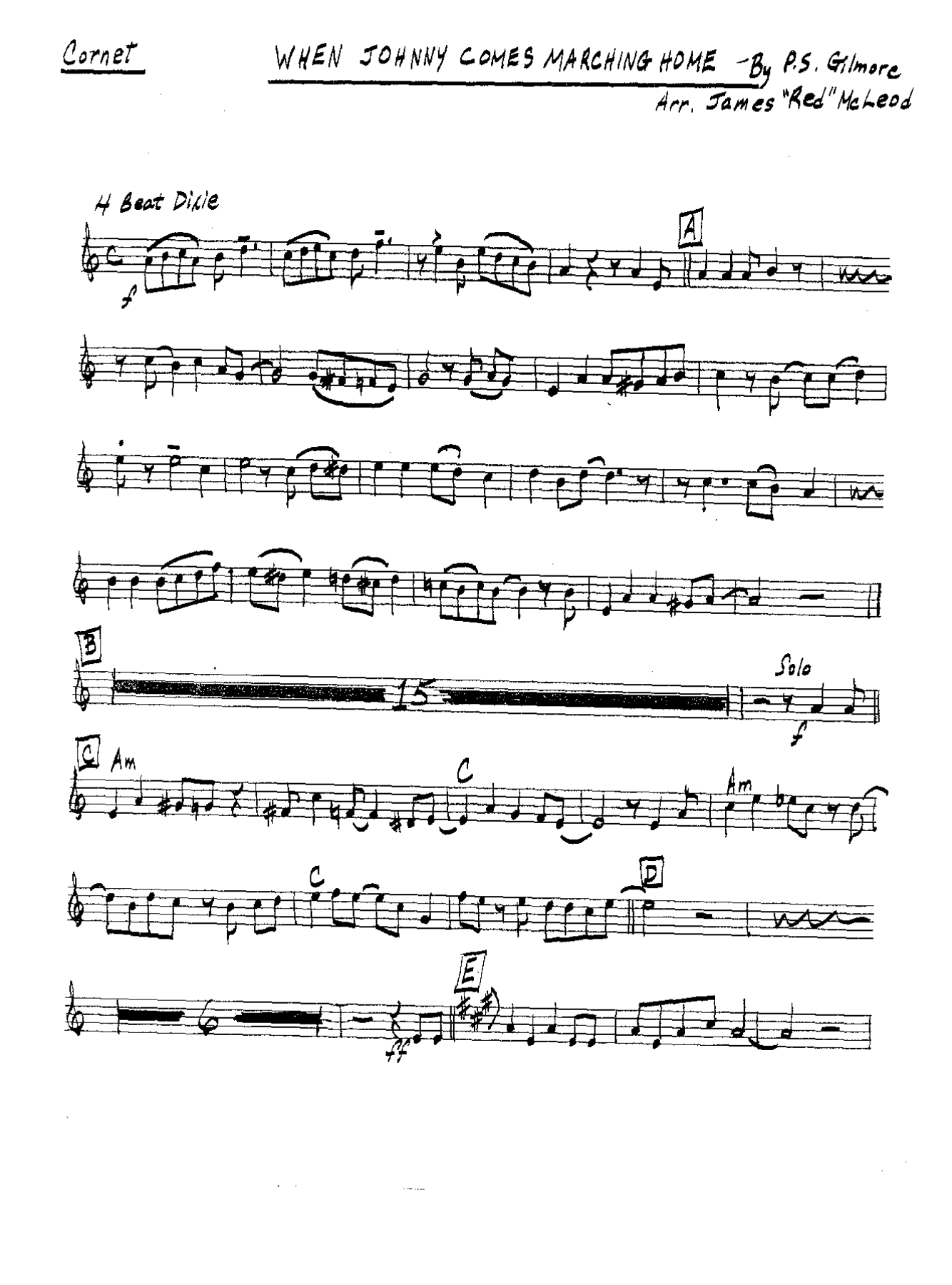
When Johnny Comes Marchin Home (J.R.McLeod (J.McLeod)
Composed by Patrick Sarsfield Gilmore
Arranged by James "Red" McLeod
- Ensemble: Small Ensemble
- Style: March
- Pages: 16
- Instruments (9): Cornet, Clarinet, Tenor Sax (optional), Trombone, Banjo, Piano, String Bass, Tuba, Drum
- Difficulty: easy
- Content: Individual Parts
- Format: PDF Download (Instant)
- Price: $12.99
"When Johnny Comes Marchin Home," originally penned by Patrick Sarsfield Gilmore in 1863, stands as an enduring anthem of the American Civil War era, capturing the profound longing for soldiers to return safely from conflict. Though published under the pseudonym "Louis Lambert," Gilmore, a prominent Irish-American bandmaster, is widely credited with its composition. The melody, often noted for its resemblance to the Irish ballad "Johnny, We Hardly Knew Ye," resonated deeply with families on both sides of the conflict, offering a universal sentiment of hope and celebration for survival rather than victory. Its initial publication in 2/4 time as an upbeat march solidified its place in the musical landscape of the 19th century, making it a piece that transcends its military origins to become a celebrated folk tune. Over the decades, its simple yet powerful theme has ensured its continued popularity, making it a recognizable and adaptable piece across various musical genres, including jazz. James "Red" McLeod's small ensemble arrangement transforms this historic march into a vibrant jazz experience, imbued with a medium swing feel that honors the original's energetic pulse while infusing it with characteristic jazz syncopation and harmonic sophistication. McLeod, a prolific American composer, music educator, and arranger known for his extensive work across various ensembles and media, including his long tenure as musical director for The Golden Strings, brings his distinctive touch to this classic. His approach typically involves crafting arrangements that are both engaging for performers and accessible, often focusing on clear melodic lines and well-constructed voicings. In this arrangement, the familiar melody is presented with fresh harmonic colors, transitioning from its traditional minor tonality to a brighter, more optimistic key of A♭ major, around a moderate tempo of approximately 111-113 BPM. The mood is one of celebratory anticipation, evoking the joyous return suggested by the original lyrics, but reinterpreted through the lens of a classic jazz ensemble. McLeod's arrangement highlights the melody through various sections, likely featuring the lead voice of the small ensemble, with intricate counter-melodies and call-and-response passages woven throughout the instrumentation. While specific solo sections are not detailed, a skilled jazz arranger like McLeod would typically include opportunities for improvisation, allowing individual musicians to showcase their interpretive abilities within the established harmonic framework. The technical challenges lie in maintaining a cohesive swing feel, executing precise articulations characteristic of jazz, and navigating the nuanced harmonic shifts that elevate the piece from a simple march to a sophisticated jazz chart. The rewarding aspect of performing this arrangement stems from its blend of historical recognition and jazz innovation, offering musicians the satisfaction of reinterpreting a beloved classic with a contemporary, swinging edge. It's a piece designed to engage audiences with its familiar melody while delighting them with its unexpected jazz treatment. This small ensemble arrangement is ideally suited for college, community, or professional jazz groups seeking a piece that offers both historical depth and musical versatility. Its 16 pages suggest a concise yet fully developed treatment, perfect for programming in a diverse concert set or as a standout feature. The arrangement's blend of a well-known melody with a refined jazz sensibility makes it an excellent choice for ensembles looking to expand their repertoire with arrangements that are both challenging and broadly appealing. To achieve the optimal performance of "When Johnny Comes Marchin Home," conductors should emphasize a consistent medium swing feel, maintaining a steady pulse around 111-113 BPM. The arrangement's transition from the traditional minor tonality to A♭ major should be executed smoothly, allowing the brighter harmonic landscape to emerge naturally without abruptness. Articulation is key in jazz march style; encourage musicians to play with a detached, marcato approach, using "dah" or "tah" articulations rather than stopping the sound with the tongue. Accents are crucial for drive and energy, particularly in rhythmic figures, ensuring the ensemble breathes together for a unified sound. Balance is paramount in a small ensemble; ensure that the bass line provides a clear harmonic foundation and rhythmic stability, while horns and other melodic instruments blend effectively. Rehearse soli sections for tight ensemble precision and dynamic contrast, allowing featured melodic lines to sing out while supporting voices provide rich harmonic texture. **Q: What instruments/parts are included in this arrangement?** A: This arrangement is designed for a small ensemble, typically including a rhythm section (piano, bass, drums) and a selection of melodic instruments such as trumpet, trombone, and saxophone(s), with specific instrumentation detailed within the 16 pages of the score and parts. **Q: What is the difficulty level of this arrangement?** A: This arrangement is suitable for intermediate to advanced ensembles, including college, community, and professional jazz groups, due to its nuanced jazz harmonies, swing feel, and the need for precise articulation and ensemble balance. **Q: What is the musical style and historical context of this piece?** A: This is a jazz arrangement of "When Johnny Comes Marching Home," a march composed by Patrick Sarsfield Gilmore in 1863 during the American Civil War. The arrangement reinterprets the traditional march with a medium swing jazz feel. **Q: What makes James "Red" McLeod's arrangement unique?** A: James "Red" McLeod's arrangement distinguishes itself by transforming the classic march into a vibrant jazz piece with a medium swing feel and sophisticated harmonic re-imagination, particularly its shift to A♭ major, while retaining the original's energetic and celebratory spirit. **Q: What is the typical performance duration or tempo for this arrangement?** A: The arrangement is intended to be performed at a medium swing tempo, approximately 111-113 BPM, which would typically result in a performance duration of around 2 to 3 minutes, depending on any included improvisational sections or repeats.
Questions and answers
- What is included in the When Johnny Comes Marchin Home (J.R.McLeod (J.McLeod) PDF?
- The verified current file contains individual parts across 16 pages.
- How many instruments or parts are listed for When Johnny Comes Marchin Home (J.R.McLeod (J.McLeod)?
- The verified instrumentation list contains 9 entries for this Small Ensemble arrangement.
- Who is credited for When Johnny Comes Marchin Home (J.R.McLeod (J.McLeod)?
- Composer: Patrick Sarsfield Gilmore. Arranger: James "Red" McLeod.
- What difficulty is listed for When Johnny Comes Marchin Home (J.R.McLeod (J.McLeod)?
- The verified difficulty level is easy.
- What style is listed for When Johnny Comes Marchin Home (J.R.McLeod (J.McLeod)?
- The catalog lists the style as March.
- Can I preview When Johnny Comes Marchin Home (J.R.McLeod (J.McLeod) before buying?
- Yes. The product page provides a preview generated from the current PDF file.
- How is When Johnny Comes Marchin Home (J.R.McLeod (J.McLeod) delivered?
- After successful payment, the digital PDF is made available for download. The displayed price is $12.99.
Musicians Also Search For
When Johnny Comes Marchin Home James "Red" McLeod PDF • When Johnny Comes Marchin Home James "Red" McLeod sheet music • When Johnny Comes Marchin Home arranged by James "Red" McLeod • James "Red" McLeod small ensemble charts • James "Red" McLeod jazz arrangements PDF • When Johnny Comes Marchin Home Patrick Sarsfield Gilmore sheet music • When Johnny Comes Marchin Home Patrick Sarsfield Gilmore small ensemble arrangements • Patrick Sarsfield Gilmore small ensemble charts • When Johnny Comes Marchin Home small ensemble arrangements • When Johnny Comes Marchin Home small ensemble PDF download • When Johnny Comes Marchin Home jazz sheet music • small ensemble sheet music download • When Johnny Comes Marchin Home individual parts download • When Johnny Comes Marchin Home sheet music PDF • When Johnny Comes Marchin Home March charts • March small ensemble arrangements • buy When Johnny Comes Marchin Home sheet music • download When Johnny Comes Marchin Home PDF • When Johnny Comes Marchin Home jazz charts • best James "Red" McLeod small ensemble arrangements • Patrick Sarsfield Gilmore arranged by James "Red" McLeod • When Johnny Comes Marchin Home printable sheet music • small ensemble repertoire PDF