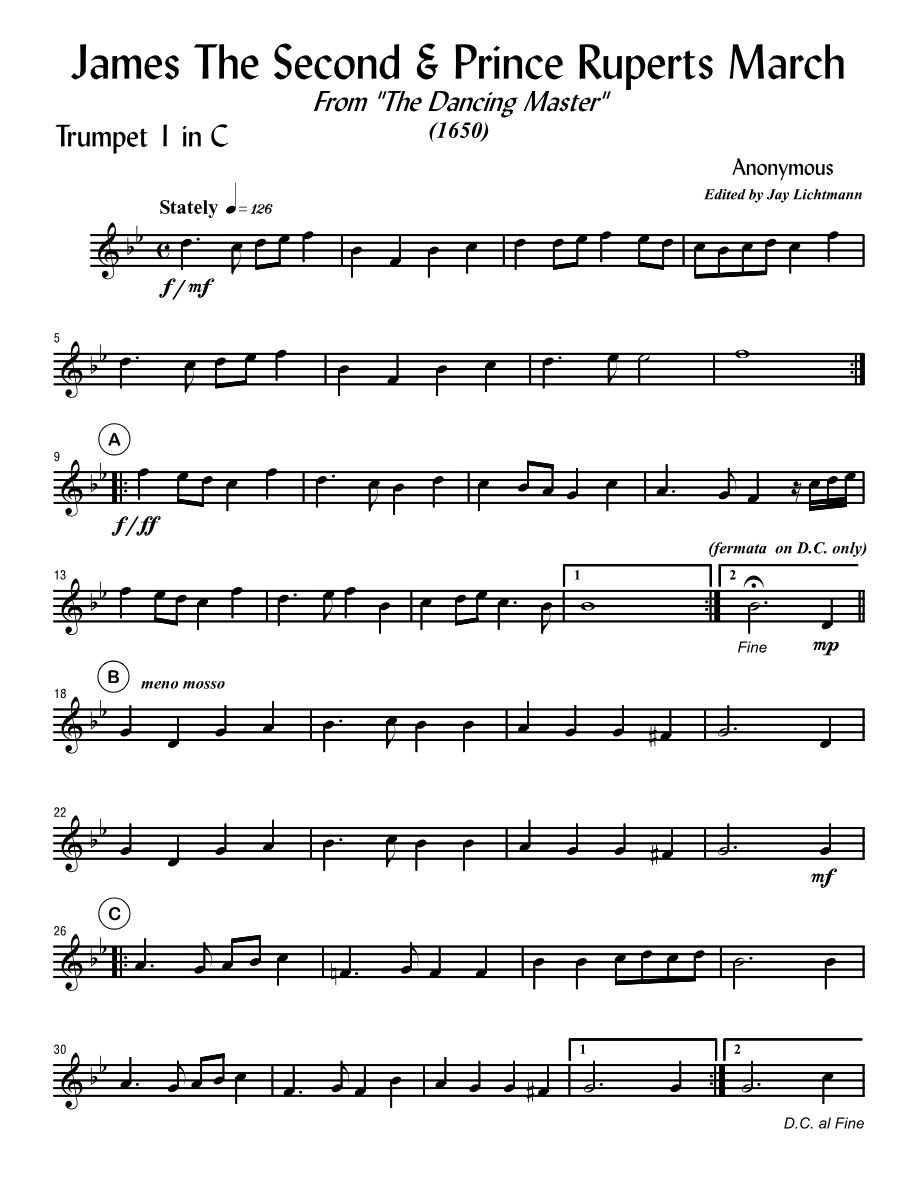
James The Second & Prince Ruperts March (comp. Jeremiah Clarke)
Composed by Jeremiah Clarke
Arranged by Unknown Arranger
- Ensemble: Small Ensemble
- Style: March
- Pages: 5
- Difficulty: easy
- Content: Sheet Music
- Format: PDF Download (Instant)
- Price: $12.99
Jeremiah Clarke's "Prince of Denmark's March," more commonly known as "Trumpet Voluntary," is a quintessential Baroque-era composition, originally penned around 1700. While not a jazz standard in its traditional sense, its enduring popularity and majestic, fanfare-like qualities have made it a frequent subject for reinterpretation across various genres. This particular arrangement, titled "James The Second & Prince Ruperts March," draws inspiration from the original's regal character, transposing its stately grandeur into a captivating small ensemble setting. The original work embodies the ceremonial pomp and intricate counterpoint characteristic of the late Baroque, a period defined by composers like Bach and Handel, and has been famously performed at countless significant events, solidifying its place in the classical canon. This arrangement reimagines Clarke's iconic march with a fresh, dynamic musical character, moving beyond its classical roots. While retaining the original's 4/4 meter, the arrangement subtly introduces a contemporary feel, allowing for a flexible interpretation that can lean towards a crisp, modern brass band style or even a light, swinging groove depending on the ensemble's preference. The key is likely set to C Major or Bb Major, providing a bright, accessible tonal center that enhances the piece's inherent celebratory mood. The energy is consistently uplifting and majestic, evoking a sense of historical pageantry combined with a vibrant, modern flair. It's a piece designed to project confidence and brilliance, suitable for opening a concert or adding a touch of sophisticated fanfare to any program. The "Unknown Arranger" demonstrates a keen understanding of both the original source material and the capabilities of a small ensemble. Their approach is characterized by intelligent part writing that maximizes the impact of each instrument without over-complicating the score. Expect clear melodic statements, often passed between instruments, ensuring each voice contributes meaningfully to the overall texture. While specific jazz techniques like extended harmonies or complex reharmonizations might be subtly integrated, the primary focus appears to be on clarity, rhythmic precision, and melodic integrity. The arrangement likely features well-crafted counter-melodies and interwoven lines that pay homage to the Baroque original's contrapuntal nature while injecting a fresh harmonic perspective. There are no explicit solo sections, emphasizing the ensemble's collective sound, but opportunities for individual voices to shine through melodic prominence are abundant. Performance of "James The Second & Prince Ruperts March" is rewarding due to its blend of historical resonance and contemporary appeal. The primary melody is typically carried by the lead trumpet or a strong brass voice, with other instruments providing harmonic support and rhythmic drive. Technical challenges include maintaining precise articulation, achieving a unified ensemble sound, and navigating the piece's stately yet driving tempo. The arrangement's compact nature (5 pages) suggests a focused, efficient score that gets straight to the musical essence. This piece is particularly well-suited for high school and college ensembles looking to explore classical repertoire through a modern lens, or community bands seeking a sophisticated yet accessible piece that offers both challenge and audience appeal. Its clarity and engaging character make it an excellent choice for developing ensemble cohesion and musical expression. This arrangement of "James The Second & Prince Ruperts March" thrives on precision and unified articulation. The primary technical challenge lies in maintaining a consistent, stately tempo (suggested around quarter note = 108-120) while ensuring crisp, detached articulation, especially in the brass. Emphasize a strong, clear attack without being harsh. The feel should be majestic and celebratory, avoiding a heavy or plodding interpretation. While not explicitly jazz, encourage a slight lift in the rhythmic pulse, particularly in accompanying figures, to prevent it from sounding overly rigid. No special techniques like plunger mutes or falls are required; focus on pure tone and blend. Rehearsal tips include isolating melodic lines to ensure clarity and then bringing in harmonic support, paying close attention to dynamic contrasts which are crucial for shaping the piece's grandeur. Ensure all entrances are confident and synchronized, particularly at phrase beginnings. Q: What instruments or parts are included in this arrangement? A: This is a small ensemble arrangement, typically including parts for Trumpet 1, Trumpet 2, Horn in F, Trombone, and Tuba, providing a complete brass quintet or similar small brass/wind configuration. Q: What is the difficulty level of "James The Second & Prince Ruperts March"? A: This arrangement is rated as medium difficulty, suitable for high school, college, and community ensembles. It presents challenges in articulation, ensemble precision, and maintaining a consistent regal character, but is highly accessible. Q: What musical style and historical context does this arrangement represent? A: It's a modern arrangement of Jeremiah Clarke's Baroque-era march, blending the original's classical majesty with a contemporary small ensemble aesthetic. It retains the original's 4/4 march feel but allows for a flexible, uplifting interpretation. Q: What makes this specific arrangement by "Unknown Arranger" unique? A: The arranger's approach is distinctive for its intelligent part writing, which maximizes the impact of a small ensemble by distributing melodic and harmonic interest effectively, creating a full sound without over-complication while honoring the original's contrapuntal nature. Q: What is the typical performance duration and recommended tempo for this piece? A: The typical performance duration is approximately 2-3 minutes. A recommended tempo is a stately quarter note = 108-120, allowing for a majestic yet flowing feel.
Musicians Also Search For
James The Second & Prince Ruperts March Unknown Arranger PDF • James The Second & Prince Ruperts March Unknown Arranger sheet music • James The Second & Prince Ruperts March arranged by Unknown Arranger • Unknown Arranger small ensemble charts • Unknown Arranger jazz arrangements PDF • James The Second & Prince Ruperts March Jeremiah Clarke sheet music • James The Second & Prince Ruperts March Jeremiah Clarke small ensemble arrangement • Jeremiah Clarke small ensemble charts • James The Second & Prince Ruperts March small ensemble arrangement • James The Second & Prince Ruperts March small ensemble PDF download • James The Second & Prince Ruperts March jazz ensemble sheet music • small ensemble sheet music instant download • James The Second & Prince Ruperts March sheet music with parts • James The Second & Prince Ruperts March March chart • March small ensemble arrangements • buy James The Second & Prince Ruperts March sheet music online • download James The Second & Prince Ruperts March PDF • James The Second & Prince Ruperts March jazz chart • best Unknown Arranger small ensemble arrangements • Jeremiah Clarke songs arranged by Unknown Arranger • James The Second & Prince Ruperts March printable sheet music • small ensemble repertoire PDF