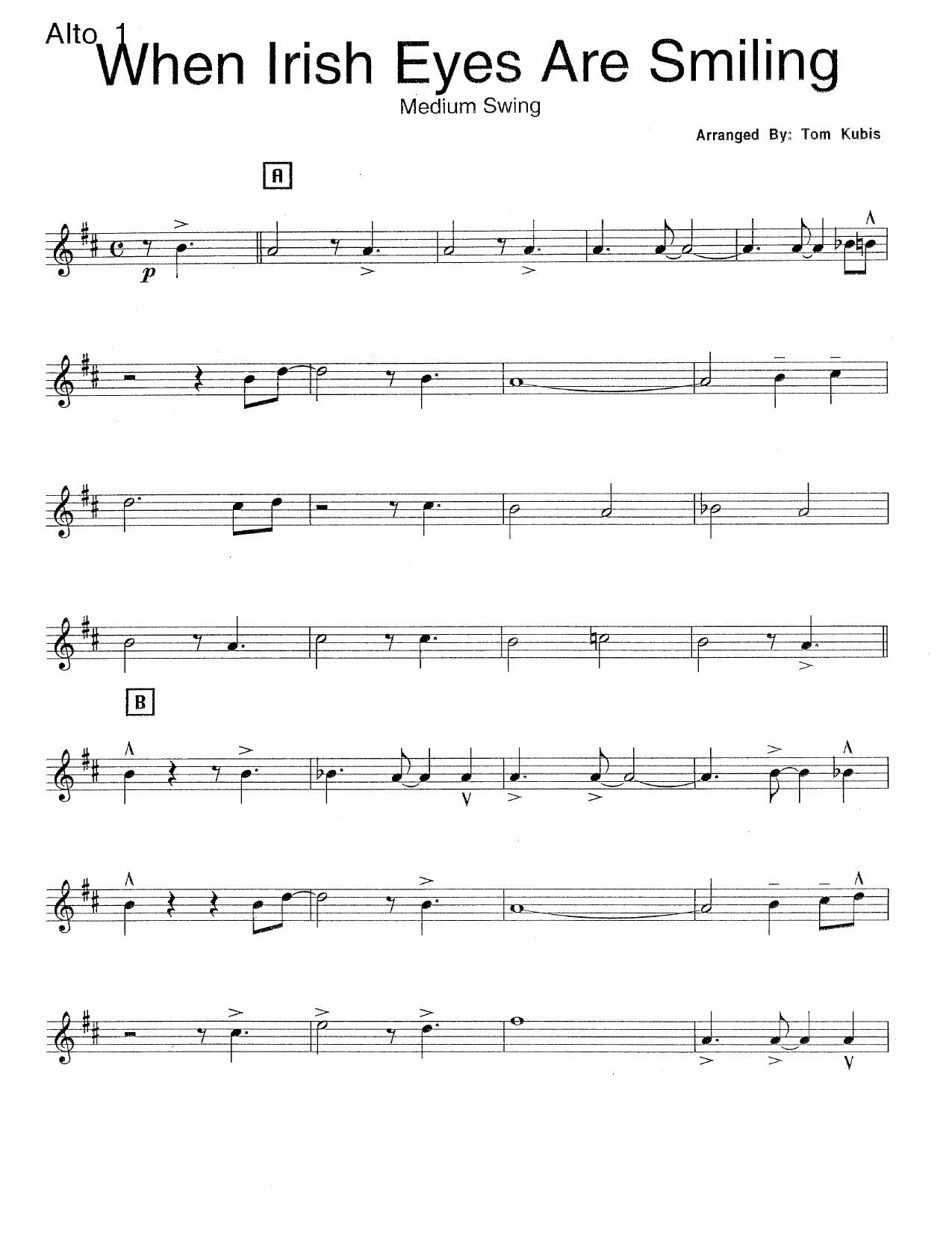
When Irish Eyes Are Smiling (T.Kubis) sheet music preview

When Irish Eyes Are Smiling (T.Kubis)

Composed by Chauncey Olcott

Arranged by Tom Kubis

  • Ensemble: Big Band
  • Pages: 70
  • Instruments (16): Alto 1, Alto 2, Tenor 1, Tenor 2, Bari Sax, Tpt 1, Tpt 2, Tpt 3, Tpt 4, Bone 1, Bone 2, Bone 3, Bone 4, Piano, Bass, Drums
  • Difficulty: advanced
  • Content: Individual Parts
  • Format: PDF Download (Instant)
  • Price: $24.99

Chauncey Olcott and George Graff Jr. originally introduced "When Irish Eyes Are Smiling" to the world in 1912 for the Broadway production *The Isle o' Dreams*, cementing its status as one of the most enduring sentimental melodies of the early 20th century. While born in the tradition of Tin Pan Alley parlor songs, the tune possesses a sweeping, modal-leaning contour that has invited imaginative reinterpretation across genres. Over the decades, it transitioned from a parlor staple into a beloved canvas for jazz arrangers seeking to blend nostalgic warmth with sophisticated harmonic color. Tom Kubis seizes upon this melodic familiarity and transforms it into a vibrant, swinging showcase that radiates optimism and clever wit. Moving away from the traditional, rubato ballad treatment, Kubis reimagines the theme with a pulsing, medium-up swing groove in 4/4 time. The arrangement bursts with high-energy vitality, utilizing rich, contemporary extended dominant harmonies, crisp brass stabs, and lush woodwind textures that evoke a classic West Coast big band sheen. The emotional trajectory shifts seamlessly from bright, buoyant optimism to driving, foot-tapping intensity, offering a masterclass in how to honor a traditional melody while injecting it with modern jazz sophistication. Kubis’s signature arranging style shines through brilliant sectional interplay and tightly knit shout choruses that build inexorably in tension and release. The arrangement features sophisticated sax solis that weave fluidly through complex chord substitutions, contrasted sharply by punchy, articulate brass responses. Throughout the 70-page conductor score and 15-instrument parts, the melody is intelligently shared across the ensemble, giving the lead alto saxophone and lead trumpet prominent voices before opening up into swinging solo sections. Technical demands center on clean articulation, accurate stylistic interpretation of standard swing eighth notes, and a nimble rhythm section capable of driving a buoyant, unhurried tempo with a lightweight touch. Advanced high school, collegiate, and professional big bands will find this chart to be an exceptionally rewarding addition to standard repertoire programs, particularly for spring concerts, festive occasions, or festival settings. The arrangement requires an ensemble with mature section blend, dependable lead players comfortable in the upper registers, and a rhythm section skilled at maintaining an infectious groove without overplaying. The interplay between intricate harmonic counterpoint and universally recognizable thematic material ensures that players remain deeply engaged while audiences connect instantly with the music's infectious, high-spirited charm. Navigating this Tom Kubis chart successfully requires meticulous attention to articulation balance and stylistic consistency from the entire ensemble. The core challenge lies in maintaining a relaxed, buoyant medium-swing feel even during dense harmonic shifts and busy ensemble passages; avoid rushing the tempo, as the groove relies entirely on a deep, forward-moving pocket in the rhythm section. Brass players should focus on clean, precise staccato markings and controlled dynamic swells, utilizing subtle falls and doits only where explicitly marked to preserve the chart's sophisticated color palette. The saxophones must approach their unison and harmony solis with a unified concept of tone and light vibrato, ensuring that the inner voicings do not obscure the primary melodic line. Directors should rehearse the rhythm section first, establishing a rock-solid, conversational interplay between the piano comping and the bass line before layering in the horns. Pay close attention to dynamic contrasts between the lush, quieter melodic statements and the roaring, high-energy shout choruses to maximize the dramatic impact of Kubis’s dynamic architecture. Q: What specific instrumentation and parts are included in this package? A: The arrangement is scored for a standard 15-instrument big band, featuring two alto saxophones, two tenor saxophones, baritone saxophone, standard brass configuration, and a full rhythm section, complete with a comprehensive 70-page conductor score. Q: What is the difficulty level of this Tom Kubis arrangement? A: This chart is graded as advanced, making it ideal for skilled high school, collegiate, and professional big bands that possess strong section cohesion, capable soloists, and experienced lead players. Q: What is the historical background and musical style of this piece? A: Originating as a 1912 Tin Pan Alley parlor song by Chauncey Olcott, this arrangement reimagines the historic melody through a vibrant, contemporary medium-swing jazz lens characteristic of Tom Kubis's signature West Coast style. Q: What makes this specific arrangement unique compared to other versions? A: Kubis elevates a traditional sentimental tune by injecting sophisticated extended harmonies, witty counterpoint, brilliantly crafted sax solis, and an infectious, driving swing groove that avoids cliché. Q: What is the approximate performance duration and tempo feel of the piece? A: The arrangement is set in a lively 4/4 medium-swing feel that typically runs between three and a half to four and a half minutes, depending on the length of the improvised solo choruses.

Questions and answers

What is included in the When Irish Eyes Are Smiling (T.Kubis) PDF?
The verified current file contains a conductor score and individual parts across 70 pages.
How many instruments or parts are listed for When Irish Eyes Are Smiling (T.Kubis)?
The verified instrumentation list contains 16 entries for this Big Band arrangement.
Who is credited for When Irish Eyes Are Smiling (T.Kubis)?
Composer: Chauncey Olcott. Arranger: Tom Kubis.
What difficulty is listed for When Irish Eyes Are Smiling (T.Kubis)?
The verified difficulty level is advanced.
Can I preview When Irish Eyes Are Smiling (T.Kubis) before buying?
Yes. The product page provides a preview generated from the current PDF file.
How is When Irish Eyes Are Smiling (T.Kubis) delivered?
After successful payment, the digital PDF is made available for download. The displayed price is $24.99.

Musicians Also Search For

When Irish Eyes Are Smiling Tom Kubis PDFWhen Irish Eyes Are Smiling Tom Kubis sheet musicWhen Irish Eyes Are Smiling arranged by Tom KubisTom Kubis big band chartsTom Kubis jazz arrangements PDFWhen Irish Eyes Are Smiling Chauncey Olcott sheet musicWhen Irish Eyes Are Smiling Chauncey Olcott big band arrangementsChauncey Olcott big band chartsWhen Irish Eyes Are Smiling big band arrangementsWhen Irish Eyes Are Smiling big band PDF downloadWhen Irish Eyes Are Smiling jazz sheet musicbig band sheet music downloadWhen Irish Eyes Are Smiling conductor score PDFWhen Irish Eyes Are Smiling individual parts downloadWhen Irish Eyes Are Smiling sheet music PDFbuy When Irish Eyes Are Smiling sheet musicdownload When Irish Eyes Are Smiling PDFWhen Irish Eyes Are Smiling jazz chartsbest Tom Kubis big band arrangementsChauncey Olcott arranged by Tom KubisWhen Irish Eyes Are Smiling printable sheet musicbig band repertoire PDF

All arrangements by Tom Kubis All Chauncey Olcott sheet music