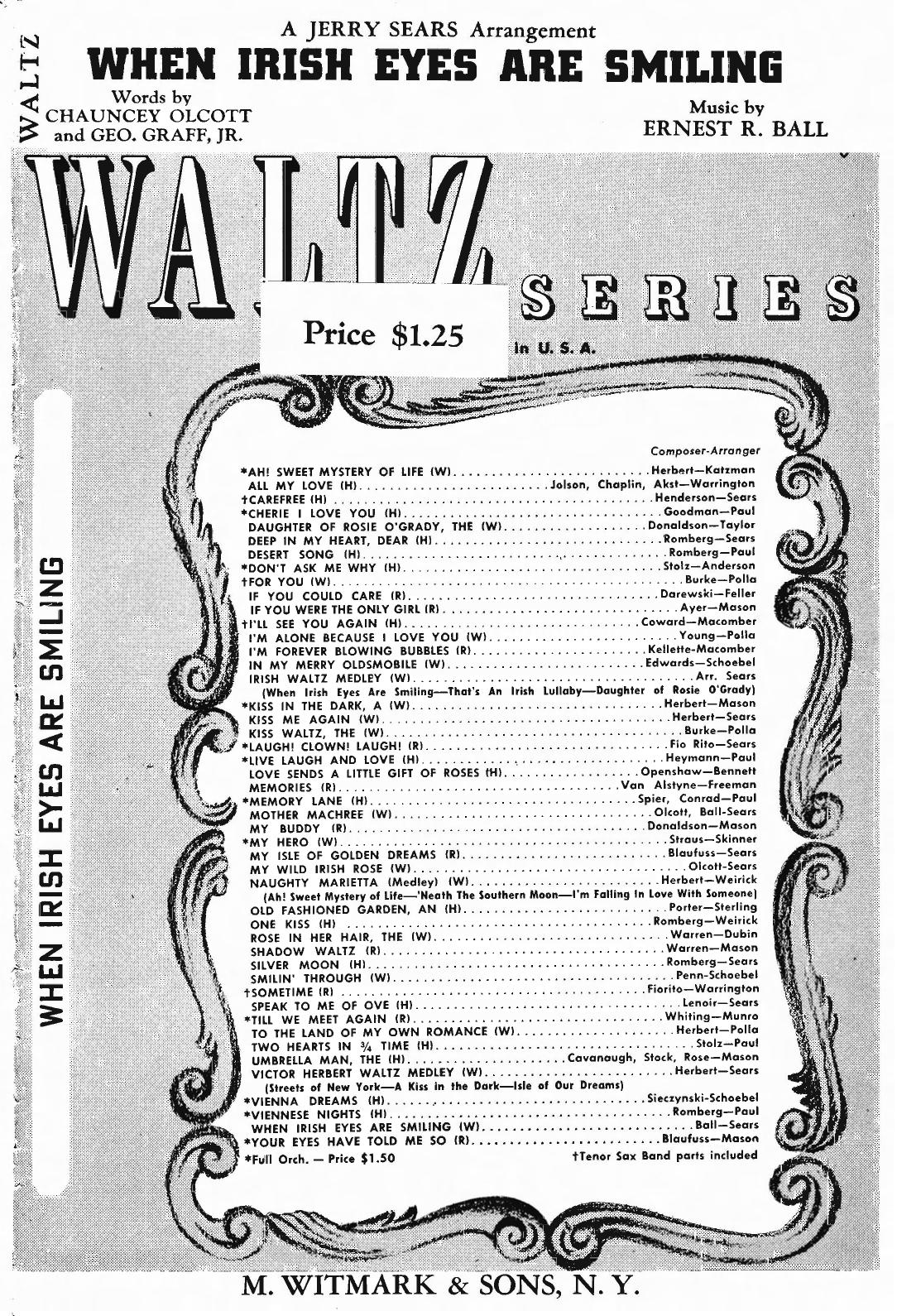
When Irish Eyes Are Smiling (J.Sears) sheet music preview

When Irish Eyes Are Smiling (J.Sears)

Composed by Chauncey Olcott

Arranged by J.Sears

  • Ensemble: Big Band
  • Style: Jazz Standard
  • Pages: 24
  • Instruments (16): 1st Sax. Eb Alto, 2nd Sax. Bb Tenor, 3rd Sax. Eb Alto, 4th Sax. Bb Tenor, 5th Sax. Eb Baritone, 1st Trumpet in Bb, 2nd Trumpet in Bb, 3rd Trumpet in Bb, 1st Trombone, 2nd Trombone, 3rd Trombone, Piano, Guitar, Bass, Drums, Violins
  • Difficulty: medium
  • Content: Individual Parts
  • Format: PDF Download (Instant)
  • Price: $24.99

Chauncey Olcott and Ernest R. Ball originally introduced "When Irish Eyes Are Smiling" to the American public in 1912 through the Broadway production *The Isle o' Dreams*, cementing it as an enduring anthem of Irish-American nostalgia. Over the decades, the tune migrated from parlor songs and theater stages into the broader American Songbook, interpreted by vocalists and instrumentalists alike across the traditional and swing eras. Transforming a turn-of-the-century waltz-adjacent ballad into a compelling jazz standard requires a deft restructuring of meter and harmony, a challenge met head-on in this modern big band interpretation. J.Sears reimagines the familiar melody through a sophisticated jazz lens, shifting the rhythmic foundation from its traditional triple meter into an infectious, buoyant medium-swing groove in 4/4 time. The arrangement opens with a harmonically rich, rubato introduction that teases the iconic motifs before settling into a steady, driving swing tempo. Throughout the chart, Sears employs extended chord extensions—utilizing major sevenths, ninths, and altered dominants—to replace predictable diatonic movements with a lush, contemporary harmonic palette. The mood oscillates between warm, reflective lyricism and high-energy, brass-driven jubilation, offering a masterclass in contrasting dynamics and texture. The structural architecture of the arrangement highlights various sections of the 16-piece big band, ensuring dynamic engagement from top to bottom. Following the intro, the saxophones take up the primary statement of the theme in a tight, harmonized soli that showcases seamless section blend and articulation control. Brass counterlines weave gracefully behind the woodwinds before opening up into a soaring shout chorus that builds intensity through clever modulation and syncopated rhythmic unisons. Featured solo space allows a designated horn player to stretch out over standard changes derived from the tune's AABA form, supported by crisp comping figures from the rhythm section. Advanced high school ensembles with strong section leaders, as well as collegiate and professional community big bands, will find this chart an immensely rewarding addition to their repertoire. While the technical demands require proficient swing phrasing, clean articulation, and confident independent reading across all five saxophone, four trumpet, four trombone, and four rhythm section parts, the pay-off is a guaranteed audience favorite that bridges traditional nostalgia with sophisticated jazz artistry. Conductors should approach this chart with a primary focus on stylistic uniformity, particularly regarding the execution of eighth-note swing phrasing. The tempo should remain a comfortable, driving medium swing; avoid rushing the turnaround figures to maintain the relaxed yet propulsive pocket. The saxophones must prioritize balance and intonation during their primary soli sections, ensuring that internal voicings do not obscure the lead alto. Brass players should utilize controlled, warm tones rather than forced volume during ensemble backgrounds, reserving maximum projection for the climactic shout chorus. Articulation markings—such as accented dits, soft doits, and carefully placed slurs—are critical to capturing the modern-standard flavor of J.Sears' writing. Rhythm section players need to lock in tightly: the drummer should maintain a feather-light ride cymbal pattern with a crisp two-and-four hi-hat chick, while the bassist walks a buoyant, quarter-note line that anchors the sophisticated reharmonizations. Q: What instruments and parts are included in this big band arrangement? A: The chart is scored for a standard 16-instrument big band lineup, consisting of five saxophones (Alto 1, Tenor 2, Alto 3, Tenor 4, Baritone 5), four trumpets, four trombones, and a standard three- or four-piece rhythm section. Q: What is the difficulty level of this arrangement? A: This arrangement is graded as advanced intermediate to advanced, making it ideal for skilled high school, collegiate, and professional community big bands that are comfortable with extended harmonies and swing style. Q: What is the musical style and historical background of this piece? A: Originally composed in 1912 by Ernest R. Ball with lyrics by Chauncey Olcott, this arrangement reimagines the classic tune as a sophisticated jazz standard set in a buoyant medium-swing feel. Q: What makes J.Sears' arrangement unique? A: It uniquely converts a traditional 3/4 parlor melody into an engaging 4/4 swing chart, featuring lush extended harmonies, a tight saxophone soli, and a dynamic shout chorus driven by clever modulations. Q: What is the recommended performance duration and tempo? A: The arrangement is set at a comfortable medium-swing tempo (approximately 120–126 BPM) and runs for an estimated performance duration of around 3.5 to 4 minutes.

Questions and answers

What is included in the When Irish Eyes Are Smiling (J.Sears) PDF?
The verified current file contains individual parts across 24 pages.
How many instruments or parts are listed for When Irish Eyes Are Smiling (J.Sears)?
The verified instrumentation list contains 16 entries for this Big Band arrangement.
Who is credited for When Irish Eyes Are Smiling (J.Sears)?
Composer: Chauncey Olcott. Arranger: J.Sears.
What difficulty is listed for When Irish Eyes Are Smiling (J.Sears)?
The verified difficulty level is medium.
What style is listed for When Irish Eyes Are Smiling (J.Sears)?
The catalog lists the style as Jazz Standard.
Can I preview When Irish Eyes Are Smiling (J.Sears) before buying?
Yes. The product page provides a preview generated from the current PDF file.
How is When Irish Eyes Are Smiling (J.Sears) delivered?
After successful payment, the digital PDF is made available for download. The displayed price is $24.99.

Musicians Also Search For

When Irish Eyes Are Smiling J.Sears PDFWhen Irish Eyes Are Smiling J.Sears sheet musicWhen Irish Eyes Are Smiling arranged by J.SearsJ.Sears big band chartsJ.Sears jazz arrangements PDFWhen Irish Eyes Are Smiling Chauncey Olcott sheet musicWhen Irish Eyes Are Smiling Chauncey Olcott big band arrangementsChauncey Olcott big band chartsWhen Irish Eyes Are Smiling big band arrangementsWhen Irish Eyes Are Smiling big band PDF downloadWhen Irish Eyes Are Smiling jazz sheet musicbig band sheet music downloadWhen Irish Eyes Are Smiling individual parts downloadWhen Irish Eyes Are Smiling sheet music PDFWhen Irish Eyes Are Smiling Jazz Standard chartsJazz Standard big band arrangementsbuy When Irish Eyes Are Smiling sheet musicdownload When Irish Eyes Are Smiling PDFWhen Irish Eyes Are Smiling jazz chartsbest J.Sears big band arrangementsChauncey Olcott arranged by J.SearsWhen Irish Eyes Are Smiling printable sheet musicbig band repertoire PDF

All arrangements by J.Sears All Chauncey Olcott sheet music