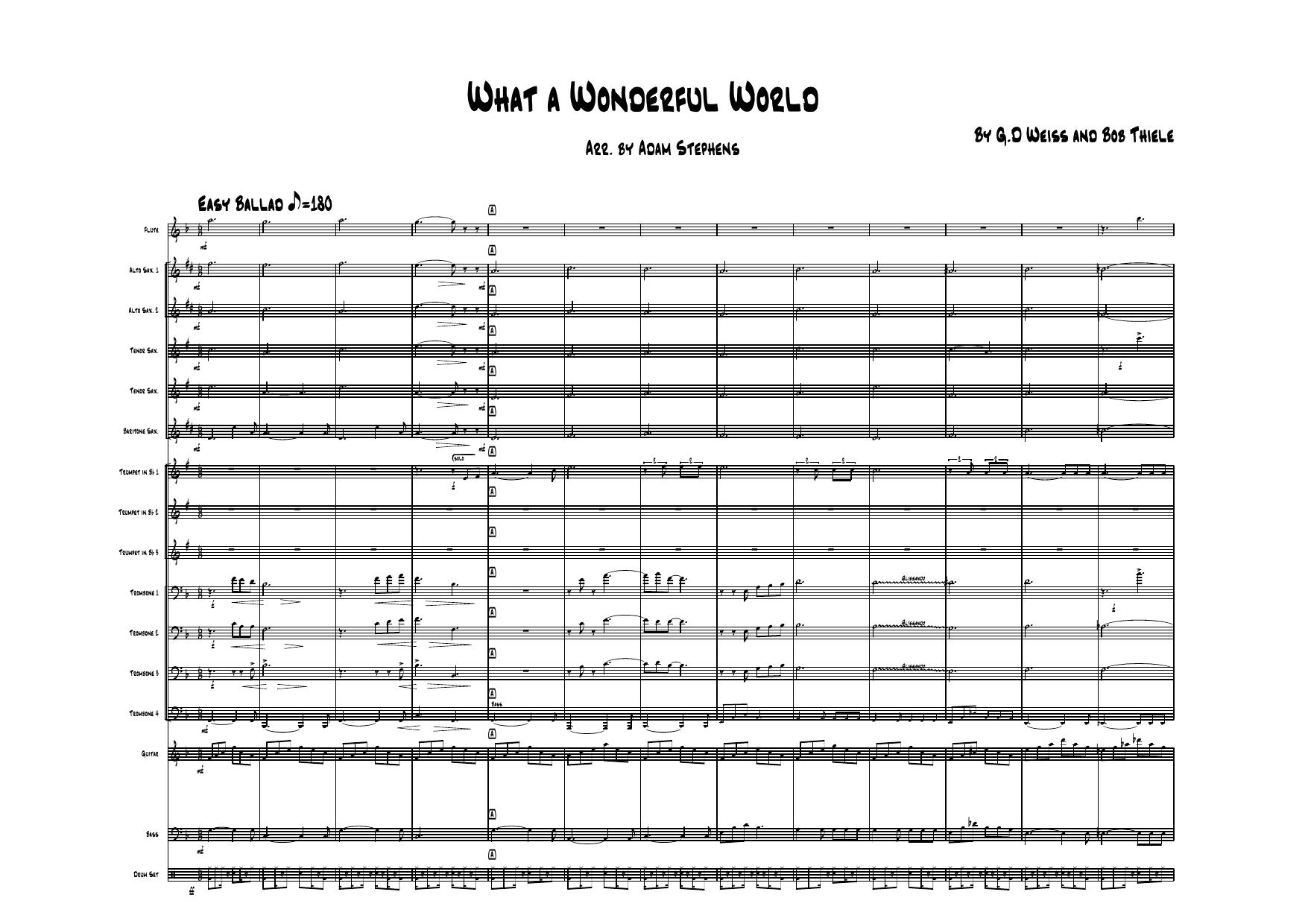
What A Wonderful World (A.Stephens)
Composed by George Douglas
Arranged by A.Stephens
- Ensemble: Big Band
- Style: Jazz Standard
- Pages: 22
- Instruments (16): Flute, Alto Saxophone 1, Alto Saxophone 2, Tenor Saxophone 1, Tenor Saxophone 2, Baritone Saxophone, Trumpet in Bb 1, Trumpet in Bb 2, Trumpet in Bb 3, Trombone 1, Trombone 2, Trombone 3, Trombone 4, Guitar, Bass, Drum Set
- Difficulty: medium
- Content: Individual Parts
- Format: PDF Download (Instant)
- Price: $24.99
Originally written by Bob Thiele (under the pseudonym George Douglas) and George David Weiss, "What A Wonderful World" was first recorded and made legendary by Louis Armstrong in 1967. Conceived as an antidote to the racial and political unrest plaguing the United States during the late 1960s, Armstrong’s iconic gravel-voiced delivery turned the lush pop ballad into an enduring anthem of hope and human connection. Over the decades, the composition has transitioned seamlessly into the core jazz and Great American Songbook repertoire, interpreted by vocalists and instrumentalists across genres. Yet, reimagining a piece so inextricably linked to a singular, definitive vocal performance requires a deft touch, demanding an arrangement that respects the fragile beauty of the original melody while expanding its sonic palette for a full jazz orchestra. Crafted as a warm, reflective ballad with an underlying gentle swing feel in 4/4 time, this arrangement by A.Stephens breathes new life into the familiar melody through rich, contemporary harmonic voicings and a deeply evocative emotional arc. The mood shifts masterfully from intimate, sparse textures in the opening statements to soaring, cinematic climaxes. Stephens employs lush extended chords—utilizing major sevenths, ninths, and subtle chromatic mediant shifts—that elevate the harmonic sophistication without losing the comforting, nostalgic warmth that defines the composition. The emotional impact relies heavily on dynamic contrast, moving the ensemble from hushed, reverent whispers to full-throated, harmonically dense ensemble passages that evoke a profound sense of awe and reflection. The arrangement opens with a delicate atmospheric introduction featuring the flute and rhythm section, establishing a tranquil landscape before handing the primary melody over to the lead alto saxophone. Rather than rushing into full ensemble writing, Stephens builds tension patiently. A gorgeously crafted sax soli serves as the emotional anchor of the chart, showcasing tight, interlocking voicings that demand exceptional blend, intonation, and lyrical phrasing from the reed section. While designed primarily as an instrumental feature that highlights a lead soloist (such as flugelhorn or tenor saxophone), the chart provides ample opportunities for sectional interplay. The technical challenges lie less in high-velocity execution and more in breath control, subtle rubato-esque phrasing within a steady tempo framework, and maintaining a warm, resonant tone across all registers at soft dynamics. Advanced high school ensembles with strong section leaders, as well as collegiate and professional community big bands, will find this chart an immensely rewarding addition to their repertoire. It offers a sophisticated change of pace for concert programs, serving as a powerful emotional centerpiece or a poignant ballad feature. Directors will appreciate how the chart teaches mature ensemble listening, blend, and stylistic restraint, making it an exceptional vehicle for developing lyrical maturity in developing jazz musicians while offering enough harmonic depth to satisfy seasoned professionals. Success with this arrangement depends heavily on establishing an unhurried, flowing tempo and maintaining meticulous control over dynamic balance. The conductor should encourage the rhythm section to keep the underlying pulse warm and transparent, avoiding heavy ride cymbal pounding; a brushed snare or light triplet-oriented stick pattern works best to maintain momentum without sacrificing the ballad feel. Technically, the primary challenge for the brass and reed sections is sustaining a rich, centered tone at ultra-soft dynamics, particularly during the exposed chordal pads in the opening and closing choruses. Ensure that intonation is checked meticulously on the extended upper-structure chords. When executing the sax soli, players must focus on uniform vibrato and seamless articulation, treating the multi-part writing as a single, unified voice. No specialized modern effects like plunger mutes or extreme extended techniques are required, allowing the ensemble to focus entirely on tone quality, balance, and expressive, vocal-style phrasing. Q: What instrumentation and parts are included in this big band arrangement? A: The arrangement is scored for a standard 15-instrument big band instrumentation, featuring Flute, Alto Saxophone 1, Alto Saxophone 2, Tenor Saxophone, Baritone Saxophone, plus a full brass and rhythm section, and includes a comprehensive conductor score and 22 total pages of parts. Q: What is the difficulty level of this chart? A: This arrangement is graded as medium-advanced, making it ideal for advanced high school, collegiate, and professional community big bands looking to showcase lyrical depth and ensemble blend. Q: What is the musical style and historical context of this piece? A: It is a jazz ballad adaptation of the 1967 classic composed by George Douglas and George David Weiss, famously popularized by Louis Armstrong as an optimistic anthem during a turbulent era. Q: What makes A.Stephens' arrangement unique? A: Stephens elevates the familiar melody through sophisticated extended harmonies, lush chordal voicings, a tightly crafted saxophone soli, and a dynamic formal design that builds from intimate textures to rich, cinematic climaxes. Q: What is the recommended performance tempo and duration? A: The chart is performed as a relaxed, flowing ballad with a gentle underlying swing feel, typically running around 4 to 5 minutes depending on the chosen rubato elements and solo extensions.
Questions and answers
- What is included in the What A Wonderful World (A.Stephens) PDF?
- The verified current file contains a conductor score and individual parts across 22 pages.
- How many instruments or parts are listed for What A Wonderful World (A.Stephens)?
- The verified instrumentation list contains 16 entries for this Big Band arrangement.
- Who is credited for What A Wonderful World (A.Stephens)?
- Composer: George Douglas. Arranger: A.Stephens.
- What difficulty is listed for What A Wonderful World (A.Stephens)?
- The verified difficulty level is medium.
- What style is listed for What A Wonderful World (A.Stephens)?
- The catalog lists the style as Jazz Standard.
- Can I preview What A Wonderful World (A.Stephens) before buying?
- Yes. The product page provides a preview generated from the current PDF file.
- How is What A Wonderful World (A.Stephens) delivered?
- After successful payment, the digital PDF is made available for download. The displayed price is $24.99.
Musicians Also Search For
What A Wonderful World A.Stephens PDF • What A Wonderful World A.Stephens sheet music • What A Wonderful World arranged by A.Stephens • A.Stephens big band charts • A.Stephens jazz arrangements PDF • What A Wonderful World George Douglas sheet music • What A Wonderful World George Douglas big band arrangements • George Douglas big band charts • What A Wonderful World big band arrangements • What A Wonderful World big band PDF download • What A Wonderful World jazz sheet music • big band sheet music download • What A Wonderful World conductor score PDF • What A Wonderful World individual parts download • What A Wonderful World sheet music PDF • What A Wonderful World Jazz Standard charts • Jazz Standard big band arrangements • buy What A Wonderful World sheet music • download What A Wonderful World PDF • What A Wonderful World jazz charts • best A.Stephens big band arrangements • George Douglas arranged by A.Stephens • What A Wonderful World printable sheet music • big band repertoire PDF