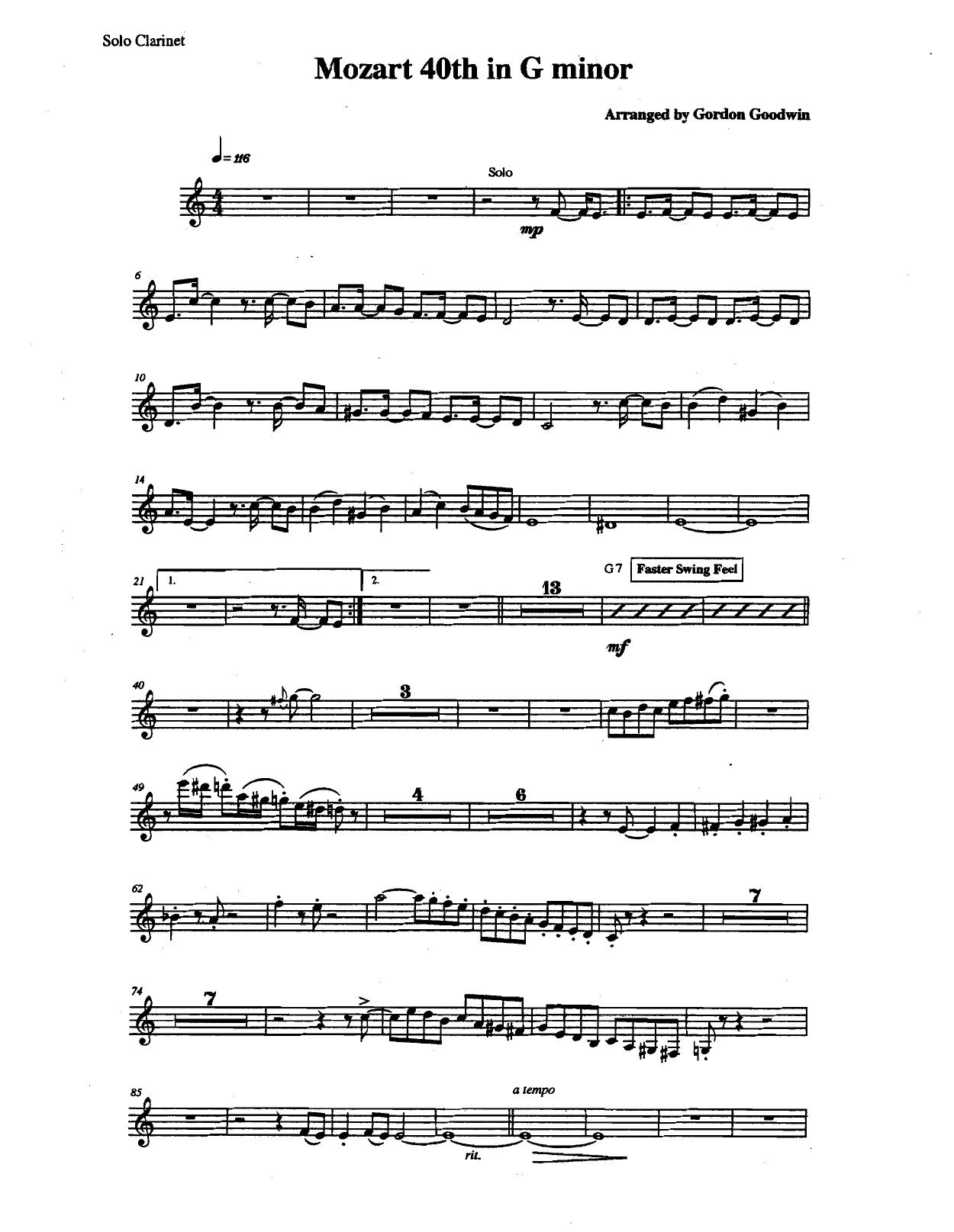
Mozart 40th in G Minor (G.Goodwin) sheet music preview

Mozart 40th in G Minor (G.Goodwin)

Composed by Wolfgang Amadeus Mozart

Arranged by Gordon Goodwin

  • Ensemble: Big Band
  • Pages: 152
  • Instruments (14): Solo Clarinet, Flute, Soprano Saxophone, Alto Saxophone, Tenor Saxophone, Baritone Saxophone, Trumpet, Flugelhorn, Trombone, Guitar, Piano, Acoustic Bass, Drums, Percussion
  • Difficulty: advanced
  • Content: Individual Parts
  • Format: PDF Download (Instant)
  • Price: $24.99

Wolfgang Amadeus Mozart originally penned his iconic Symphony No. 40 in G Minor, K. 550, in the summer of 1788 during an astonishingly prolific period in Vienna, establishing it as one of the crown jewels of the Classical era. Known for its brooding turbulence, chromatic urgency, and unmistakable opening motif, this masterpiece has transcended its orchestral origins to become a canvas for various interpretations across genres. Master arranger and composer Gordon Goodwin takes this timeless classical monument and reimagines it through the lens of a contemporary big band, injecting the taut, dramatic architecture of the 18th century with the fiery pulse, sophisticated harmonic extensions, and infectious drive of modern jazz. Blending classical counterpoint with a high-octane swing feel, this chart opens with the unmistakable angst of Mozart’s original theme before quickly transforming into a dynamic, driving groove. The tempo maintains an energetic clip, propelled by a crisp, modern rhythm section pulse that allows the intricate lines to breathe while retaining a relentless forward momentum. Goodwin weaves lush, contemporary extended voicings through the saxophone and brass sections, shifting the mood from dark, dramatic intensity to brilliant, cinematic euphoria. The arrangement avoids gimmickry, instead treating Mozart's rigorous voice-leading with deep structural respect while fully exploiting the tonal color palette of a modern 19-piece big band. Woodwinds play a pivotal role in this 152-page tour de force, with doubled parts in the flute, clarinet, and soprano saxophone adding a brilliant, orchestral sheen to the traditional big band brass and sax setup. Goodwin constructs intricate woodwind solis and high-flying brass counter-lines that demand immaculate articulation and blend. The melody is tossed dynamically between the low reeds and the full ensemble, leading into explosive shout choruses that bridge the gap between classical developmental sections and jazz climaxes. Featured solo space allows advanced improvisers to stretch out over sophisticated harmonic changes that pay homage to the underlying minor-key modal framework, while rhythm section parts require a steady, virtuosic command of both straight-eighth and swinging feels. Advanced collegiate, professional, and elite community big bands will find this ambitious chart a thrilling centerpiece for concert programming. Because of its dense orchestration, intricate ensemble integration, and demanding technical requirements across all 19 chairs—including auxiliary woodwinds—it rewards meticulous sectional rehearsing. Conductors looking to challenge their musicians with a brilliant synthesis of classical mastery and big band wizardry will discover that Goodwin’s setting of Mozart’s G Minor Symphony offers a profound, unforgettable musical statement that consistently leaves audiences spellbound. Unlocking the brilliance of Gordon Goodwin’s treatment of Mozart requires a meticulous approach to articulation, balance, and stylistic dualism. The rhythm section acts as the engine, and the drummer must maintain a driving, crisp swing feel that never overpowers the delicate, classical-derived counterpoint passing through the horns. Pianist and bassists should carefully voice the extended harmonies to reflect a contemporary jazz sensibility without clouding the transparent voice-leading inherent in Mozart's original score. Technically, the woodwind doublings (flute, clarinet, soprano saxophone) demand players with strong intonation and agile fingers, as they frequently double or carry rapid, scalar passages traditionally assigned to classical violins. Brass players must exercise restraint during lyrical statements to preserve a refined chamber-music clarity, while reserving full power for the sweeping crescendoes and explosive shout choruses. Rehearsals should begin slowly, isolating the complex rhythmic unisons between the rhythm section and horns to ensure absolute tightness before introducing the final tempo and stylistic nuances. Q: What instruments and parts are included in this arrangement? A: This 152-page publication is scored for a 19-instrument big band, including standard a 5-sax section with extensive woodwind doublings (flute, clarinet, soprano saxophone, alto saxophone, tenor saxophone, baritone saxophone), 4 trumpets, 4 trombones, a full rhythm section (piano, guitar, bass, drums), and a comprehensive conductor score. Q: What is the difficulty level of this arrangement? A: This piece is rated as advanced, best suited for elite collegiate, professional, and top-tier community big bands that possess strong section-playing capabilities, advanced improvisers, and woodwind doublers. Q: How does this arrangement blend classical music with jazz? A: Gordon Goodwin retains the structural integrity, thematic motifs, and dark minor-key mood of Mozart's original 1788 classical masterpiece while recontextualizing the harmony with contemporary jazz voicings, driving swing feels, and dynamic shout choruses. Q: What makes this specific arrangement unique compared to other classical-to-jazz adaptations? A: Unlike superficial adaptations, Goodwin deeply integrates symphonic counterpoint with modern big band orchestration, heavily utilizing auxiliary woodwinds like clarinet and flute to replicate string-like agility and brilliance within a jazz framework. Q: What is the performance duration and tempo feel of the chart? A: While performance time varies based on chosen tempos and open solo sections, the arrangement generally runs between 5 to 7 minutes and is anchored by an energetic, driving tempo that balances brisk swing feels with intricate, fast-moving ensemble passages.

Questions and answers

What is included in the Mozart 40th in G Minor (G.Goodwin) PDF?
The verified current file contains a conductor score and individual parts across 152 pages.
How many instruments or parts are listed for Mozart 40th in G Minor (G.Goodwin)?
The verified instrumentation list contains 14 entries for this Big Band arrangement.
Who is credited for Mozart 40th in G Minor (G.Goodwin)?
Composer: Wolfgang Amadeus Mozart. Arranger: Gordon Goodwin.
What difficulty is listed for Mozart 40th in G Minor (G.Goodwin)?
The verified difficulty level is advanced.
Can I preview Mozart 40th in G Minor (G.Goodwin) before buying?
Yes. The product page provides a preview generated from the current PDF file.
How is Mozart 40th in G Minor (G.Goodwin) delivered?
After successful payment, the digital PDF is made available for download. The displayed price is $24.99.

Musicians Also Search For

Mozart 40th in G Minor Gordon Goodwin PDFMozart 40th in G Minor Gordon Goodwin sheet musicMozart 40th in G Minor arranged by Gordon GoodwinGordon Goodwin big band chartsGordon Goodwin jazz arrangements PDFMozart 40th in G Minor Wolfgang Amadeus Mozart sheet musicMozart 40th in G Minor Wolfgang Amadeus Mozart big band arrangementsWolfgang Amadeus Mozart big band chartsMozart 40th in G Minor big band arrangementsMozart 40th in G Minor big band PDF downloadMozart 40th in G Minor jazz sheet musicbig band sheet music downloadMozart 40th in G Minor conductor score PDFMozart 40th in G Minor individual parts downloadMozart 40th in G Minor sheet music PDFbuy Mozart 40th in G Minor sheet musicdownload Mozart 40th in G Minor PDFMozart 40th in G Minor jazz chartsbest Gordon Goodwin big band arrangementsWolfgang Amadeus Mozart arranged by Gordon GoodwinMozart 40th in G Minor printable sheet musicbig band repertoire PDF

All arrangements by Gordon Goodwin All Wolfgang Amadeus Mozart sheet music