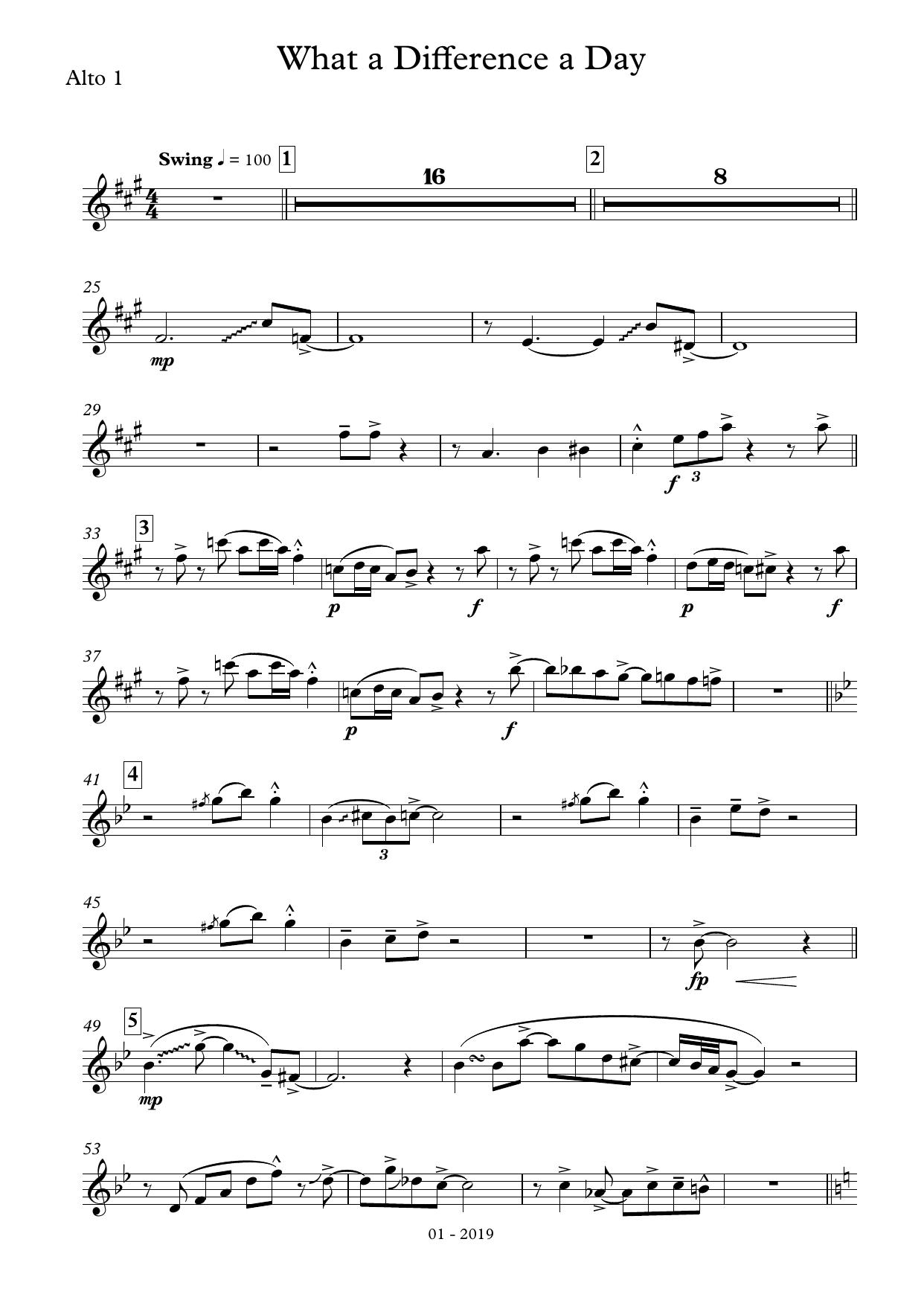
What A Difference A Day Made_ Sax group
Composed by María Grever
Arranged by Th. Waleffe
- Ensemble: Big Band
- Style: Jazz Standard
- Pages: 10
- Instruments (5): Alto Saxophone 1, Alto Saxophone 2, Tenor Saxophone 1, Tenor Saxophone 2, Baritone Saxophone
- Difficulty: easy
- Content: Individual Parts
- Format: PDF Download (Instant)
- Price: $24.99
Originally penned in 1934 by the prolific Mexican composer María Grever under the title "Cuando vuelva a tu lado," the timeless melody achieved global iconic status in 1959 when Dinah Washington delivered her definitive, Grammy Award-winning rhythm-and-blues-infused vocal rendition. This masterwork seamlessly bridges the worlds of Latin-American songwriting and the Great American Songbook, cementing its place as an enduring jazz standard. Over the decades, luminaries from Coleman Hawkins to Jamie Cullum have reharmonized and reinterpreted its sweeping, romantic contours, proving its remarkable adaptability across stylistic spectrums. Brimming with a sophisticated blend of lush romanticism and vibrant groove, Th. Waleffe’s adaptation reimagines Grever’s classic through a refined, contemporary lens tailored specifically for a full saxophone quintet. The arrangement maintains a buoyant medium-swing and occasional Latin-inflected pulse that highlights the inherent warmth and agility of the sax family. The harmonic language employs rich extended voicings—utilizing major ninths, altered dominants, and smooth chromatic voice-leading—that evoke an intimate, late-night club atmosphere while sustaining an uplifting, engaging energy throughout. Th. Waleffe approaches the ensemble texture with an acute ear for color separation and dynamic interplay. Rather than treating the five voices as a rigid, homophonic block, the arrangement distributes melodic fragments and counter-lines democratically across the spectrum. Alto Saxophone 1 carries the primary lyrical statements with soaring phrasing, while the inner voices—Alto 2 and Tenor 1—interweave rich counter-melodies and tight harmonized interludes. Tenor Saxophone 2 often anchors the groove alongside the Baritone Saxophone, which provides a robust, foundational bassline and occasional percussive slap-tongue or walking figures that propel the rhythm forward in the absence of a traditional rhythm section. Advanced high school, collegiate, and professional sax ensembles will find this chart exceptionally rewarding. The technical demands require precise intonation, nimble fingerwork across rapid scalar passages, and a unified approach to articulation—particularly in balancing swing eighth-note feels with crisp, articulated bebop lines. Performers must navigate subtle dynamic shifts and rubato-esque phrasing moments that demand mature musical communication within the section. Offering a rich, self-contained textural experience without requiring piano or bass support, this 10-page masterwork stands out as a sophisticated showcase for saxophone chamber groups looking to explore standard jazz repertoire with elegance and depth. Success with this saxophone quintet arrangement hinges on immaculate blend, balance, and a unified concept of time. Because the ensemble lacks a rhythm section, the pulse must be internalized collectively; Tenor 2 and Baritone Saxophone must lock in their foundational lines to establish a rock-solid groove, especially during passages that transition from Latin feels to swinging four-four. Technically, players should watch out for shifting accidentals within the altered chord structures, requiring slow sectional intonation rehearsals to lock in the rich extended harmonies. Alto 1 must project the lead lines effortlessly without forcing the tone, while inner voices (Alto 2, Tenor 1) must dynamically back off during soloistic or exposed counter-melody moments. Pay close attention to articulation markings: short notes must be dry and clipped, while lyrical lines require a warm, connected airflow reminiscent of a vocalist. Balance the chordal density carefully so the lowest and highest voices frame the harmony without obscuring the moving middle voices. Q: What instruments and parts are included in this sheet music package? A: The arrangement is scored for a 5-part saxophone ensemble consisting of Alto Saxophone 1, Alto Saxophone 2, Tenor Saxophone 1, Tenor Saxophone 2, and Baritone Saxophone, spanning a total of 10 pages. Q: What is the difficulty level of this arrangement? A: This piece is best suited for advanced high school, collegiate, and professional saxophone quartets or quintets due to its intricate extended harmonies, required blend, and demand for precise swing articulation without a rhythm section. Q: What is the musical style and historical background of the piece? A: It is a jazz standard based on María Grever’s 1934 composition "Cuando vuelva a tu lado," famously popularized by Dinah Washington in 1959, styled here with a sophisticated blend of medium swing and Latin grooves. Q: What makes Th. Waleffe’s arrangement unique? A: It features democratic voice distribution, rich extended chord voicings, and independent counter-lines that allow a self-contained saxophone choir to replicate the fullness of a larger jazz ensemble without rhythm accompaniment. Q: What is the performance tempo and duration of the piece? A: The arrangement is set at a comfortable, flowing medium tempo (approx. 116–124 BPM) with a performance duration of approximately 3 to 4 minutes, making it ideal for recitals or festival programs.
Questions and answers
- What is included in the What A Difference A Day Made_ Sax group PDF?
- The verified current file contains individual parts across 10 pages.
- How many instruments or parts are listed for What A Difference A Day Made_ Sax group?
- The verified instrumentation list contains 5 entries for this Big Band arrangement.
- Who is credited for What A Difference A Day Made_ Sax group?
- Composer: María Grever. Arranger: Th. Waleffe.
- What difficulty is listed for What A Difference A Day Made_ Sax group?
- The verified difficulty level is easy.
- What style is listed for What A Difference A Day Made_ Sax group?
- The catalog lists the style as Jazz Standard.
- Can I preview What A Difference A Day Made_ Sax group before buying?
- Yes. The product page provides a preview generated from the current PDF file.
- How is What A Difference A Day Made_ Sax group delivered?
- After successful payment, the digital PDF is made available for download. The displayed price is $24.99.
Musicians Also Search For
What A Difference A Day Made_ Sax group Th. Waleffe PDF • What A Difference A Day Made_ Sax group Th. Waleffe sheet music • What A Difference A Day Made_ Sax group arranged by Th. Waleffe • Th. Waleffe big band charts • Th. Waleffe jazz arrangements PDF • What A Difference A Day Made_ Sax group María Grever sheet music • What A Difference A Day Made_ Sax group María Grever big band arrangements • María Grever big band charts • What A Difference A Day Made_ Sax group big band arrangements • What A Difference A Day Made_ Sax group big band PDF download • What A Difference A Day Made_ Sax group jazz sheet music • big band sheet music download • What A Difference A Day Made_ Sax group individual parts download • What A Difference A Day Made_ Sax group sheet music PDF • What A Difference A Day Made_ Sax group Jazz Standard charts • Jazz Standard big band arrangements • buy What A Difference A Day Made_ Sax group sheet music • download What A Difference A Day Made_ Sax group PDF • What A Difference A Day Made_ Sax group jazz charts • best Th. Waleffe big band arrangements • María Grever arranged by Th. Waleffe • What A Difference A Day Made_ Sax group printable sheet music • big band repertoire PDF