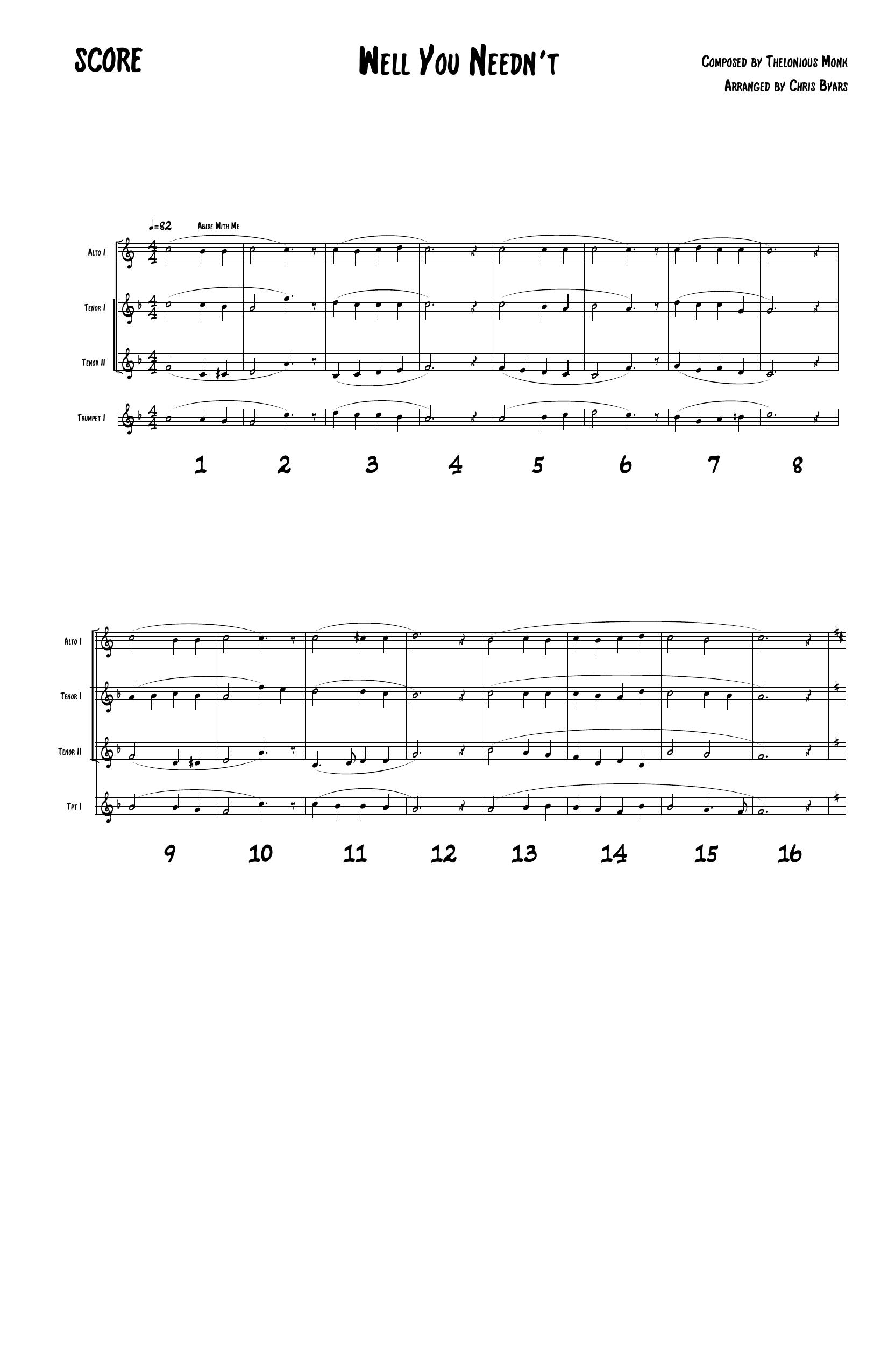
Well You Needn't (C.Byarrs) sheet music preview

Well You Needn't (C.Byarrs)

Composed by Thelonious Monk

Arranged by Thelonious Monk (arr.C.Byars)

  • Ensemble: Big Band
  • Pages: 13
  • Instruments (18): Alto Saxophone I, Alto Saxophone II, Tenor Saxophone I, Tenor Saxophone II, Baritone Saxophone, Trumpet I, Trumpet II, Trumpet III, Trumpet IV, Trumpet V, Trombone I, Trombone II, Trombone III, Trombone IV, Guitar, Piano, Bass, Drums
  • Difficulty: easy
  • Content: Individual Parts
  • Format: PDF Download (Instant)
  • Price: $24.99

Thelonious Monk’s iconic composition "Well You Needn't," first recorded in 1944 for Blue Note Records and popularized across the jazz canon by Miles Davis, Art Blakey, and countless modernists, stands as a cornerstone of bebop architecture. Built upon a distinctive descending chromatic pattern and Monk's idiosyncratic harmonic inversions, the tune challenges conventional tonal gravity. This masterful big band adaptation by C. Byars channels Monk's quirky, angular sensibility into a full-ensemble palette, transforming a classic small-group vehicle into a sprawling, dynamic showcase for modern jazz orchestra. Propelled by an insistent, driving medium-up swing feel in 4/4 time, the arrangement crackles with quirky syncopation, unexpected harmonic pivots, and vibrant tonal colors. The mood shifts effortlessly between playful, teasing motifs and high-octane ensemble power. Byars exploits the full 18-piece big band instrumentation to mirror Monk’s harmonic ambiguity, utilizing dense cluster voicings in the brass and spiky, interlocking counter-lines in the saxophones. The signature root-movement and characteristic intervals are preserved, yet re-imagined through rich sectional solis and a blistering shout chorus that recontextualizes the original melody for a larger ensemble. The melody is initially introduced through tightly knit saxophone and trumpet pairings before the full ensemble erupts into roaring counterpoint. Solo opportunities are carved out for key chair players, allowing space for improvisers to stretch over standard rhythm changes or Monk's unique bridge structures. Technically demanding due to its rapid tempo shifts, tricky chromatic intervals, and the precision required to execute Monk's jagged phrasing, this chart rewards the ensemble with an infectious groove and deep historical resonance. Rhythmic accuracy in the rhythm section—particularly a crisp, unyielding ride cymbal pulse and comping that mirrors Monk's sparse, percussive piano style—is essential to unlocking the chart's authentic voice. Advanced college ensembles, elite high school jazz bands, and professional repertory orchestras will find this chart an exhilarating addition to their repertoire. It demands advanced sight-reading, excellent internal pulse, and a mature grasp of post-swing articulation. Directors looking to challenge their horn sections while delivering a sophisticated, historically grounded performance will discover that Byars's treatment captures the adventurous spirit of Monk while offering a fresh, contemporary big band architecture. Unlocking the authentic drive of "Well You Needn't (C.Byars)" begins with establishing a relentless, forward-moving medium-up swing tempo. The rhythm section serves as the primary engine; the drummer should avoid heavy downbeat crushing, opting instead for a feather bass drum technique and crisp ride cymbal definition, while the pianist must embrace Monk’s penchant for dissonant clusters and strategic silence. Technically, the primary challenge lies in the execution of the angular chromatic lines shared across the sax and brass sections. Musicians must articulate eighth-note passages with clean, pointed tongue placements to prevent the fast-moving lines from smearing. Pay close attention to dynamic contrast: when the ensemble drops to a whisper behind the soloists, the background figures must remain transparent and weightless. In the shout chorus, brass players should utilize clean, precise plunger mutes or controlled cup mutes where indicated, ensuring that doits and falls sound stylistic rather than sloppy. Rehearsals should initially focus on sectional isolation of the complex bridge modulation before integrating the rhythm section's harmonic scaffolding. Q: What instruments and parts are included in this arrangement? A: Scoring is designed for a standard 18-instrument big band, featuring Alto Saxophone I, Alto Saxophone II, Tenor Saxophone I, Tenor Saxophone II, Baritone Saxophone, four trumpets, four trombones, piano, guitar, bass, drums, and a comprehensive conductor score spanning 13 pages. Q: What is the difficulty level of this arrangement? A: This arrangement is rated as advanced, making it best suited for collegiate jazz ensembles, advanced high school bands, and professional big bands that possess strong technical facility and familiarity with bebop idioms. Q: What is the historical style and musical context of the piece? A: Rooted in the foundational bebop era established by composer Thelonious Monk in 1944, this arrangement honors the traditional small-group jazz standard while translating its quirky harmonic language into a modern, large-ensemble setting. Q: What makes this specific arrangement by C. Byars unique? A: Byars successfully captures Monk’s idiosyncratic, angular phrasing and chromatic voice-leading within an 18-piece orchestrational framework, utilizing dense sectional voicings and clever counterpoint that feel both deeply respectful of the original recording and refreshingly contemporary. Q: What is the expected performance duration and tempo feel? A: The arrangement is set to a driving medium-up swing feel (approx. quarter note = 208–220 BPM) and typically runs between 5 to 6 minutes depending on the length of improvised solo choruses.

Questions and answers

What is included in the Well You Needn't (C.Byarrs) PDF?
The verified current file contains a conductor score across 13 pages.
How many instruments or parts are listed for Well You Needn't (C.Byarrs)?
The verified instrumentation list contains 18 entries for this Big Band arrangement.
Who is credited for Well You Needn't (C.Byarrs)?
Composer: Thelonious Monk. Arranger: Thelonious Monk (arr.C.Byars).
What difficulty is listed for Well You Needn't (C.Byarrs)?
The verified difficulty level is easy.
Can I preview Well You Needn't (C.Byarrs) before buying?
Yes. The product page provides a preview generated from the current PDF file.
How is Well You Needn't (C.Byarrs) delivered?
After successful payment, the digital PDF is made available for download. The displayed price is $24.99.

Musicians Also Search For

Well You Needn't Thelonious Monk (arr.C.Byars) PDFWell You Needn't Thelonious Monk (arr.C.Byars) sheet musicWell You Needn't arranged by Thelonious Monk (arr.C.Byars)Thelonious Monk (arr.C.Byars) big band chartsThelonious Monk (arr.C.Byars) jazz arrangements PDFWell You Needn't Thelonious Monk sheet musicWell You Needn't Thelonious Monk big band arrangementsThelonious Monk big band chartsWell You Needn't big band arrangementsWell You Needn't big band PDF downloadWell You Needn't jazz sheet musicbig band sheet music downloadWell You Needn't conductor score PDFWell You Needn't sheet music PDFbuy Well You Needn't sheet musicdownload Well You Needn't PDFWell You Needn't jazz chartsbest Thelonious Monk (arr.C.Byars) big band arrangementsThelonious Monk arranged by Thelonious Monk (arr.C.Byars)Well You Needn't printable sheet musicbig band repertoire PDF

All arrangements by Thelonious Monk (arr.C.Byars) All Thelonious Monk sheet music