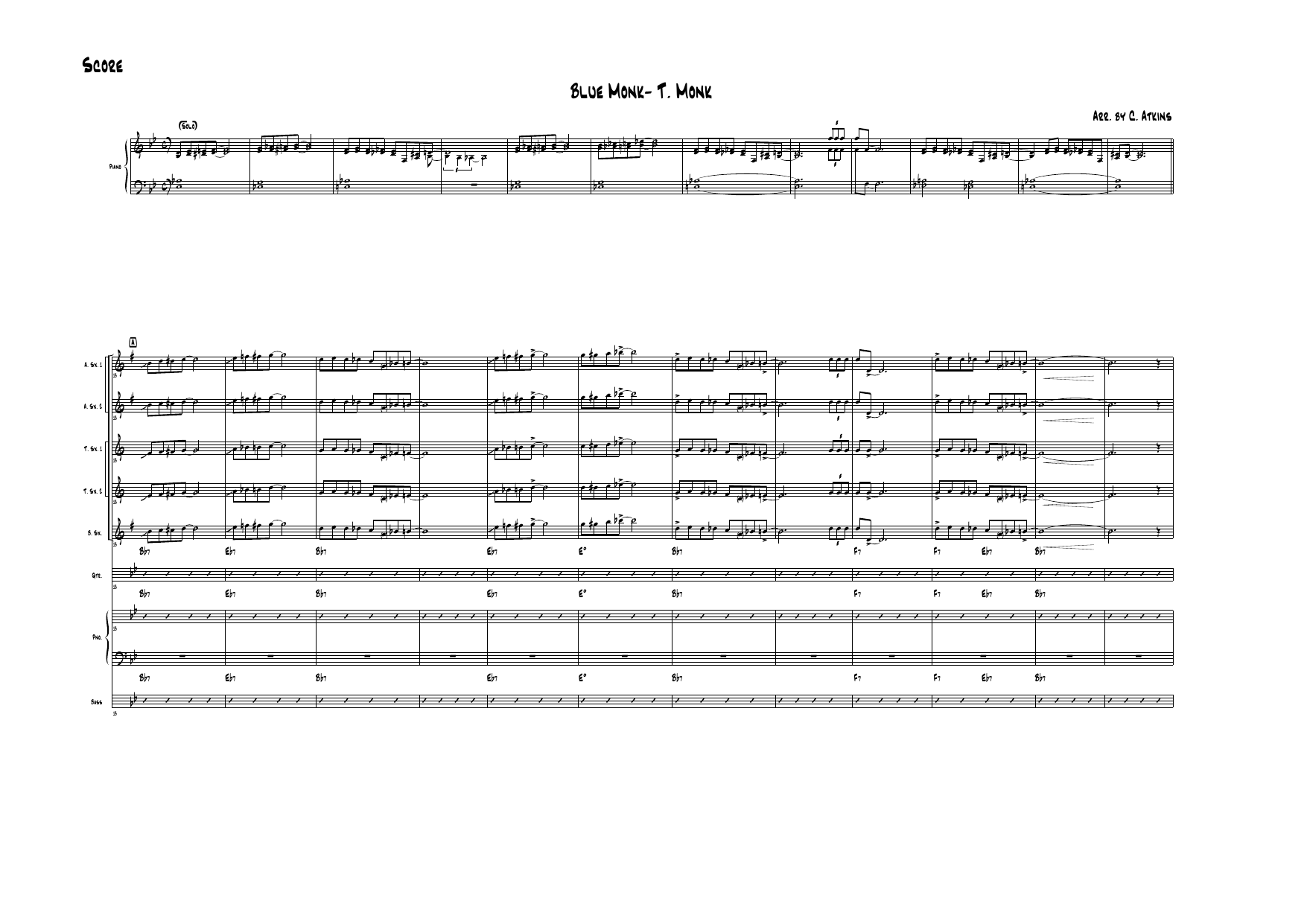
Blue Monk (C.Atkins)
Composed by Thelonious Monk
Arranged by C.Atkins
- Ensemble: Big Band
- Pages: 49
- Instruments (17): Alto Saxophone 1, Alto Saxophone 2, Tenor Saxophone 1, Tenor Saxophone 2, Baritone Saxophone, Trumpet in Bb 1, Trumpet in Bb 2, Trumpet in Bb 3, Trumpet in Bb 4, Trombone 1, Trombone 2, Trombone 3, Trombone 4, Guitar, Piano, Bass, Drum Set
- Difficulty: medium
- Content: Individual Parts
- Format: PDF Download (Instant)
- Price: $24.99
The unmistakable, descending chromatic motif of "Blue Monk"—composed by the High Priest of Bebop himself, Thelonious Monk—stands as one of the most idiosyncratic and enduring blues structures in the jazz canon. First recorded by Monk for Prestige Records in 1954, this 12-bar masterwork bridges the gap between classic barrelhouse blues and the angular, harmonically sophisticated architecture of modern jazz. Unlike standard major blues forms, Monk’s composition relies on deceptive simplicity, utilizing stark intervals, asymmetrical phrasing, and pregnant pauses that force both soloist and ensemble to rethink every conventional resolution. It represents a pillar of mid-century modern jazz composition, celebrated for its stubborn melodic logic and irresistible, laid-back swagger. Within this expansive 17-instrument big band setting, C.Atkins captures the playful yet enigmatic spirit of the original while translating Monk's jagged piano-centric voicings into a lush, dynamic orchestral palette. The arrangement operates at a relaxed, medium-swing tempo (around 116 BPM), driven by a spacious rhythm section foundation that encourages a deep, behind-the-beat pocket. The mood shifts effortlessly from sultry, intimate ensemble whispers to roaring, brass-heavy counterpunches that highlight the blues' inherent grit. Atkins avoids predictable predictability by scattering Monk-esque harmonic clusters across the saxophones, utilizing wide intervals and minor-second rubs that pay direct homage to the composer's idiosyncratic piano touch. Textural variety anchors the chart's structural design, with the melody initially introduced by a tight, conversational saxophone soli before the full brass section enters with characteristic Monk-like angularity. A standout shout chorus builds tension through cunning use of rhythmic displacement and cascading dynamic swells, challenging the ensemble to maintain absolute precision during sudden syncopated stops. Solo opportunities are provided over standard blues changes, allowing featured performers to stretch out within a traditional swinging context. The interplay between the rhythm section and the horn tiers demands attentive listening, particularly regarding the execution of subtle ghost notes, plunger effects, and delayed resolutions that define the chart's authentic jazz articulation. Advanced high school, collegiate, and professional jazz ensembles will find this 49-page tour de force exceptionally rewarding, as it tests an orchestra's internal cohesion, stylistic flexibility, and command of space. While the individual technical demands on range and fingering remain moderate, the true test lies in capturing the elusive, tongue-in-cheek phrasing that defines Monk’s musical universe. The included conductor score provides clear guidance for balancing the dense harmonic voicings, ensuring that the transparent textures never feel cluttered and that the inherent swing feel remains unhurried and profoundly grounded. Achieving success with this arrangement requires prioritizing space, articulation, and stylistic unity over sheer volume. The tempo must remain a steady, unhurried medium swing at approximately 116 BPM; rushing the groove destroys the lazy, confident swagger inherent to Monk's compositional style. Conductors should pay meticulous attention to the dynamic contrast between the whispered background figures and the forceful shout choruses, ensuring that the rhythm section—particularly the piano and bass—maintains an economic, sparse approach modeled after Monk's own accompaniment style. Horn players must execute short notes with a crisp, dry articulation and treat longer notes with subtle, delayed vibrato. Encourage the section leaders to emphasize the eccentric harmonic rubs in the saxophone voicings, leaning into the minor seconds rather than shying away from them. Rehearsals should initially isolate the rhythm section to lock in the 12-bar blues groove before layering the horn tiers, ensuring everyone understands where the dramatic pauses and syncopated hits land. Q: What instruments and parts are included in this publication? A: This 49-page publication includes a full conductor score and complete parts for a standard 17-instrument big band lineup, featuring Alto Saxophone 1, Alto Saxophone 2, Tenor Saxophone 1, Tenor Saxophone 2, Baritone Saxophone, 4 Trumpets, 4 Trombones, Piano, Guitar, Bass, and Drums. Q: What is the difficulty level of this arrangement? A: This chart is best suited for advanced high school, collegiate, and professional jazz ensembles due to its heavy reliance on subtle stylistic interpretation, stylistic maturity, and precise ensemble cohesion rather than extreme technical speed. Q: What is the historical context and style of the piece? A: Based on Thelonious Monk’s iconic 1954 blues composition, this arrangement honors the bebop and hard-bop eras, framing the classic 12-bar blues form within a classic medium-swing big band aesthetic. Q: What makes this specific C.Atkins arrangement unique? A: Atkins brilliantly translates Monk’s angular, piano-driven dissonances and asymmetric phrasing into full big band voicings, incorporating clever harmonic clusters, conversational sax solis, and dynamic shout choruses that capture Monk's eccentric spirit. Q: What is the performance duration and recommended tempo for this chart? A: The arrangement runs approximately 4 to 5 minutes depending on the length of improvised solos, and should be performed at a relaxed, steady medium-swing tempo of around 116 BPM.
Questions and answers
- What is included in the Blue Monk (C.Atkins) PDF?
- The verified current file contains a conductor score and individual parts across 49 pages.
- How many instruments or parts are listed for Blue Monk (C.Atkins)?
- The verified instrumentation list contains 17 entries for this Big Band arrangement.
- Who is credited for Blue Monk (C.Atkins)?
- Composer: Thelonious Monk. Arranger: C.Atkins.
- What difficulty is listed for Blue Monk (C.Atkins)?
- The verified difficulty level is medium.
- Can I preview Blue Monk (C.Atkins) before buying?
- Yes. The product page provides a preview generated from the current PDF file.
- How is Blue Monk (C.Atkins) delivered?
- After successful payment, the digital PDF is made available for download. The displayed price is $24.99.
Musicians Also Search For
Blue Monk C.Atkins PDF • Blue Monk C.Atkins sheet music • Blue Monk arranged by C.Atkins • C.Atkins big band charts • C.Atkins jazz arrangements PDF • Blue Monk Thelonious Monk sheet music • Blue Monk Thelonious Monk big band arrangements • Thelonious Monk big band charts • Blue Monk big band arrangements • Blue Monk big band PDF download • Blue Monk jazz sheet music • big band sheet music download • Blue Monk conductor score PDF • Blue Monk individual parts download • Blue Monk sheet music PDF • buy Blue Monk sheet music • download Blue Monk PDF • Blue Monk jazz charts • best C.Atkins big band arrangements • Thelonious Monk arranged by C.Atkins • Blue Monk printable sheet music • big band repertoire PDF