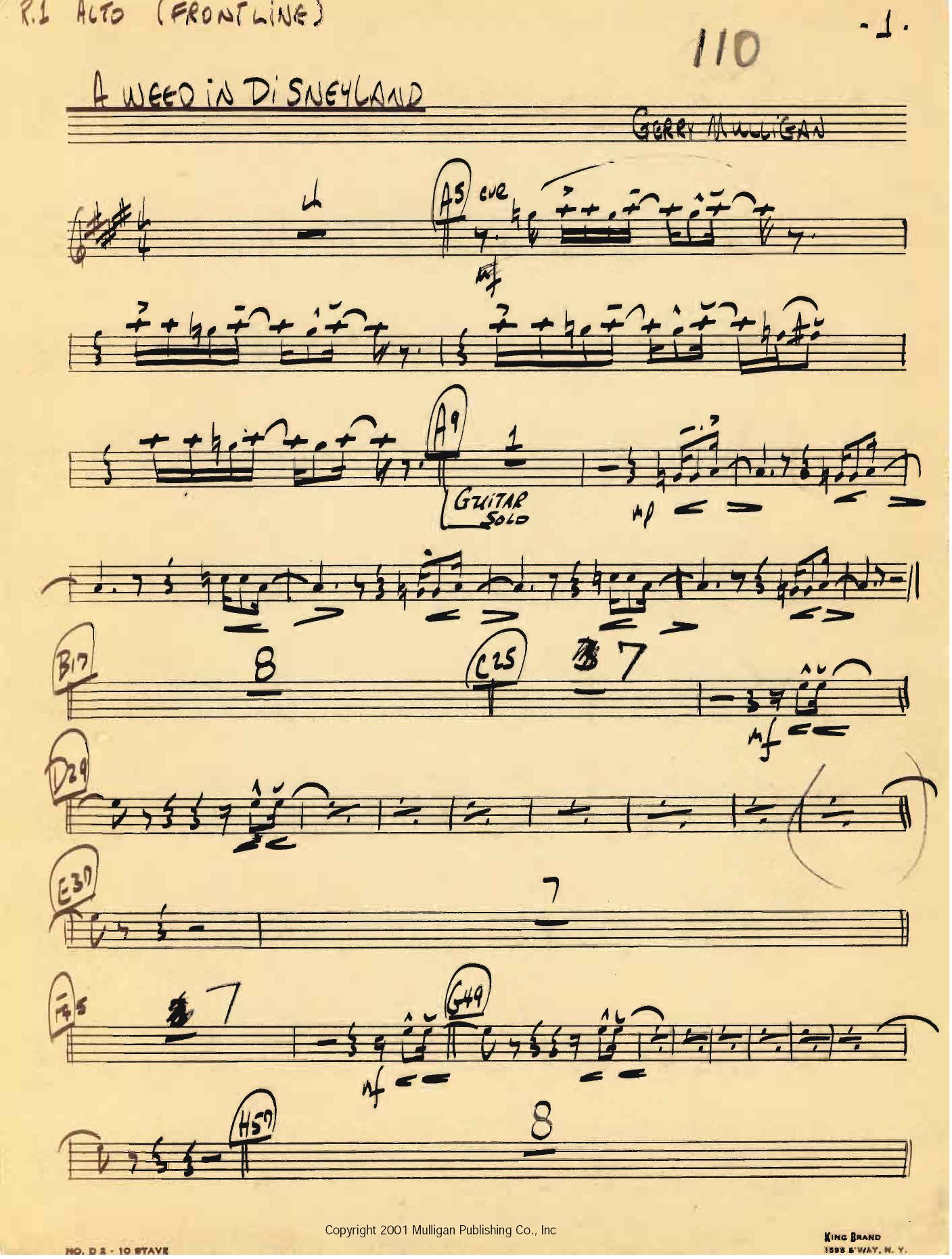
Weed In Disneyland (G.Mulligan)
Composed by Gerry Mulligan
Arranged by Gerry Mulligan
- Ensemble: Big Band
- Pages: 49
- Instruments (17): Alto Saxophone 1, Alto Saxophone 2, Soprano Saxophone, Tenor Saxophone, Baritone Saxophone, Trumpet 1, Trumpet 2, Trumpet 3, Trombone 1, Trombone 2, Trombone 3, Horn, Tuba, Piano, Bass, Drums, Percussion
- Difficulty: medium
- Content: Individual Parts
- Format: PDF Download (Instant)
- Price: $24.99
Gerry Mulligan’s distinctive compositional voice, forged during the West Coast cool jazz movement of the 1950s, reaches a fascinating maturity in "Weed In Disneyland." Originally conceived by the baritone saxophone titan known for his innovative pianoless quartet configurations, this composition showcases Mulligan’s penchant for sophisticated counterpoint, witty thematic development, and rich, linear-driven harmony. While Mulligan is most celebrated for smaller ensembles, his ventures into writing for larger aggregations retain the intimate conversational interplay of his small groups while expanding the sonic palette through clever brass and reed pairing. This particular chart captures the playful yet intellectually rigorous spirit of post-bop West Coast jazz, blending harmonic sophistication with an infectious, laid-back swing groove. Driven by a bright, bouncing medium-up swing feel in 4/4 time, "Weed In Disneyland" radiates a clever, urbane energy characterized by sharp rhythmic hits and buoyant melodic contours. The piece opens with an instantly engaging thematic hook that bounces between the registers, evoking the sleek modernism and breezy optimism of mid-century California culture. Mulligan’s harmonic language here avoids heavy-handed brass bombast in favor of transparent, interlocking textures where voices move independently. The mood shifts effortlessly from jaunty humor to driving intensity, driven by a crisp rhythmic foundation that demands absolute precision from the rhythm section to maintain the signature Mulligan lightness without losing momentum. Mulligan’s approach as both composer and arranger relies heavily on non-traditional voicing and the unique textural weight of a modified horn section. Written for an 8-instrument ensemble comprising Alto Saxophone, Tenor Saxophone, Baritone Saxophone, Trumpet, Trombone, and a robust rhythm section backing, the arrangement achieves a remarkably full, orchestral sound despite its compact footprint. The baritone saxophone frequently anchors or counterpoints the melody, utilizing Mulligan's characteristic warmth and agility in the upper register. Soli sections are tightly knit, demanding a unified articulation style that mimics the interplay of a much larger section, while the harmonic extensions—utilizing sharp major-seventh colors, altered dominants, and clever chromatic passing tones—give the chart its signature sophisticated bite. Advanced high school, collegiate, and professional jazz ensembles will find this 49-page arrangement an exceptional vehicle for developing sectional transparency, stylistic versatility, and advanced phrasing. Because the instrumentation is streamlined to 8 instruments, individual players cannot hide behind a massed section; every part requires independent confidence and chamber-jazz sensitivity. The technical demands center on crisp articulation, nimble fingerwork across changing accidentals, and the ability to swing hard at a brisk tempo. Performing this piece rewards the ensemble with a masterclass in linear jazz writing, offering audiences a refreshing alternative to standard big band bombast by highlighting clarity, wit, and supreme compositional craft. Conductors approaching "Weed In Disneyland" must prioritize horizontal linear motion over vertical block-chord blasting. The primary technical challenge lies in maintaining a clean, weightless swing feel at a brisk tempo without rushing the quarter-note pulse. The rhythm section is the engine: the drummer should employ a feather-light ride cymbal pattern with crisp hi-hat chicks on beats two and four, avoiding heavy backbeats that would muddy Mulligan’s transparent counterpoint. Horn players should focus on short, articulate phrasing with careful attention to dynamic shading, ensuring that inner-voice countermelodies weave clearly through the texture. Pay close attention to the specific articulation markings—staccatos must be clipped yet warm, and accented notes should carry a vocal quality. Rehearsals should begin under tempo, isolating the intricate horn solis section by section to lock in intonation and unified phrasing before pushing toward the performance tempo. Q: What specific instruments and parts are included in this 49-page arrangement? A: This arrangement is scored for an 8-instrument ensemble consisting of Alto Saxophone, Tenor Saxophone, Baritone Saxophone, Trumpet, Trombone, and a complete rhythm section (Piano, Bass, and Drums), totaling 49 pages of comprehensive score and individual parts. Q: What is the difficulty level of this Gerry Mulligan chart? A: This piece is best suited for advanced high school, collegiate, and professional jazz ensembles due to its exposed 8-instrument scoring, which requires individual part independence, advanced reading skills, and chamber-jazz precision. Q: What style and historical era does "Weed In Disneyland" represent? A: The piece represents the sophisticated West Coast cool jazz and post-bop eras of the 1950s and 1960s, capturing Gerry Mulligan’s signature witty thematic development, linear counterpoint, and swinging harmonic language. Q: What makes this particular arrangement unique compared to standard big band charts? A: Unlike traditional massive horn-section charts, Mulligan utilizes a streamlined 8-instrument format that highlights transparent textures, intricate countermelodies, and the prominent, agile voice of the baritone saxophone leading the ensemble. Q: What is the recommended tempo and performance duration for this piece? A: The arrangement is performed at a bright, bouncing medium-up swing tempo (approximately quarter note = 208-220), with a total duration of roughly 4 to 5 minutes depending on solo extensions.
Questions and answers
- What is included in the Weed In Disneyland (G.Mulligan) PDF?
- The verified current file contains individual parts across 49 pages.
- How many instruments or parts are listed for Weed In Disneyland (G.Mulligan)?
- The verified instrumentation list contains 17 entries for this Big Band arrangement.
- Who is credited for Weed In Disneyland (G.Mulligan)?
- Composer: Gerry Mulligan. Arranger: Gerry Mulligan.
- What difficulty is listed for Weed In Disneyland (G.Mulligan)?
- The verified difficulty level is medium.
- Can I preview Weed In Disneyland (G.Mulligan) before buying?
- Yes. The product page provides a preview generated from the current PDF file.
- How is Weed In Disneyland (G.Mulligan) delivered?
- After successful payment, the digital PDF is made available for download. The displayed price is $24.99.
Musicians Also Search For
Weed In Disneyland Gerry Mulligan PDF • Weed In Disneyland Gerry Mulligan sheet music • Weed In Disneyland arranged by Gerry Mulligan • Gerry Mulligan big band charts • Gerry Mulligan jazz arrangements PDF • Weed In Disneyland Gerry Mulligan big band arrangements • Weed In Disneyland big band arrangements • Weed In Disneyland big band PDF download • Weed In Disneyland jazz sheet music • big band sheet music download • Weed In Disneyland individual parts download • Weed In Disneyland sheet music PDF • buy Weed In Disneyland sheet music • download Weed In Disneyland PDF • Weed In Disneyland jazz charts • best Gerry Mulligan big band arrangements • Weed In Disneyland printable sheet music • big band repertoire PDF