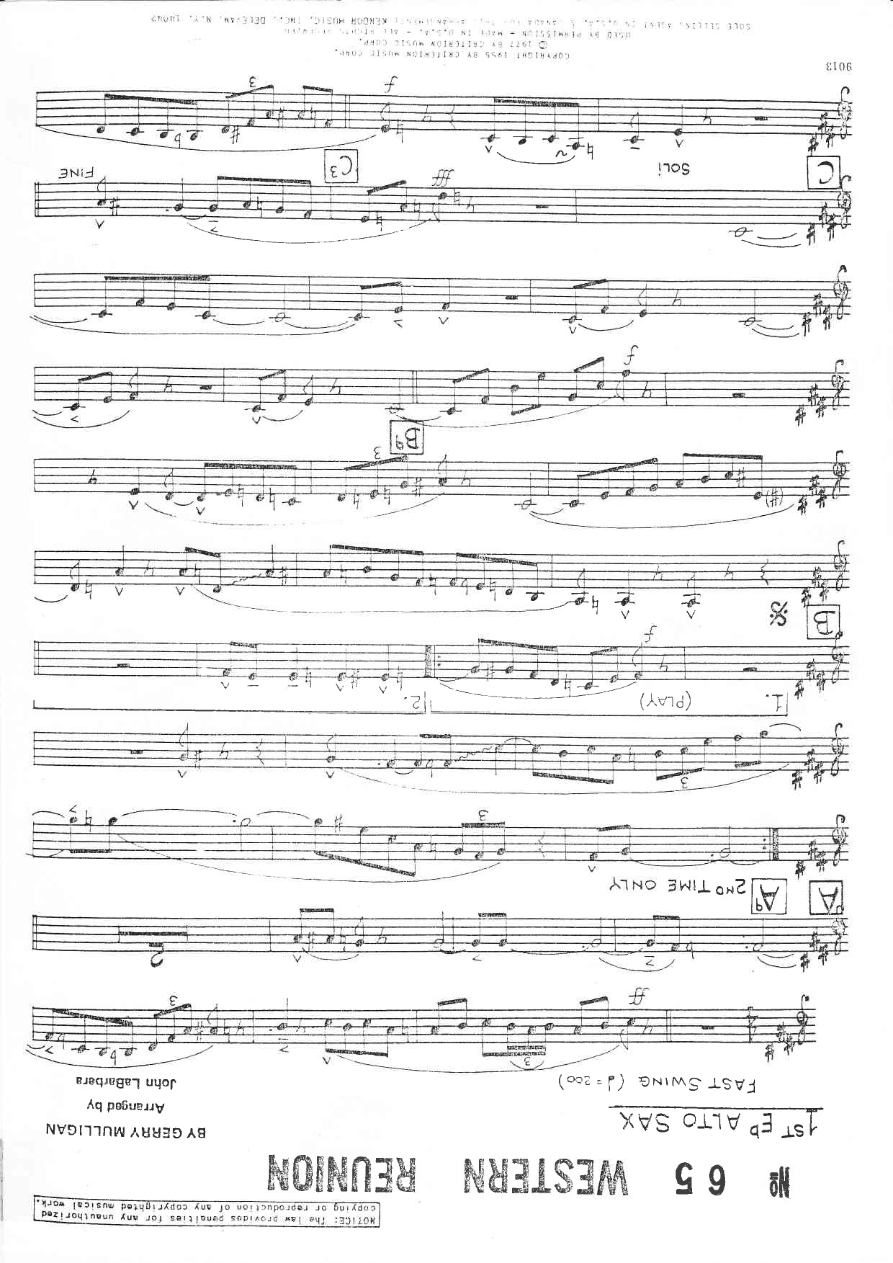
Western Reunion (J.Labarbera) sheet music preview

Western Reunion (J.Labarbera)

Composed by John LaBarbera

Arranged by Gerry Mulligan

  • Ensemble: Big Band
  • Pages: 47
  • Instruments (17): 1st Eb Alto Saxophone, 2nd Eb Alto Saxophone, 1st Bb Tenor Saxophone, 2nd Bb Tenor Saxophone, Eb Baritone Saxophone, 1st Bb Trumpet, 2nd Bb Trumpet, 3rd Bb Trumpet, 4th Bb Trumpet, 1st Trombone, 2nd Trombone, 3rd Trombone, 4th Trombone, Piano, Guitar, Bass, Drums
  • Difficulty: medium
  • Content: Individual Parts
  • Format: PDF Download (Instant)
  • Price: $24.99

John LaBarbera’s composition "Western Reunion" stands as a brilliant testament to the vitality of modern big band writing, capturing the expansive, driving spirit of the contemporary jazz idiom. Originally brought to prominence through dynamic performances and recordings that showcased the finest elements of post-bop and West Coast sensibilities, LaBarbera’s writing bridges intricate harmonic structures with an infectious, rhythmic momentum. This particular iteration benefits from the legendary interpretive genius of baritone saxophone icon Gerry Mulligan, whose arranging hand brings a distinct architectural clarity and sophisticated cool-jazz elegance to the chart. Mulligan, celebrated for his peerless economy of voice and innovative counterpoint in large ensemble settings, strips away extraneous clutter to let the muscular, driving lines of LaBarbera’s original composition breathe with remarkable transparency. At its core, "Western Reunion" thrives on a propulsive medium-up swing groove that immediately establishes a sense of forward motion and cinematic scope. The harmonic landscape is rich with extended chord extensions, subtle chromatic shifts, and modal colorings that evoke wide-open spaces contrasted with the gritty urbanity of a modern jazz club. The mood shifts effortlessly from sophisticated, cool introspection during the horn solis to explosive, high-octane energy during the ensemble tuttis. Mulligan utilizes the saxophone section as the primary vehicle for exposition, capitalizing on the unique blend of alto, tenor, and baritone voices to weave dense, linear countermelodies. The brass section functions both as a rhythmic punctuator and a soaring foil to the reeds, creating a dynamic dialogue that keeps both performers and listeners completely engaged from the downbeat. Executing this 47-page masterwork requires precision, stylistic unity, and a mature command of ensemble balance. The arrangement features designated solo space for key chairs—typically spotlighting the tenor saxophone and trumpet—allowing soloists to stretch out over harmonically sophisticated changes that demand a strong vocabulary in modern jazz language. The technical challenges lie primarily in the nimble execution of fast-moving scalar passages, articulated syncopations across section boundaries, and maintaining an effortless, floating swing feel at a demanding tempo. The culmination of the chart features a brilliantly constructed shout chorus that gradually builds in intensity, utilizing Mulligan’s signature layered voicings to achieve maximum dynamic impact without sacrificing clarity. Advanced collegiate ensembles, professional big bands, and top-tier community jazz orchestras will find "Western Reunion" to be an exceptionally rewarding addition to their repertoire. The chart serves as an ideal vehicle for showcasing a band's section work, dynamic control, and rhythmic sophistication. Conductor and ensemble alike will appreciate how Mulligan’s meticulous scoring highlights individual instrumental colors while welding the 8-instrument configuration into a cohesive, powerhouse unit capable of filling any concert hall with rich, sophisticated jazz tradition. Achieving success with Gerry Mulligan’s arrangement of "Western Reunion" demands meticulous attention to rhythmic precision and articulation. The underlying swing feel must remain driving yet relaxed, avoiding any tendency to rush the medium-up tempo. Conductors should emphasize a lightweight, horizontal phrasing approach in the saxophone section, ensuring that eighth-note lines bounce with natural, forward-pointing accents on the off-beats. Key technical hurdles include executing the interlocking horn solis cleanly at speed. Rehearsals should isolate the sectional counterlines before combining brass and reeds. Pay close attention to dynamic markings: when the full ensemble plays behind the soloists, the accompanying figures must be voiced with transparent lightness to maintain clarity. Trumpets and trombones should utilize clean, unforced attacks, employing subtle falls and doits only where explicitly indicated to preserve the sophisticated Mulligan aesthetic. Section leaders must unify tongue lengths, particularly on the syncopated ensemble hits that punctuate the head. Q: What instruments and parts are included in this arrangement? A: This 47-page big band chart is scored for an 8-instrument core ensemble featuring Alto Saxophone, Tenor Saxophone, Baritone Saxophone, Trumpet, Trombone, and a robust rhythm section framework tailored to support Mulligan's harmonic density. Q: What is the difficulty level of this arrangement? A: This chart is graded as advanced, making it best suited for college ensembles, professional big bands, and highly accomplished high school or community jazz orchestras with strong soloists and tight section playing. Q: What is the historical context and musical style of "Western Reunion"? A: Originally composed by John LaBarbera, the piece represents the pinnacle of modern post-bop and West Coast jazz composition, reimagined through the sophisticated, counterpoint-driven arranging lens of Gerry Mulligan. Q: What makes this specific arrangement by Gerry Mulligan unique? A: Mulligan applies his signature cool-jazz transparency and linear counterpoint to LaBarbera's composition, favoring lean, harmonically rich voicings and dynamic sectional interplay over dense, wall-of-sound orchestration. Q: What is the performance duration and recommended tempo feel? A: While performance time varies based on solo choruses, the piece is designed as a substantial concert work operating at a driving, medium-up swing tempo that requires sustained energy and endurance.

Questions and answers

What is included in the Western Reunion (J.Labarbera) PDF?
The verified current file contains a conductor score and individual parts across 47 pages.
How many instruments or parts are listed for Western Reunion (J.Labarbera)?
The verified instrumentation list contains 17 entries for this Big Band arrangement.
Who is credited for Western Reunion (J.Labarbera)?
Composer: John LaBarbera. Arranger: Gerry Mulligan.
What difficulty is listed for Western Reunion (J.Labarbera)?
The verified difficulty level is medium.
Can I preview Western Reunion (J.Labarbera) before buying?
Yes. The product page provides a preview generated from the current PDF file.
How is Western Reunion (J.Labarbera) delivered?
After successful payment, the digital PDF is made available for download. The displayed price is $24.99.

Musicians Also Search For

Western Reunion Gerry Mulligan PDFWestern Reunion Gerry Mulligan sheet musicWestern Reunion arranged by Gerry MulliganGerry Mulligan big band chartsGerry Mulligan jazz arrangements PDFWestern Reunion John LaBarbera sheet musicWestern Reunion John LaBarbera big band arrangementsJohn LaBarbera big band chartsWestern Reunion big band arrangementsWestern Reunion big band PDF downloadWestern Reunion jazz sheet musicbig band sheet music downloadWestern Reunion conductor score PDFWestern Reunion individual parts downloadWestern Reunion sheet music PDFbuy Western Reunion sheet musicdownload Western Reunion PDFWestern Reunion jazz chartsbest Gerry Mulligan big band arrangementsJohn LaBarbera arranged by Gerry MulliganWestern Reunion printable sheet musicbig band repertoire PDF

All arrangements by Gerry Mulligan All John LaBarbera sheet music