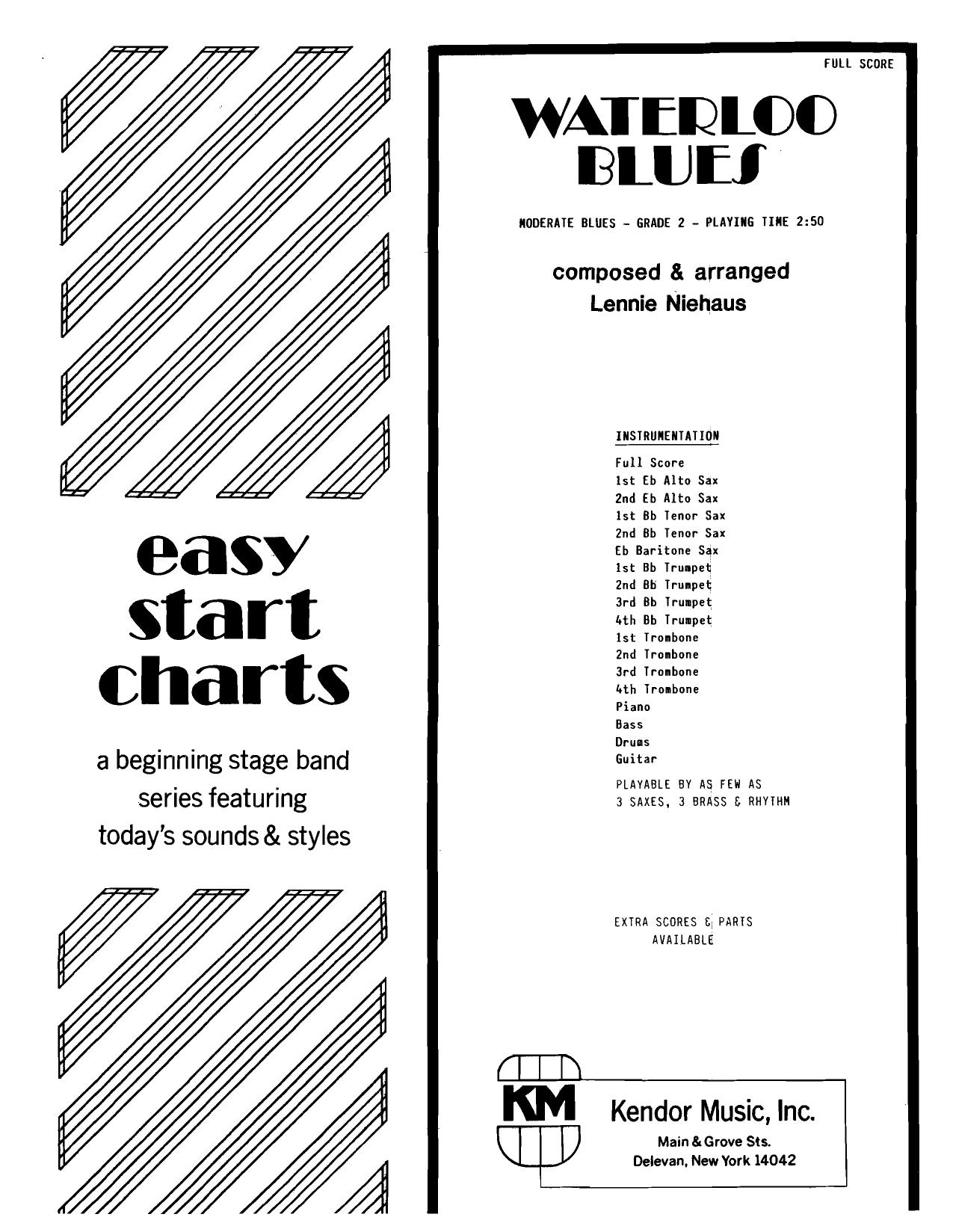
Waterloo Blues (L.Niehaus)
Composed by Lennie Niehaus
Arranged by Lennie Niehaus
- Ensemble: Big Band
- Pages: 43
- Instruments (17): 1st Eb Alto Saxophone, 2nd Eb Alto Saxophone, 1st Bb Tenor Saxophone, 2nd Bb Tenor Saxophone, Eb Baritone Saxophone, 1st Bb Trumpet, 2nd Bb Trumpet, 3rd Bb Trumpet, 4th Bb Trumpet, 1st Trombone, 2nd Trombone, 3rd Trombone, 4th Trombone, Piano, Guitar, Bass, Drums
- Difficulty: medium
- Content: Individual Parts
- Format: PDF Download (Instant)
- Price: $24.99
"Waterloo Blues," penned and arranged by the legendary saxophonist, composer, and educator Lennie Niehaus, stands as a masterclass in West Coast cool jazz orchestration. Emerging from the vibrant modernist jazz movement of the 1950s—where Niehaus was a pivotal architectural voice through his landmark writing for the Stan Kenton Orchestra—this composition captures the sophisticated, linear-driven harmonic language that defined the California jazz scene. While drawing deep roots from traditional blues forms, Niehaus elevates the genre through intricate counterpoint, buoyant swing grooves, and a distinctive cool-school restraint that prioritizes clarity of voice leading and crisp ensemble interplay over sheer volume. Driving forward with an infectious, laid-back medium-swing tempo, the chart opens with a catchy, blues-infused thematic statement that immediately establishes an upbeat, sophisticated mood. The harmonic landscape is rich with Niehaus’s signature extended and altered chord voicings—frequently utilizing upper-structure triads and parallel motion within the saxophone section that evoke the breezy, intellectual elegance of the Lighthouse All-Stars era. The energy builds steadily through clever rhythmic displacement and dynamic contrast, shifting seamlessly from transparent, harmonized horn lines to a roaring, tightly knit shout chorus that reinterprets traditional big band climax through a cool-jazz lens. The melodic heavy lifting is shared dynamically across the ensemble, featuring lush sax solis that highlight Niehaus’s intimate understanding of woodwind acoustics and balance. Brass integration is razor-sharp, requiring agile articulation and precise intonation to navigate the contradictory demands of a relaxed swing feel combined with brisk, bebop-inflected eighth-note lines. Featured solo space allows improvisers to stretch out over standard blues changes made fresh by Niehaus’s sophisticated background figures. The primary technical challenges lie in maintaining a weightless, buoyant 4/4 time feel without rushing, executing clean dynamic shadings, and locking in the unison section passages that demand absolute rhythmic unity. Advanced high school, collegiate, and professional big bands will find this arrangement an exceptionally rewarding addition to their repertoire. It serves as an ideal vehicle for teaching students how to balance modern jazz harmony with traditional swing phrasing, moving away from heavy Basie-style bombast toward a lighter, more transparent West Coast articulation style. Director and players alike will appreciate how the chart naturally instructs the ensemble in section blending, swing subdivision, and stylistic nuance. Navigating "Waterloo Blues" successfully requires careful attention to articulation, balance, and tempo control. The ideal tempo sits squarely in a comfortable medium-swing zone (approx. Quarter Note = 120-126); pushing the tempo too hard will strip the arrangement of its signature West Coast cool elegance. The primary technical challenge for the rhythm section and horns alike is maintaining an ultra-relaxed, behind-the-beat eighth-note subdivision while executing fast-moving bebop lines with absolute crispness. Conductors should pay close attention to the saxophone soli sections, ensuring that the inner voices project clearly without forcing the tone. Brass players must exercise restraint, using controlled, vibrato-light tones that complement rather than overpower the woodwinds. Articulation should lean toward short, detached quarter notes and articulated upbeats, avoiding overly heavy tongue accents. Rehearsal should begin by isolating the rhythm section to lock in a driving, feather-light ride cymbal pulse and comping that leaves plenty of sonic space. Balance the background figures carefully during open solo sections so the soloist remains prominent without needing to overplay. Q: What instrumentation and parts are included in this arrangement? A: This chart is scored for a standard 16-instrument big band lineup consisting of 5 saxophones (Alto Sax 1, Alto Sax 2, Tenor Sax 1, Tenor Sax 2, Baritone Sax), 8 brass (typically 4 trumpets and 4 trombones), and a 3-piece rhythm section (piano, bass, drums), totaling 43 pages of comprehensive performance materials. Q: What is the difficulty level of this Lennie Niehaus arrangement? A: This arrangement is graded as intermediate-advanced (suitable for advanced high school, collegiate, and professional jazz ensembles), primarily due to its demand for precise stylistic uniformity, crisp articulation, and advanced sight-reading of linear cool-jazz phrasing. Q: What is the musical style and historical background of "Waterloo Blues"? A: Composed and arranged by Lennie Niehaus, this piece exemplifies the West Coast cool jazz movement of the 1950s, blending traditional blues structures with sophisticated, modern harmonic voicings and linear counterpoint reminiscent of Niehaus's celebrated writing for Stan Kenton. Q: What makes this particular arrangement unique? A: The arrangement stands out through Niehaus's signature saxophone voicings, transparent orchestration, and clever contradiction of playing blues material with a restrained, intellectual cool-school aesthetic rather than traditional heavy-swing bombast. Q: What is the recommended performance duration and tempo for this piece? A: The arrangement is designed for a medium-swing feel at roughly 120 to 126 beats per minute, resulting in an ideal performance duration of approximately 3.5 to 4.5 minutes depending on the length of open solo choruses.
Questions and answers
- What is included in the Waterloo Blues (L.Niehaus) PDF?
- The verified current file contains a conductor score and individual parts across 43 pages.
- How many instruments or parts are listed for Waterloo Blues (L.Niehaus)?
- The verified instrumentation list contains 17 entries for this Big Band arrangement.
- Who is credited for Waterloo Blues (L.Niehaus)?
- Composer: Lennie Niehaus. Arranger: Lennie Niehaus.
- What difficulty is listed for Waterloo Blues (L.Niehaus)?
- The verified difficulty level is medium.
- Can I preview Waterloo Blues (L.Niehaus) before buying?
- Yes. The product page provides a preview generated from the current PDF file.
- How is Waterloo Blues (L.Niehaus) delivered?
- After successful payment, the digital PDF is made available for download. The displayed price is $24.99.
Musicians Also Search For
Waterloo Blues Lennie Niehaus PDF • Waterloo Blues Lennie Niehaus sheet music • Waterloo Blues arranged by Lennie Niehaus • Lennie Niehaus big band charts • Lennie Niehaus jazz arrangements PDF • Waterloo Blues Lennie Niehaus big band arrangements • Waterloo Blues big band arrangements • Waterloo Blues big band PDF download • Waterloo Blues jazz sheet music • big band sheet music download • Waterloo Blues conductor score PDF • Waterloo Blues individual parts download • Waterloo Blues sheet music PDF • buy Waterloo Blues sheet music • download Waterloo Blues PDF • Waterloo Blues jazz charts • best Lennie Niehaus big band arrangements • Waterloo Blues printable sheet music • big band repertoire PDF