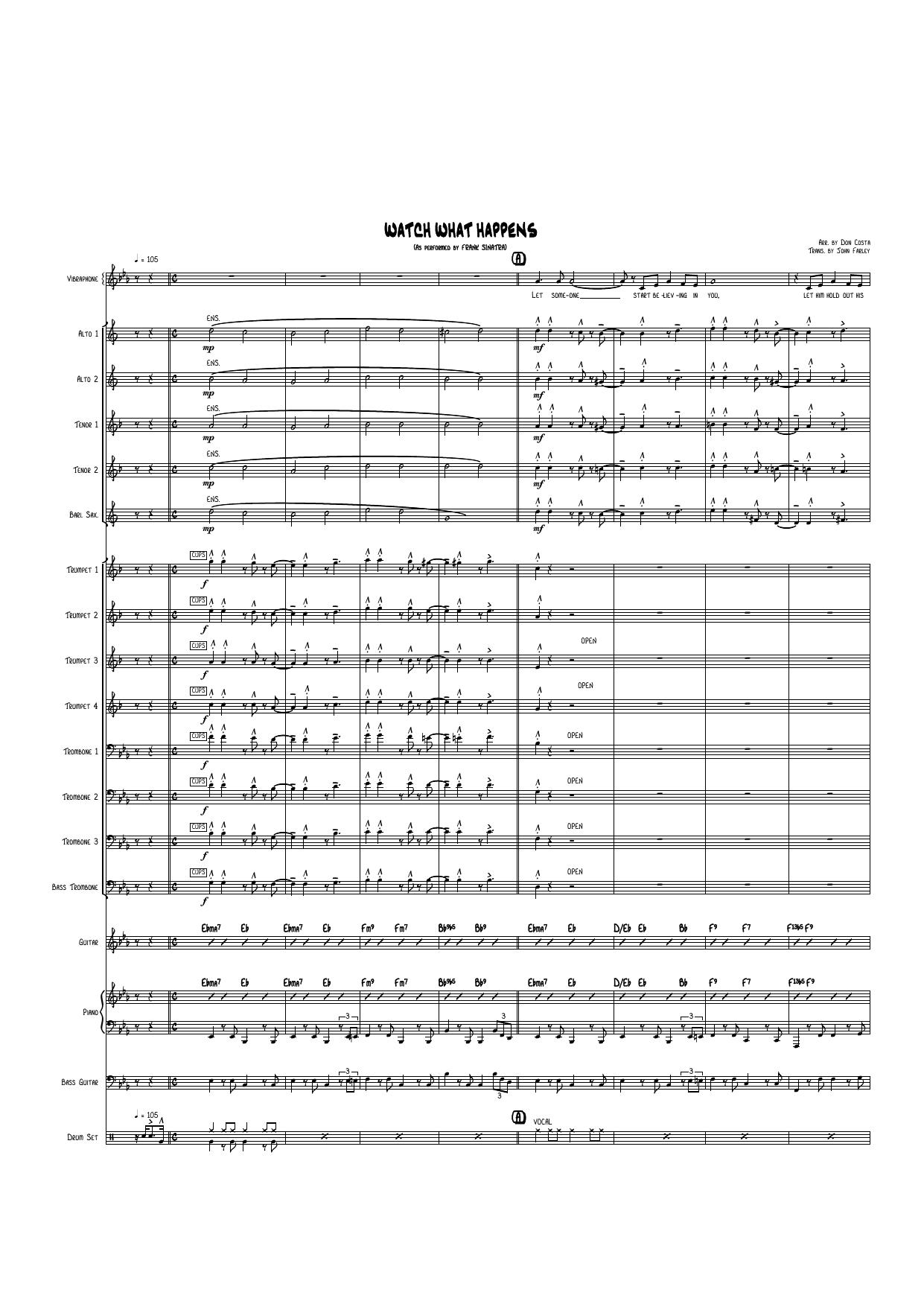
Watch What Happens (J.Farley)
Composed by John Farley
Arranged by Frank Sinatra & Nelson Riddle
- Ensemble: Big Band
- Pages: 40
- Instruments (19): Vocal, Alto Saxophone 1, Alto Saxophone 2, Tenor Saxophone 1, Tenor Saxophone 2, Baritone Saxophone, Trumpet 1, Trumpet 2, Trumpet 3, Trumpet 4, Trombone 1, Trombone 2, Trombone 3, Bass Trombone, Vibraphone, Guitar, Piano, Bass Guitar, Drum Set
- Difficulty: medium
- Content: Individual Parts
- Format: PDF Download (Instant)
- Price: $24.99
"Watch What Happens," originally composed by Michel Legrand with English lyrics by Norman Gimbel for the 1964 French musical film *The Umbrellas of Cherbourg* (*Les Parapluies de Cherbourg*), stands as one of the most sophisticated cinematic contributions to the Great American Songbook. While initially conceived as a delicate bossa nova-inflected film cue, the composition quickly transcended its silver-screen origins to become a favorite vehicle for vocalists and jazz instrumentalists alike. The definitive vocal treatment by Frank Sinatra, coupled with the lush, masterclass orchestrations of Nelson Riddle, cemented the tune's status as a mid-century swinging standard. Riddle’s arrangement style for Sinatra is legendary for its cinematic scope, combining crisp brass punch, warm woodwind countermelodies, and an underlying rhythmic drive that elevates popular songcraft into high art. Rooted in a buoyant, driving medium-swing feel in 4/4 time, this 10-instrument big band adaptation captures the glittering, sophisticated atmosphere of mid-1960s Las Vegas and Capitol Records studio sessions. The arrangement opens with an iconic, cascading harmonic introduction that immediately establishes a sense of anticipation and romantic urgency. The emotional arc transitions fluidly from intimate, conversational verses carried by the horns to expansive, brass-heavy plateaus that evoke classic Rat Pack glamour. Rich extended chord voicings—featuring characteristic Riddle-esque major sevenths, sharp ninths, and chromatic inner-voice movements—impart a lush, sophisticated harmonic palette that sounds remarkably full despite the compact 10-piece instrumentation. Nelson Riddle’s signature compositional fingerprints are woven throughout the 40-page score, prominently featuring a tightly knit sax soli that mirrors the vocal phrasing of the definitive Sinatra recording. The arrangement balances delicate, textural scoring—where muted trumpets and warm trombone pads cradle the melody—with assertive, swinging shout choruses that demand precision and dynamic control from the ensemble. The lead trumpet and tenor saxophone share primary melodic responsibilities, while structured solo space allows a featured instrumentalist to stretch out over standard changes. Articulation is paramount; players must execute crisp, clipped staccatos on the off-beats and smooth, connected legato lines during the transitional phrasing to achieve that authentic, buoyant swing aesthetic. Advanced high school ensembles, collegiate jazz orchestras, and professional regional big bands will find this arrangement an ideal centerpiece for a concert program. While the 10-instrument configuration makes it exceptionally practical for groups with limited personnel, it demands mature section playing, particularly in maintaining blend and intonation across the saxophone and brass tiers. Conductors will appreciate how effectively the writing compensates for a smaller horn section by utilizing clever counterpoint and open, register-spanning voicings. Performing this chart offers students and professionals alike a masterclass in stylistic phrasing, dynamic contrast, and the timeless art of vocal-accompaniment jazz arranging. The rhythmic foundation of this chart relies on an authentic, relaxed medium-swing feel; avoid rushing the tempo, as the groove must breathe to capture the quintessential Sinatra-Riddle swagger. Rhythm section players should study classic swing recordings to lock in the lightweight, pulsing ride-cymbal pattern and four-to-the-bar acoustic bass feel, ensuring the hi-hat snaps cleanly on beats two and four. Horn sections must prioritize uniform articulation, paying close attention to marked accents on the upbeat syncopations and maintaining a warm, blended tone during the sustained ballad-esque interludes. Dynamic restraint is crucial during the developmental verses to allow the featured soloist or melody carrier to project effortlessly without forcing their tone. Rehearsal should begin by isolating the sax soli at a reduced tempo to clean up the intricate chromatic passing tones before integrating the brass counterlines. Encourage the ensemble to listen across sections so that the inner-voice harmonies bloom organically, particularly during the modulatory transitions. Q: What instruments and parts are included in this 10-instrument arrangement? A: The scoring is tailored for a compact 10-piece ensemble, featuring parts for Alto Saxophone, Tenor Saxophone, Baritone Saxophone, Trumpet, Trombone, and a complete rhythm section (Piano, Guitar, Bass, Drums), optimized for a full and balanced sound. Q: What is the difficulty level of this chart? A: This arrangement is graded as advanced intermediate to advanced, best suited for collegiate groups, advanced high school bands, and professional ensembles capable of handling subtle swing nuances and tight section blends. Q: What is the historical style and musical context of this piece? A: It reflects the golden era of 1960s vocal jazz and big band orchestration, specifically mirroring the iconic, sophisticated collaboration style between Frank Sinatra and arranger Nelson Riddle. Q: What makes this particular Nelson Riddle-style arrangement unique? A: It condenses the massive, lush sonic landscape of a full studio orchestra into a tight 10-player format without sacrificing harmonic richness, utilizing signature cascading introductions and intricate sax solis. Q: What is the recommended performance duration and tempo for this arrangement? A: The piece is set at a comfortable medium-swing tempo (approximately 120-126 BPM) and typically runs for roughly 3.5 to 4 minutes, depending on the length of the improvised solo choruses.
Questions and answers
- What is included in the Watch What Happens (J.Farley) PDF?
- The verified current file contains a conductor score and individual parts across 40 pages.
- How many instruments or parts are listed for Watch What Happens (J.Farley)?
- The verified instrumentation list contains 19 entries for this Big Band arrangement.
- Who is credited for Watch What Happens (J.Farley)?
- Composer: John Farley. Arranger: Frank Sinatra & Nelson Riddle.
- What difficulty is listed for Watch What Happens (J.Farley)?
- The verified difficulty level is medium.
- Can I preview Watch What Happens (J.Farley) before buying?
- Yes. The product page provides a preview generated from the current PDF file.
- How is Watch What Happens (J.Farley) delivered?
- After successful payment, the digital PDF is made available for download. The displayed price is $24.99.
Musicians Also Search For
Watch What Happens Frank Sinatra & Nelson Riddle PDF • Watch What Happens Frank Sinatra & Nelson Riddle sheet music • Watch What Happens arranged by Frank Sinatra & Nelson Riddle • Frank Sinatra & Nelson Riddle big band charts • Frank Sinatra & Nelson Riddle jazz arrangements PDF • Watch What Happens John Farley sheet music • Watch What Happens John Farley big band arrangements • John Farley big band charts • Watch What Happens big band arrangements • Watch What Happens big band PDF download • Watch What Happens jazz sheet music • big band sheet music download • Watch What Happens conductor score PDF • Watch What Happens individual parts download • Watch What Happens sheet music PDF • buy Watch What Happens sheet music • download Watch What Happens PDF • Watch What Happens jazz charts • best Frank Sinatra & Nelson Riddle big band arrangements • John Farley arranged by Frank Sinatra & Nelson Riddle • Watch What Happens printable sheet music • big band repertoire PDF