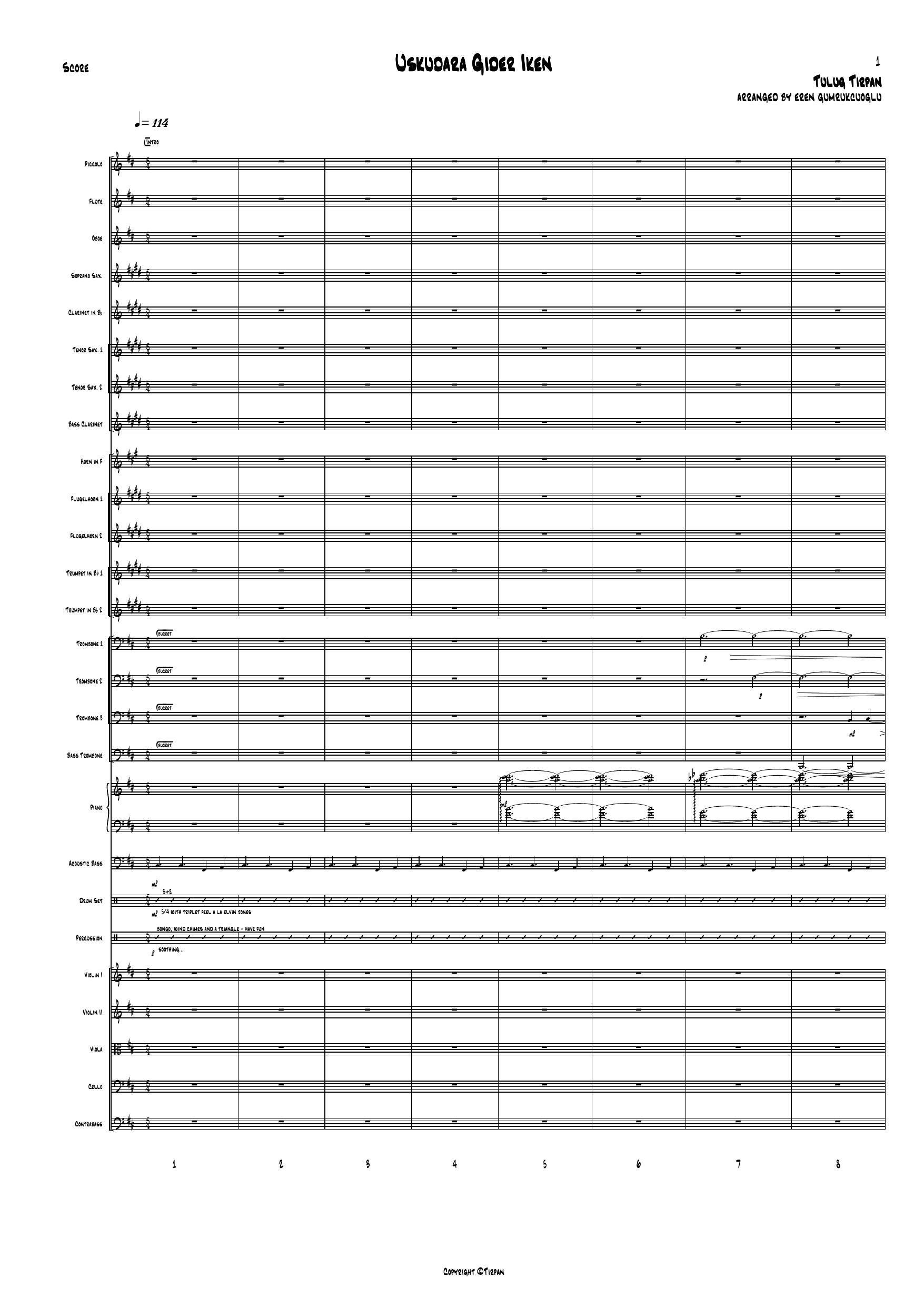
Uscudara (T.Tirpan)
Composed by T. Tirpan
Arranged by T.Tirpan
- Ensemble: Big Band
- Style: Jazz Standard
- Pages: 21
- Instruments (26): Piccolo, Flute, Oboe, Soprano Saxophone, Clarinet in Bb, Tenor Saxophone 1, Tenor Saxophone 2, Bass Clarinet, Horn in F, Flugelhorn 1, Flugelhorn 2, Trumpet in Bb 1, Trumpet in Bb 2, Trombone 1, Trombone 2, Trombone 3, Bass Trombone, Piano, Acoustic Bass, Drum Set, Percussion, Violin I, Violin II, Viola, Cello, Contrabass
- Difficulty: medium
- Content: Individual Parts
- Format: PDF Download (Instant)
- Price: $24.99
Bridging traditional Near Eastern modal flavor with the sophisticated harmonic vocabulary of modern big band jazz, "Uscudara" (composed and arranged by T. Tirpan) reimagines classic folkloric roots through a thoroughly contemporary compositional lens. Originally inspired by timeless trans-continental melodic motifs associated with the historical Üsküdar district, this distinctive jazz standard adaptation elevates modal interchange and intricate rhythmic displacement. Tirpan captures the bustling energy and romantic nostalgia of the historic waterfront, translating ancient metric concepts into an expansive, modern jazz orchestra framework that honors its heritage while pushing the boundaries of contemporary large-ensemble writing. Driving forward with an infectious, hybridized Mediterranean-swing groove, the arrangement opens with an atmospheric, rubato introduction before settling into a relentless, hypnotic medium-up meter that blends compound time feels with straight-eighth modal propulsion. The harmonic landscape shifts fluidly between modal vamp sections and lush, extended-tertian chord progressions. Rich, impressionistic voicings in the woodwinds and muted brass create an exotic yet instantly accessible sonic palette, evoking a mood that swings effortlessly between sultry mystery and explosive, high-octane euphoria. The dynamic contrast is stark, moving from intimate, whispered counterpoint to thunderous, brass-heavy climaxes. T. Tirpan’s orchestration is remarkably expansive, utilizing a 26-instrument palette that goes far beyond standard big band instrumentation by incorporating a coloristic woodwind choir—including Piccolo, Flute, Oboe, Soprano Saxophone, and Clarinet in Bb. This multi-layered woodwind foundation allows for intricate, interwoven countermelodies that dance around bold, aggressive brass shout choruses. The melody is initially introduced by the soprano saxophone and solo clarinet before being handed off to a lush full-ensemble soli that showcases Tirpan’s signature dense, cluster-infused drop-2 and drop-4 voicings. Open-ended blowing changes provide an ideal canvas for featured tenor saxophone and trumpet improvisations, underpinned by a dynamic rhythm section vamp that invites modal exploration. Advanced collegiate, community, and professional jazz orchestras will find this chart to be an exhilarating centerpiece for a contemporary concert program. While the rhythm section must maintain a steady, resilient pocket amidst shifting metric feels, the horn sections will benefit from strong sectional blend, particularly within the extended woodwind choir. Technical demands include rapid double-tonguing passages for the flutes, high-register endurance for the lead trumpet, and a deep collective understanding of modal phrasing. Ultimately, "Uscudara" offers a deeply rewarding performance experience that shatters conventional big band formulas and rewards precision, stylistic versatility, and expressive group interplay. Navigating "Uscudara" successfully requires a keen focus on rhythmic precision and stylistic duality, balancing traditional swing articulation with precise, straight-eighth modal execution. The conductor should establish a crisp, driving tempo marking around MM 188, ensuring the underlying rhythm section groove remains resilient and unhurried during complex metric modulations. Key technical challenges lie within the woodwind choir (Piccolo, Flute, Oboe, Soprano Sax, Clarinet), which must execute rapid, interlocking scalar passages with absolute clarity. Brass players should utilize subtle tonal colorations—incorporating harmonic mutes and controlled cup mutes where indicated—to mimic the vocal inflection of traditional Middle Eastern instrumentation without sacrificing big band projection. Rehearsal strategy should begin with sectionals isolated by choir (reeds, brass, rhythm) before integrating the expanded woodwind textures. Pay close attention to balance during the dense, cluster-voiced soli sections; inner voices must project clearly beneath the primary melodic line. The rhythm section should treat the modal vamps as interactive landscapes, allowing the piano and bass to weave conversational counterlines beneath the featured soloists while maintaining an unyielding rhythmic anchor. Q: What instruments and parts are included in this arrangement? A: This comprehensive 26-instrument big band score features expanded instrumentation including Piccolo, Flute, Oboe, Soprano Saxophone, Clarinet in Bb, standard saxophone, trumpet, and trombone sections, plus a full rhythm section and a dedicated conductor score spanning 21 pages. Q: What is the difficulty level of this arrangement? A: This chart is best suited for advanced collegiate, community, and professional jazz orchestras due to its sophisticated harmonic language, extended woodwind integration, and demanding rhythmic interplay. Q: What is the musical style and historical context of "Uscudara"? A: Composed by T. Tirpan, the piece functions as a modern jazz standard that bridges traditional Near Eastern folkloric modal flavors from the Üsküdar region with contemporary big band arranging techniques. Q: What makes T. Tirpan's arrangement of "Uscudara" unique? A: Its uniqueness lies in its massive 26-instrument orchestration—incorporating classical color instruments like oboe and piccolo alongside soprano sax and clarinet—and its seamless blending of modal exoticism with rich, extended jazz harmony. Q: What is the performance duration and recommended tempo for this piece? A: The arrangement performs at an energetic medium-up tempo of approximately MM 188, with a total performance duration averaging around 6 to 7 minutes depending on the length of the open improvised solos.
Questions and answers
- What is included in the Uscudara (T.Tirpan) PDF?
- The verified current file contains a conductor score across 21 pages.
- How many instruments or parts are listed for Uscudara (T.Tirpan)?
- The verified instrumentation list contains 26 entries for this Big Band arrangement.
- Who is credited for Uscudara (T.Tirpan)?
- Composer: T. Tirpan. Arranger: T.Tirpan.
- What difficulty is listed for Uscudara (T.Tirpan)?
- The verified difficulty level is medium.
- What style is listed for Uscudara (T.Tirpan)?
- The catalog lists the style as Jazz Standard.
- Can I preview Uscudara (T.Tirpan) before buying?
- Yes. The product page provides a preview generated from the current PDF file.
- How is Uscudara (T.Tirpan) delivered?
- After successful payment, the digital PDF is made available for download. The displayed price is $24.99.
Musicians Also Search For
Uscudara T.Tirpan PDF • Uscudara T.Tirpan sheet music • Uscudara arranged by T.Tirpan • T.Tirpan big band charts • T.Tirpan jazz arrangements PDF • Uscudara T. Tirpan sheet music • Uscudara T. Tirpan big band arrangements • T. Tirpan big band charts • Uscudara big band arrangements • Uscudara big band PDF download • Uscudara jazz sheet music • big band sheet music download • Uscudara conductor score PDF • Uscudara sheet music PDF • Uscudara Jazz Standard charts • Jazz Standard big band arrangements • buy Uscudara sheet music • download Uscudara PDF • Uscudara jazz charts • best T.Tirpan big band arrangements • T. Tirpan arranged by T.Tirpan • Uscudara printable sheet music • big band repertoire PDF