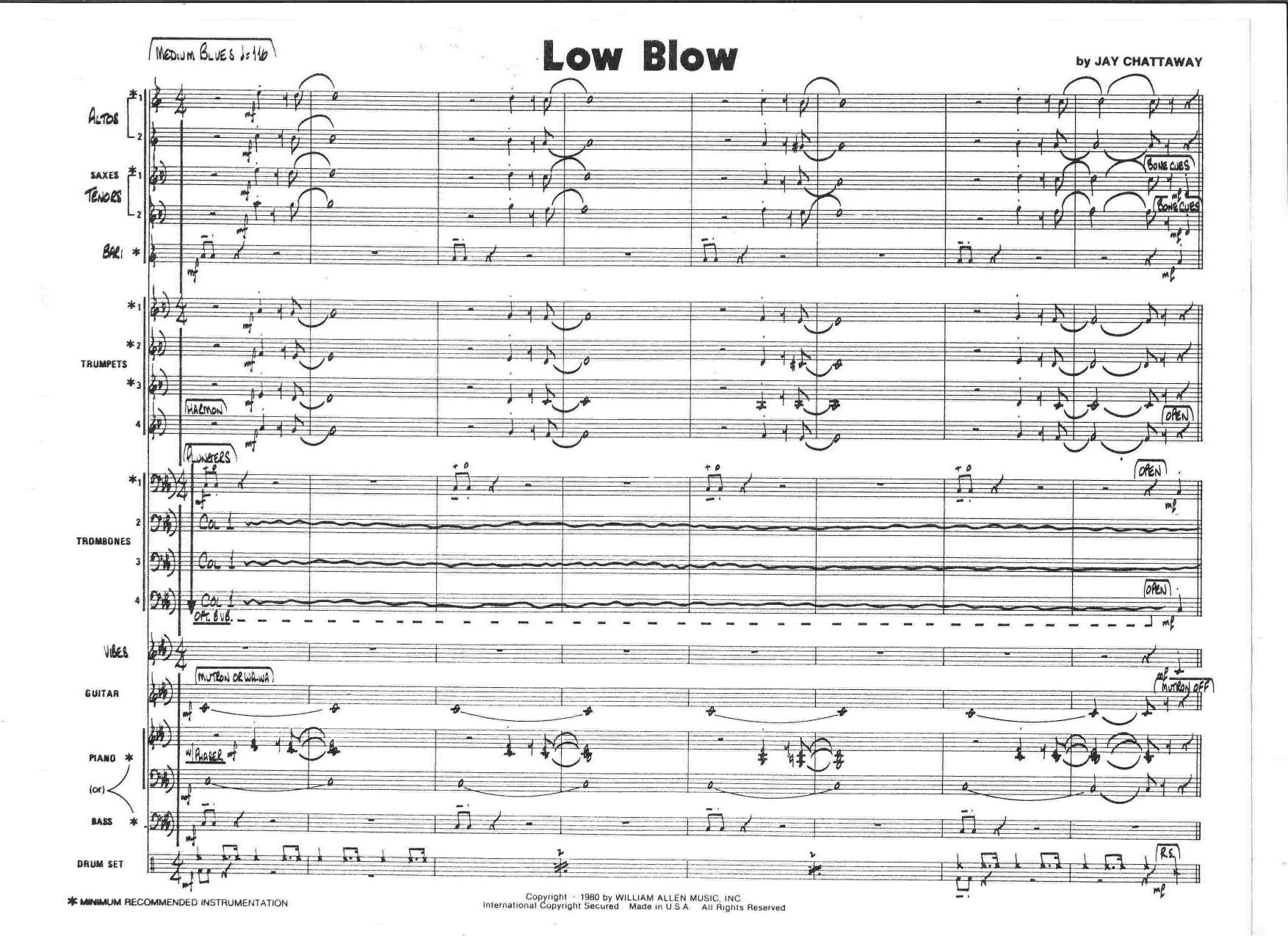
Low Blow (J.Chattaway) sheet music preview

Low Blow (J.Chattaway)

Composed by Jay Chattaway

Arranged by Jay Chattaway

  • Ensemble: Big Band
  • Pages: 42
  • Instruments (18): Alto Sax I, Alto Sax II, Tenor Sax I, Tenor Sax II, Baritone Sax, Trumpet I, Trumpet II, Trumpet III, Trumpet IV, Trombone I, Trombone II, Trombone III, Trombone IV, Piano, Bass, Guitar, Vibes, Drums
  • Difficulty: medium
  • Content: Individual Parts
  • Format: PDF Download (Instant)
  • Price: $24.99

Composed during Jay Chattaway’s prolific writing period in the late 20th century—an era where the writer cemented his reputation through dynamic contributions to contemporary big band repertoire and jazz pedagogy—"Low Blow" stands as an engaging showcase of straight-ahead swing writing. Emerging shortly after Chattaway’s prominent associations with jazz icons like Maynard Ferguson, this chart captures the vibrant, high-energy pulse of modern stage band literature. It reflects a compositional style that bridges accessible educational frameworks with authentic jazz articulation, offering ensembles a taste of professional-grade swing phrasing without insurmountable technical roadblocks. Built around a robust, driving medium-swing feel in 4/4 time, the composition projects an attitude of confident swagger and cool intensity. The harmonic language relies on straightforward blues-infused extensions and punchy brass counterlines that instantly grip both performers and listeners. Rather than relying on dense, modern modal shifts, Chattaway anchors the mood in traditional swing aesthetics, utilizing rich foundational voicings that make the entire ensemble sound massive. The emotional arc moves from a gutsy, assertive head statement straight into an infectious groove that commands steady foot-tapping and high audience engagement. True to its clever title, the defining feature of this arrangement is its deliberate spotlighting of the lower-register voices within the big band. While conventional charts frequently favor the upper saxophones and lead trumpets, Chattaway cleverly shifts the spotlight downward, giving substantive thematic material, soli segments, and melodic weight to the baritone saxophone, tenor saxophones, and low trombones. The scoring treats these lower instruments not merely as harmonic padding, but as primary drivers of the swing momentum. The background figures behind the solo sections utilize tight, interlocking brass voicings that demand clean articulation and a unified section blend, ensuring that even standard chord changes feel fresh and rhythmically vital. Developing bands will find the melodic distribution particularly rewarding, as lower-voice players get a rare chance to carry the primary lines rather than remaining locked in rhythmic background accompaniment. Technical challenges are intentionally scaled to foster growth, centering primarily on clean swing eighth-note subdivision, proper tongue-release control, and maintaining a steady tempo without rushing the backbeat. The rhythm section is provided with clear, supportive prompts to lay down an authentic walking bass line and ride cymbal pulse that anchors the horn sections. Advanced middle school, high school, and community jazz ensembles looking to bolster their straight-ahead swing repertoire will find this chart an ideal vehicle. It teaches fundamental big band literacy—such as section balance, dynamic contrast, and accent placement on beats two and four—while delivering a thoroughly entertaining performance piece that is guaranteed to be a highlight of any concert program. Achieving an authentic performance of this chart requires meticulous attention to the swing eighth-note feel. Ensure the band avoids a sterile, even-eighth interpretation by emphasizing the natural triplet subdivision, keeping the upbeats light and buoyant while tonguing downbeats with weight. The tempo should remain locked and unhurried; letting the groove sit comfortably in a medium pocket allows the low-end instruments to project their lines with clarity and resonance. The primary technical challenge lies in the dynamic balance between the foreground and background voices. Because the arrangement intentionally features the lower instruments—tenor saxophones, baritone saxophone, and trombones—conductors must insist that the higher register trumpets and upper saxophones practice strict dynamic restraint during accompaniment passages. When the lower voices carry the melody, they should project with a fat, centered tone rather than forced volume. Pay close attention to articulation markings: standard quarter notes should be slightly detached, and marked accents must be crisp without sacrificing the overall legato swing flow. The rhythm section pianist and guitarist should comp sparsely with rootless shell voicings to leave ample sonic space for the low-register counterlines. Q: What instruments and parts are included in this big band arrangement? A: The package includes a full conductor score and 18 instrument parts, accommodating standard big band instrumentation featuring 2 alto saxophones, 2 tenor saxophones, baritone saxophone, trumpet parts, trombone parts, a full rhythm section (piano, bass, drums, guitar), and a dedicated vibe part. Q: What is the difficulty level of this piece? A: This arrangement is graded as medium-easy (approximately Grade 2.5), making it exceptionally well-suited for developing high school and advanced middle school jazz bands seeking authentic swing style without extreme technical demands. Q: What musical style and historical context does this chart represent? A: Composed by Jay Chattaway in 1980, it represents classic late-20th-century educational big band literature rooted in traditional straight-ahead swing and blues idioms. Q: What makes this specific Jay Chattaway arrangement unique? A: Unlike standard charts that heavily favor lead trumpets and alto saxophones, this arrangement cleverly shifts its primary melodic focus and thematic weight to the lower-register instruments, specifically the baritone saxophone, tenor saxophones, and trombones. Q: What is the recommended tempo and performance duration for this arrangement? A: It is performed at a comfortable, driving medium-swing tempo that naturally dictates the groove, with a typical performance duration spanning approximately 3 to 4 minutes depending on solo extensions.

Questions and answers

What is included in the Low Blow (J.Chattaway) PDF?
The verified current file contains a conductor score and individual parts across 42 pages.
How many instruments or parts are listed for Low Blow (J.Chattaway)?
The verified instrumentation list contains 18 entries for this Big Band arrangement.
Who is credited for Low Blow (J.Chattaway)?
Composer: Jay Chattaway. Arranger: Jay Chattaway.
What difficulty is listed for Low Blow (J.Chattaway)?
The verified difficulty level is medium.
Can I preview Low Blow (J.Chattaway) before buying?
Yes. The product page provides a preview generated from the current PDF file.
How is Low Blow (J.Chattaway) delivered?
After successful payment, the digital PDF is made available for download. The displayed price is $24.99.

Musicians Also Search For

Low Blow Jay Chattaway PDFLow Blow Jay Chattaway sheet musicLow Blow arranged by Jay ChattawayJay Chattaway big band chartsJay Chattaway jazz arrangements PDFLow Blow Jay Chattaway big band arrangementsLow Blow big band arrangementsLow Blow big band PDF downloadLow Blow jazz sheet musicbig band sheet music downloadLow Blow conductor score PDFLow Blow individual parts downloadLow Blow sheet music PDFbuy Low Blow sheet musicdownload Low Blow PDFLow Blow jazz chartsbest Jay Chattaway big band arrangementsLow Blow printable sheet musicbig band repertoire PDF

All arrangements by Jay Chattaway All Jay Chattaway sheet music