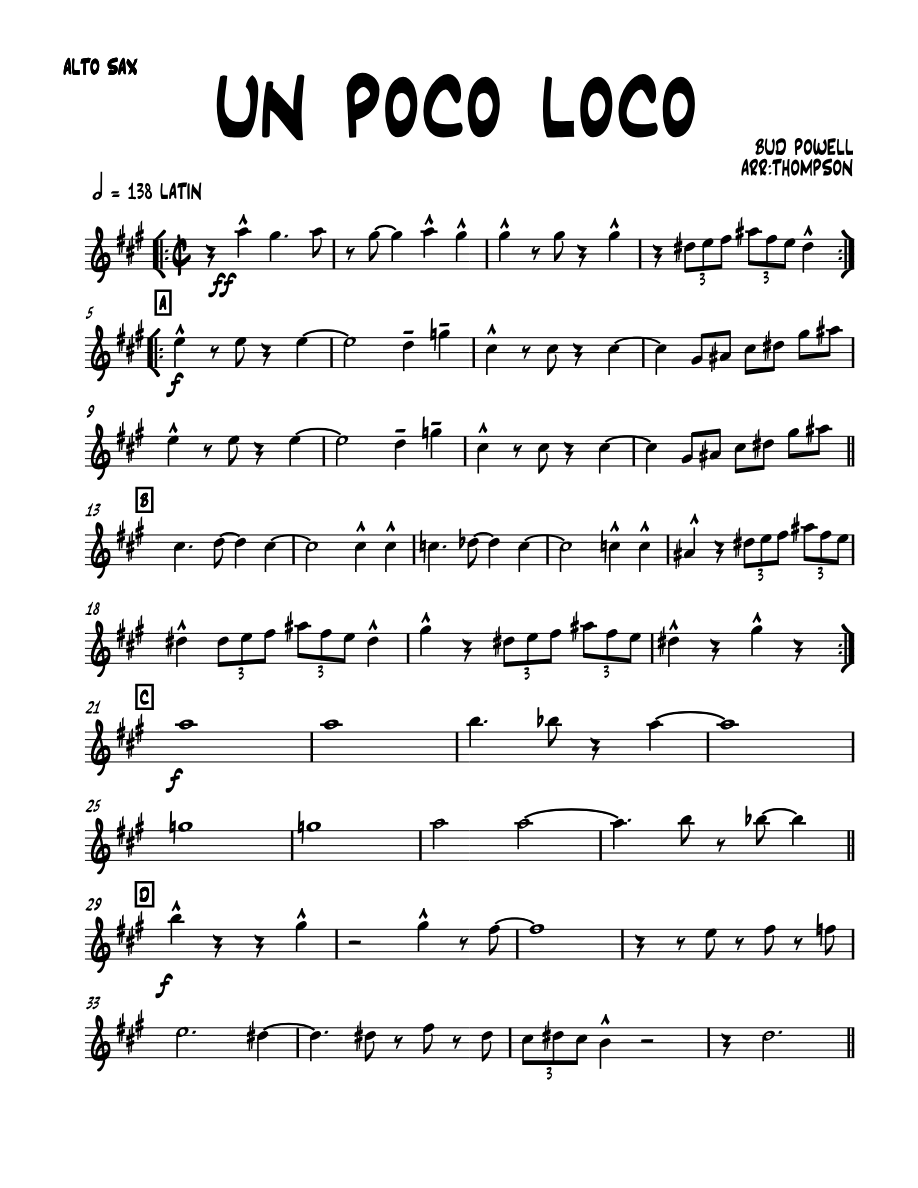
Un Poco Loco (B.Powel) sheet music preview

Un Poco Loco (B.Powel)

Composed by Bud Powell

Arranged by B Powel

  • Ensemble: Small Ensemble
  • Style: Jazz Standard
  • Pages: 5
  • Difficulty: easy
  • Content: Sheet Music
  • Format: PDF Download (Instant)
  • Price: $12.99

"Un Poco Loco," penned by the legendary pianist and composer Bud Powell, stands as an iconic cornerstone of the bebop and Afro-Cuban jazz canons. First recorded on May 1, 1951, for Blue Note Records with Curly Russell on bass and Max Roach on drums, this composition emerged from an era of profound innovation, where jazz was rapidly evolving beyond the swing tradition. Powell, a pivotal figure in the development of bebop piano, is celebrated for translating the lightning-fast, horn-like improvisational lines of Charlie Parker and Dizzy Gillespie to the keyboard, fundamentally altering the role of the piano in jazz ensembles. "Un Poco Loco" itself is renowned for its daring harmonic and rhythmic complexity, featuring polytonality, the distinctive use of the Lydian scale, and Max Roach's groundbreaking 5-over-4 drum pattern, which adds a layer of rhythmic tension and excitement. Its inclusion in literary critic Harold Bloom's list of "sublime" twentieth-century American art underscores its cultural and musical significance. This arrangement of "Un Poco Loco" by B Powel captures the exhilarating, up-tempo bebop energy of the original while thoughtfully adapting it for a small ensemble. The musical character is defined by its driving, medium-fast Latin groove, which underpins the intricate melodic and harmonic interplay. The piece is primarily in a minor key, evoking a mood of sophisticated intensity and playful unpredictability, perfectly reflecting its title, "A Little Crazy." The energy is consistently high, propelled by syncopated rhythms and the inherent forward momentum of bebop. Performers will find themselves immersed in a vibrant soundscape that demands precision and stylistic authenticity, delivering a thrilling experience for both musicians and audience. B Powel's distinctive approach to this arrangement emphasizes clarity and dynamic contrast within the small ensemble format. The melody is initially carried by a lead instrument, often doubled or harmonized in tight, modern voicings that showcase the arranger's keen ear for contemporary jazz harmony. Soli sections are meticulously crafted, allowing the ensemble to shine with unified precision, while strategically placed shout choruses build excitement towards featured solo sections. The arrangement masterfully navigates the original's harmonic intricacies, including its polytonal implications and altered dominant chords, presenting them in an accessible yet challenging manner. Soloists are given ample space to improvise over the form, often over a repetitive vamp or montuno, providing a direct link to the original's improvisational spirit. This treatment ensures that the arrangement remains true to Bud Powell's groundbreaking vision while offering fresh interpretive possibilities. Performing this arrangement is a rewarding challenge, suitable for college-level jazz ensembles, advanced community bands, and professional small groups. The technical demands include navigating fast melodic lines, executing precise rhythmic figures, and improvising over complex harmonic structures. Specific musical moments that stand out include the initial statement of the iconic melody with its rhythmic drive, the carefully constructed soli passages, and the dynamic build-up into and out of the solo sections. The interplay between the rhythm section and the melodic instruments requires attentive listening and tight ensemble cohesion. The arrangement's five pages are packed with musical substance, offering a deep dive into one of jazz's most influential compositions. Conductors should emphasize a consistent, driving Latin groove throughout, ensuring the rhythm section maintains the characteristic syncopation and energy without rushing. The tempo should be a medium-fast, energetic feel, allowing for both rhythmic precision and melodic fluidity. Key technical challenges include the intricate melodic figures, which require clean articulation and nimble fingerwork from the lead voices. Encourage musicians to practice these lines slowly to ensure accuracy before bringing them up to tempo. The ensemble voicings, particularly in the soli sections, demand careful attention to balance and blend to achieve a cohesive sound. For soloists, focus on harmonic awareness, particularly the polytonal implications and altered dominant chords that define the piece's harmonic landscape. Encourage melodic development that builds intensity over the vamp sections, drawing inspiration from bebop language. Rehearsal tips include isolating challenging rhythmic passages and practicing them with a metronome, gradually increasing the speed. Pay close attention to dynamic contrasts, using them to shape the musical narrative and highlight specific sections. While no special techniques like plunger mutes are explicitly required, a strong command of jazz articulation (e.g., falls, scoops, ghost notes) will enhance the authentic bebop character. **Q: What instruments/parts are included in this arrangement?** A: This arrangement is designed for a small ensemble, typically featuring a lead melodic instrument (e.g., trumpet, alto saxophone), a second melodic instrument (e.g., tenor saxophone, trombone), piano, bass, and drums. Specific instrumentation may vary slightly, but it adheres to a standard small combo format. **Q: What is the difficulty level of this arrangement?** A: This arrangement is considered advanced, suitable for college-level jazz ensembles, advanced high school groups with strong improvisational skills, experienced community bands, and professional musicians. It requires proficiency in bebop articulation, advanced harmonic understanding, and rhythmic precision. **Q: What is the musical style and historical context of "Un Poco Loco"?** A: "Un Poco Loco" is an iconic Afro-Cuban jazz standard composed by Bud Powell in 1951. It is a seminal work within the bebop movement, celebrated for its innovative harmonic language, rhythmic complexity, and its fusion of bebop with Latin influences. **Q: What makes this particular arrangement unique?** A: B Powel's arrangement distinguishes itself by maintaining the original's complex bebop and Latin character while providing clear, modern voicings and well-structured soli and shout sections for a small ensemble. It offers a balanced blend of ensemble precision and ample space for individual improvisation, capturing the essence of Bud Powell's genius. **Q: What is the approximate performance duration or tempo of the piece?** A: The performance duration typically ranges from 4 to 6 minutes, depending on the length of improvised solos. The tempo is a medium-fast Latin groove, maintaining the energetic and driving feel characteristic of the original recording.

Musicians Also Search For

Un Poco Loco B Powel PDFUn Poco Loco B Powel sheet musicUn Poco Loco arranged by B PowelB Powel small ensemble chartsB Powel jazz arrangements PDFUn Poco Loco Bud Powell sheet musicUn Poco Loco Bud Powell small ensemble arrangementBud Powell small ensemble chartsUn Poco Loco small ensemble arrangementUn Poco Loco small ensemble PDF downloadUn Poco Loco jazz ensemble sheet musicsmall ensemble sheet music instant downloadUn Poco Loco sheet music with partsUn Poco Loco Jazz Standard chartJazz Standard small ensemble arrangementsbuy Un Poco Loco sheet music onlinedownload Un Poco Loco PDFUn Poco Loco jazz chartbest B Powel small ensemble arrangementsBud Powell songs arranged by B PowelUn Poco Loco printable sheet musicsmall ensemble repertoire PDF

All arrangements by B Powel All Bud Powell sheet music