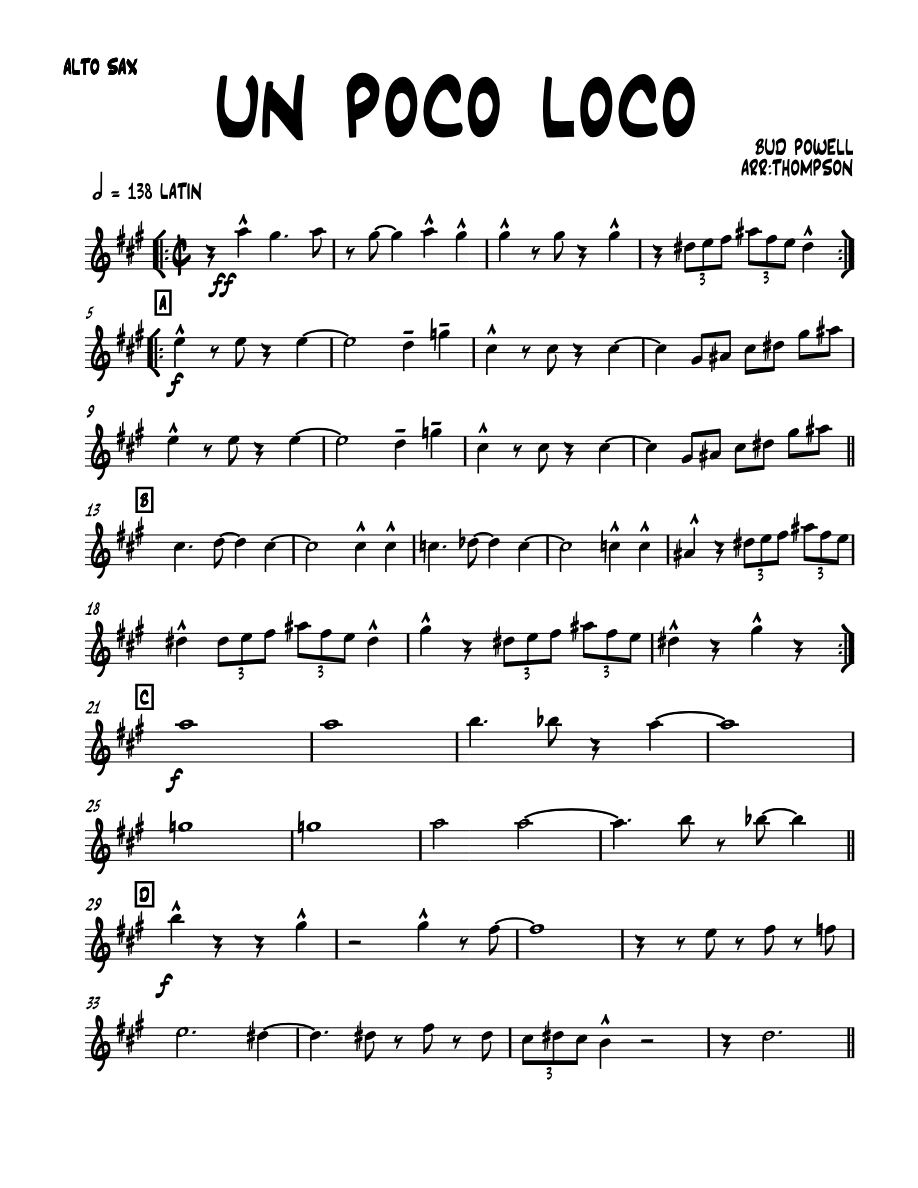
Un Poco Loco (Thompson)
Composed by BUD POWELL
Arranged by Thompson
- Ensemble: Big Band
- Style: Jazz Standard
- Pages: 5
- Instruments (1): Piano
- Difficulty: easy
- Content: Individual Parts
- Format: PDF Download (Instant)
- Price: $24.99
Bud Powell's iconic "Un Poco Loco," a cornerstone of the bebop repertoire, emerged in 1951, forever cementing its place as a groundbreaking composition that fused Afro-Cuban rhythms with the harmonic and melodic sophistication of modern jazz. This piece, originally recorded as a trio by Powell, Max Roach, and Curley Russell, is celebrated for its distinctive AABA form, its driving, syncopated rhythms, and Powell's virtuosic piano improvisation. It represents a pivotal moment in jazz history, showcasing bebop's expansion beyond swing and its embrace of complex rhythmic interplay, influencing countless musicians across generations and remaining a true test of a jazz musician's agility and harmonic understanding. Thompson's big band arrangement of "Un Poco Loco" reimagines this classic with a vibrant, up-tempo bebop feel, maintaining the original's restless energy while expanding its sonic palette. Set in the key of F minor, the arrangement opens with the instantly recognizable, angular melody, initially presented by the saxophones in a tight, unison voicing, underscored by the brass's sharp, rhythmic punctuations. Thompson masterfully employs call-and-response figures between sections, creating a dynamic interplay that propels the piece forward. The mood is exhilarating and intense, demanding precision and rhythmic accuracy from all instrumentalists to capture the essence of Powell's original vision within a larger ensemble context. A hallmark of Thompson's arranging style is evident in the intricate soli sections and the powerful shout chorus. Following the initial melodic statements, a meticulously crafted saxophone soli takes center stage, showcasing Thompson's sophisticated harmonic language and contrapuntal writing, requiring excellent blend and articulation. The arrangement features several opportunities for improvised solos, typically over the original chord changes, allowing individual voices to shine. The full ensemble shout chorus is a highlight, building tension and excitement with its dense voicings and driving rhythmic figures, before returning to a re-harmonized statement of the theme. This arrangement is a testament to Thompson's ability to honor the original while infusing it with fresh, big band vitality. This arrangement is ideally suited for advanced high school, college, community, or professional jazz ensembles. Its technical demands, particularly in the saxophone soli and the brass's rhythmic precision, require experienced players. The rewarding experience of performing "Un Poco Loco" lies in navigating its complex rhythmic patterns, achieving a tight ensemble sound, and delivering the high-energy performance it demands. The piece offers a fantastic opportunity to explore bebop phrasing and articulation within a challenging yet incredibly satisfying big band setting, making it a staple for any ensemble looking to showcase their technical prowess and stylistic understanding. Approach "Un Poco Loco" with an unwavering, up-tempo bebop swing feel, ensuring the rhythm section lays down a solid, driving foundation. The key technical challenges include the precise articulation and rhythmic accuracy required for the saxophone soli, which demands careful rehearsal for blend and balance. Brass players should focus on sharp, short articulations for rhythmic figures, utilizing falls and doits where indicated to add authentic bebop flavor. The melody, often played in unison or octaves, needs to be delivered with conviction and a forward momentum. Rehearsal should emphasize rhythmic precision across all sections, especially during the intricate ensemble passages and the powerful shout chorus, ensuring a cohesive and energetic performance that captures the original's intensity. Q: What instruments are included in this arrangement? A: This arrangement is scored for a standard 17-piece big band, including Alto Saxophone 1, Alto Saxophone 2, Tenor Saxophone 1, Tenor Saxophone 2, Baritone Saxophone, Trumpet 1-4, Trombone 1-4, Piano, Bass, and Drums. Q: What is the difficulty level of this arrangement? A: This arrangement is considered advanced, suitable for college, community, or professional jazz ensembles due to its demanding technical passages, intricate rhythms, and sophisticated harmonic language. Q: What is the musical style and historical context of "Un Poco Loco"? A: "Un Poco Loco" is a seminal bebop jazz standard composed by Bud Powell in 1951, known for its fusion of Afro-Cuban rhythms with complex bebop harmony and improvisation. Q: What makes Thompson's arrangement of "Un Poco Loco" unique? A: Thompson's arrangement uniquely translates Powell's iconic trio piece into a vibrant big band setting, featuring intricate saxophone soli sections, powerful shout choruses, and sophisticated voicings while maintaining the original's up-tempo bebop energy. Q: What is the typical performance duration and tempo for this piece? A: The typical performance duration for this arrangement is approximately 4-5 minutes, performed at a brisk, up-tempo bebop swing feel, generally around 220-240 beats per minute.
Musicians Also Search For
Un Poco Loco Thompson PDF • Un Poco Loco Thompson sheet music • Un Poco Loco arranged by Thompson • Thompson big band charts • Thompson jazz arrangements PDF • Un Poco Loco BUD POWELL sheet music • Un Poco Loco BUD POWELL big band arrangement • BUD POWELL big band charts • Un Poco Loco big band arrangement • Un Poco Loco big band PDF download • Un Poco Loco jazz ensemble sheet music • big band sheet music instant download • Un Poco Loco individual parts download • Un Poco Loco sheet music with parts • Un Poco Loco Jazz Standard chart • Jazz Standard big band arrangements • buy Un Poco Loco sheet music online • download Un Poco Loco PDF • Un Poco Loco jazz chart • best Thompson big band arrangements • BUD POWELL songs arranged by Thompson • Un Poco Loco printable sheet music • big band repertoire PDF