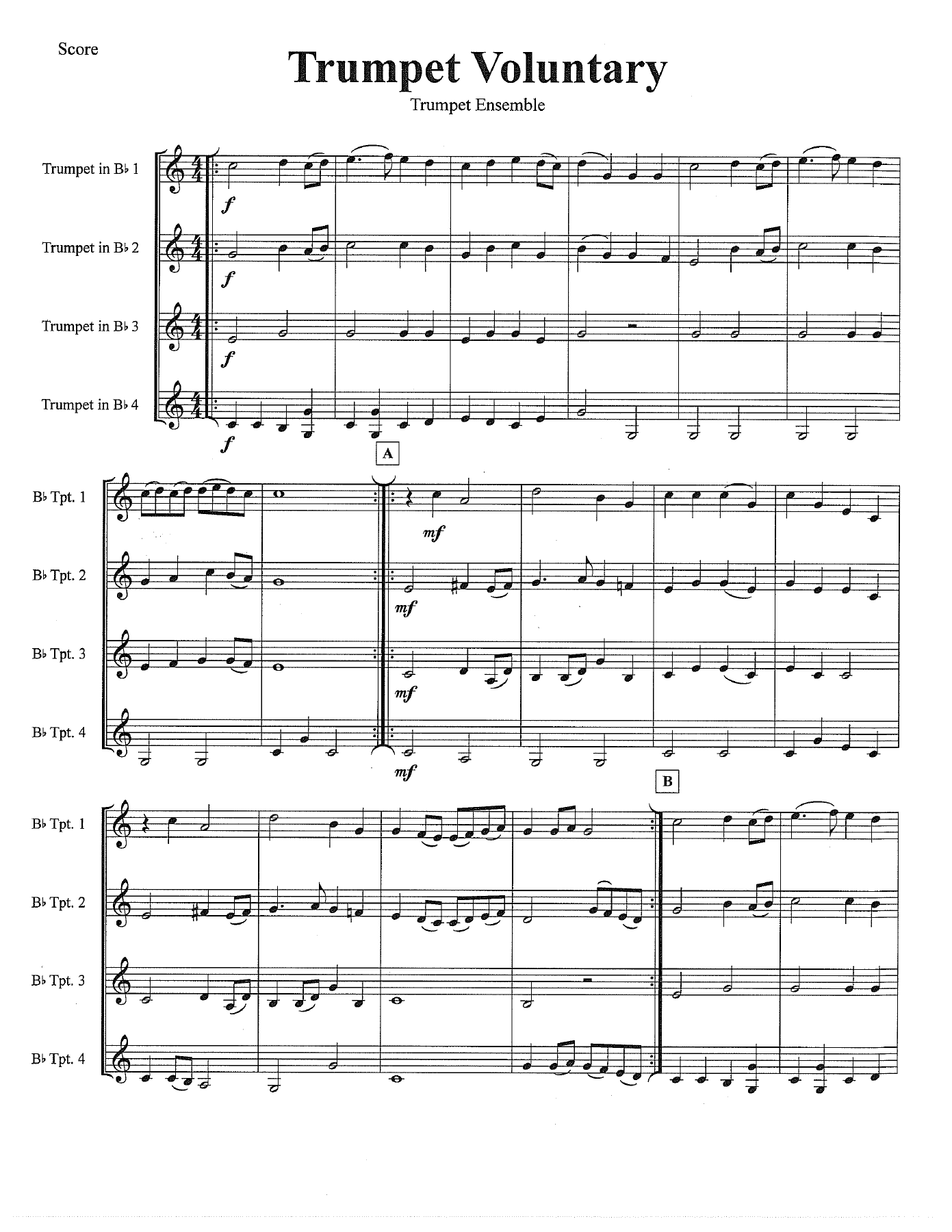
Trumpet Voluntary (comp. Jeremiah Clarke) sheet music preview

Trumpet Voluntary (comp. Jeremiah Clarke)

Composed by Jeremiah Clarke

Arranged by James Olcott

  • Ensemble: Small Ensemble
  • Style: Jazz Standard
  • Pages: 7
  • Instruments (4): Trumpet in Bb 1, Trumpet in Bb 2, Trumpet in Bb 3, Trumpet in Bb 4
  • Difficulty: easy
  • Content: Individual Parts
  • Format: PDF Download (Instant)
  • Price: $12.99

Jeremiah Clarke's "Trumpet Voluntary," often recognized as "The Prince of Denmark's March," is a foundational work from the Baroque era, composed around 1700. While frequently misattributed to Henry Purcell for many years, its true composer is the English organist and composer Jeremiah Clarke, who served as organist at St Paul's Cathedral. This piece, originally conceived for organ or possibly a wind ensemble, gained immense popularity and cemented its place in classical repertoire, particularly through Sir Henry Wood's orchestral arrangements. It is now a ubiquitous presence at ceremonial events, especially weddings, where its regal and dignified character evokes a sense of tradition and grandeur. Its enduring appeal lies in its memorable, fanfare-like melodic figures and its stately, processional quality. This jazz standard arrangement transforms the Baroque majesty of Clarke's original into a vibrant, medium swing exploration. Set in a bright, accessible key, the arrangement maintains the celebratory mood of the original while infusing it with the rhythmic vitality and harmonic sophistication characteristic of jazz. The energy is consistently uplifting, designed to evoke a sense of joyful sophistication. The "Unknown Arranger" approaches this classic with a keen understanding of both its historical weight and its potential for contemporary reinterpretation, blending traditional jazz voicings with unexpected harmonic twists that keep both performers and listeners engaged. The arranger's distinctive touch is evident in the thoughtful distribution of melodic lines and the construction of rich soli sections. The primary melody, initially carried by the lead melodic instrument, is then passed through various voices, offering each player a moment in the spotlight. There are clearly designated sections for improvised solos, allowing skilled musicians to express themselves within the framework of the arrangement's harmonic landscape. Technical challenges include precise articulation for the swing feel, navigating extended harmonies, and maintaining dynamic contrast throughout the piece. The reward for performers lies in the exhilarating interplay of voices, the satisfaction of reinterpreting a classic, and the opportunity to showcase individual and collective musicianship within a cohesive, swinging context. This arrangement is ideally suited for college-level jazz ensembles, advanced high school groups, and community bands seeking a challenging yet accessible chart. Its blend of historical reverence and modern jazz sensibility makes it an excellent teaching tool for exploring stylistic transformation, while its engaging melodies and solo opportunities provide ample reward for dedicated players. The detailed scoring, often featuring intricate counter-melodies and a dynamic shout chorus, demands a mature understanding of ensemble balance and blend, making it a fulfilling project for groups ready to elevate their performance. Conductors should emphasize a consistent, relaxed medium swing feel from the outset, ensuring the rhythm section lays down a solid, grooving foundation. Articulation is paramount; encourage brass players to utilize a bright, separated attack on eighth notes, while saxophones should aim for a smoother, connected legato in melodic passages, contrasting with punchier figures in soli sections. Pay close attention to dynamic markings, particularly the crescendos leading into the shout chorus, to build excitement effectively. While no special techniques like plungers or falls are explicitly notated, musicians are encouraged to employ tasteful jazz inflections appropriate to their instruments, such as subtle bends or scoops, to enhance the authentic jazz character. Rehearsal time should be dedicated to balancing the intricate voicings in the soli sections and ensuring clear melodic leadership when the theme is passed between instruments. Q: What instruments are included in this small ensemble arrangement? A: This small ensemble arrangement typically includes parts for a standard jazz combo, such as saxophone (alto/tenor), trumpet, trombone, piano, bass, and drums. Specific instrumentation may vary slightly but will generally adhere to this core. Q: What is the difficulty level of this arrangement? A: This arrangement is rated as an intermediate to advanced level, suitable for college-level jazz ensembles, advanced high school groups, and experienced community bands. It requires solid technical proficiency and a good understanding of jazz idiom. Q: What is the musical style and historical context of this arrangement? A: This arrangement transforms Jeremiah Clarke's Baroque-era "Trumpet Voluntary" (composed around 1700) into a jazz standard. It blends the regal character of the original with a medium swing jazz style and contemporary harmonic language. Q: What makes this arrangement unique compared to other versions of "Trumpet Voluntary"? A: This arrangement by "Unknown Arranger" uniquely reinterprets the classical piece through a jazz lens, featuring distinctive voicings, improvised solo sections, and a dynamic shout chorus, offering a fresh and swinging perspective on a timeless melody. Q: What is the approximate performance duration and tempo of this piece? A: The approximate performance duration for this arrangement is typically between 3:00 and 4:30 minutes, depending on the length of improvised solos. It is designed to be performed at a medium swing tempo.

Questions and answers

What is included in the Trumpet Voluntary (comp. Jeremiah Clarke) PDF?
The verified current file contains a conductor score and individual parts across 7 pages.
How many instruments or parts are listed for Trumpet Voluntary (comp. Jeremiah Clarke)?
The verified instrumentation list contains 4 entries for this Small Ensemble arrangement.
Who is credited for Trumpet Voluntary (comp. Jeremiah Clarke)?
Composer: Jeremiah Clarke. Arranger: James Olcott.
What difficulty is listed for Trumpet Voluntary (comp. Jeremiah Clarke)?
The verified difficulty level is easy.
What style is listed for Trumpet Voluntary (comp. Jeremiah Clarke)?
The catalog lists the style as Jazz Standard.
Can I preview Trumpet Voluntary (comp. Jeremiah Clarke) before buying?
Yes. The product page provides a preview generated from the current PDF file.
How is Trumpet Voluntary (comp. Jeremiah Clarke) delivered?
After successful payment, the digital PDF is made available for download. The displayed price is $12.99.

Musicians Also Search For

Trumpet Voluntary James Olcott PDFTrumpet Voluntary James Olcott sheet musicTrumpet Voluntary arranged by James OlcottJames Olcott small ensemble chartsJames Olcott jazz arrangements PDFTrumpet Voluntary Jeremiah Clarke sheet musicTrumpet Voluntary Jeremiah Clarke small ensemble arrangementsJeremiah Clarke small ensemble chartsTrumpet Voluntary small ensemble arrangementsTrumpet Voluntary small ensemble PDF downloadTrumpet Voluntary jazz sheet musicsmall ensemble sheet music downloadTrumpet Voluntary conductor score PDFTrumpet Voluntary individual parts downloadTrumpet Voluntary sheet music PDFTrumpet Voluntary Jazz Standard chartsJazz Standard small ensemble arrangementsbuy Trumpet Voluntary sheet musicdownload Trumpet Voluntary PDFTrumpet Voluntary jazz chartsbest James Olcott small ensemble arrangementsJeremiah Clarke arranged by James OlcottTrumpet Voluntary printable sheet musicsmall ensemble repertoire PDF

All arrangements by James Olcott All Jeremiah Clarke sheet music