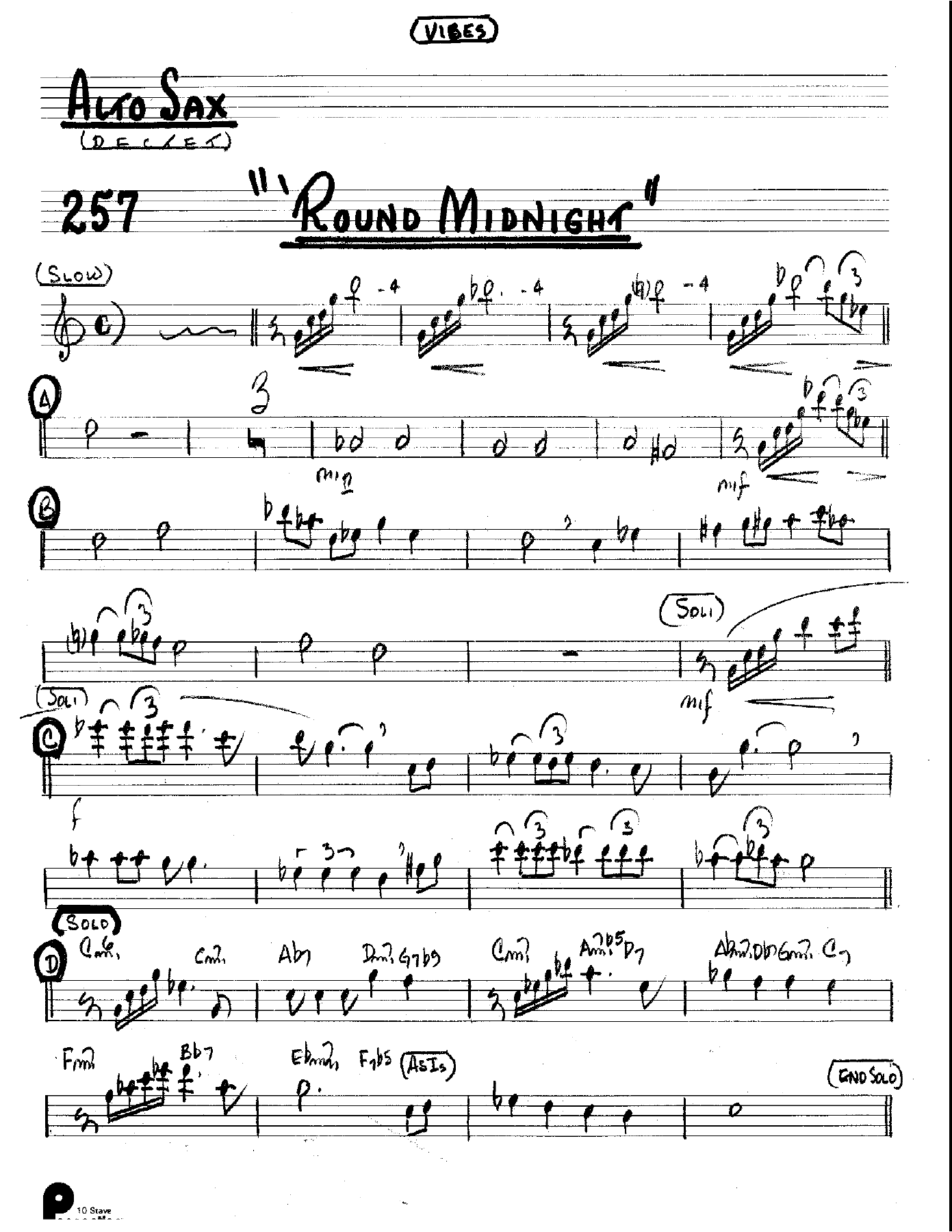
Round Midnight (6.Dectet)
Composed by Thelonious Monk
Arranged by 6 horns + Rhythm (Vibes Feature) Unk Dectet
- Ensemble: Small Ensemble
- Style: Jazz Standard
- Pages: 20
- Instruments (10): Alto Sax, Tenor Sax, Baritone Sax, Trumpet 1, Trumpet 2, Trombone, Piano, Bass, Drums, Vibes
- Difficulty: easy
- Content: Individual Parts
- Format: PDF Download (Instant)
- Price: $12.99
Thelonious Monk's "'Round Midnight," composed in the early 1940s, stands as one of the most iconic and frequently recorded jazz standards, often dubbed the "National Anthem of Jazz." Monk is thought to have penned an early version as early as 1936, though it was copyrighted in 1943 and first recorded by Cootie Williams in 1944. This piece emerged during a pivotal era in jazz, bridging the swing and bebop movements, and its complex harmonies and haunting melody quickly cemented its place in the jazz canon. Its enduring fame was further amplified by legendary interpretations from artists like Miles Davis, whose 1955 Newport Jazz Festival performance with Monk was instrumental in launching his career, and Herbie Hancock, whose reharmonized version for the 1986 film of the same name won an Academy Award. The composition's ability to evoke a profound sense of melancholy, introspection, and late-night contemplation has made it a rite of passage for jazz musicians across generations. This arrangement for 6 horns + Rhythm (Vibes Feature) Unk Dectet captures the profound, introspective mood of the original while offering a fresh, sophisticated perspective. Typically performed as a slow, walking ballad, the piece is generally in a minor key, often C minor or E-flat minor, though this arrangement may explore subtle harmonic shifts characteristic of modern interpretations. The musical character is one of poignant beauty, characterized by Monk's signature angular melodies and rich, often dissonant, harmonies that create a sense of mystery and depth. The arrangement emphasizes a contemplative energy, allowing for expressive phrasing and nuanced dynamics, evoking the quiet solitude of the late hours. Unk Dectet's distinctive arranging approach for this piece centers on its unique instrumentation, particularly the prominent vibraphone feature. The vibraphone, with its bell-like timbre and controllable vibrato, is perfectly suited to convey the haunting quality of Monk's melody, offering both lyrical lines and shimmering chordal textures. The arrangement likely utilizes intricate voicings across the six horns (which could include various combinations of trumpets, trombones, and saxophones) to create a rich, layered sound that supports and interacts with the featured vibes. Expect carefully crafted soli sections that highlight the ensemble's blend and precision, along with moments of harmonically rich counterpoint. While staying true to the original's melancholic essence, the arranger may introduce subtle reharmonizations or extended harmonies, adding contemporary depth without sacrificing Monk's original intent. The arrangement features the melody primarily carried by the vibraphone, often supported by lush horn pads, with dedicated solo sections for improvisation, likely including the vibraphone and potentially one or more horn players. Performance of this arrangement demands exceptional musicality and sensitivity. Technical challenges include precise control of dynamics and articulation to maintain the ballad feel, navigating Monk's often unexpected harmonic progressions, and achieving a cohesive blend within the small ensemble. The vibraphone soloist will need strong mallet technique and improvisational fluency to fully realize the feature. The rewarding aspects lie in the opportunity for profound emotional expression and the chance to interpret one of jazz's most revered compositions in a unique setting. This arrangement is ideally suited for college-level jazz ensembles, advanced community bands, or professional small groups seeking a challenging yet deeply satisfying piece that showcases individual talent within a sophisticated ensemble context. Its intricate scoring and expressive demands make it an excellent vehicle for developing advanced ensemble playing and improvisational artistry. Conductors should emphasize a deliberate, unhurried tempo, typically a slow ballad feel (around 60-70 BPM), allowing ample space for the melodic lines to breathe and the harmonies to resonate. The inherent rubato and expressive nuances of the original piece should be encouraged, particularly in the vibraphone feature and any improvised solos. Horn players must focus on achieving a warm, blended sound with precise intonation, paying close attention to dynamic shaping to support the soloist without overpowering. Articulation should generally be legato, with subtle inflections to highlight melodic contours. The rhythm section needs to maintain a consistent, gentle swing feel, with the bassist providing a steady walking line and the drummer using brushes or light sticks to create a delicate texture. The vibraphonist should utilize four-mallet technique where indicated for rich chordal pads and employ careful pedaling to control sustain and clarity, ensuring the motor speed is set to a subtle vibrato to enhance the melancholic mood. Rehearsals should prioritize listening across the ensemble, focusing on blend, balance, and the emotional arc of the piece. Q: What instruments are included in the "Round Midnight (6.Dectet)" arrangement? A: This arrangement is scored for a small ensemble, specifically 6 horns plus a rhythm section, with a featured vibraphone. The exact horn instrumentation (e.g., trumpets, trombones, saxophones) would be specified in the full score and parts. Q: What is the difficulty level of this arrangement? A: This arrangement is considered advanced, suitable for college-level jazz ensembles, advanced community bands, or professional small groups. It requires strong technical proficiency, advanced improvisational skills, and a high degree of musical maturity. Q: What is the musical style and historical context of this piece? A: "Round Midnight" is a seminal jazz standard composed by Thelonious Monk in the early 1940s, representing a bridge between the swing and bebop eras. It is characterized by its haunting, melancholic slow ballad feel and complex harmonies. Q: What makes this arrangement unique? A: This arrangement stands out due to its specific instrumentation of 6 horns plus rhythm, with a dedicated vibraphone feature that brings a distinctive timbre and textural depth to Monk's classic. It offers a fresh, sophisticated interpretation of a beloved standard. Q: What is the typical performance duration and tempo for this arrangement? A: As a slow ballad, "Round Midnight" typically has a performance duration of 5-7 minutes, depending on the number and length of improvised solos. The tempo should be a deliberate, expressive slow swing, around 60-70 beats per minute.
Questions and answers
- What is included in the Round Midnight (6.Dectet) PDF?
- The verified current file contains individual parts across 20 pages.
- How many instruments or parts are listed for Round Midnight (6.Dectet)?
- The verified instrumentation list contains 10 entries for this Small Ensemble arrangement.
- Who is credited for Round Midnight (6.Dectet)?
- Composer: Thelonious Monk. Arranger: 6 horns + Rhythm (Vibes Feature) Unk Dectet.
- What difficulty is listed for Round Midnight (6.Dectet)?
- The verified difficulty level is easy.
- What style is listed for Round Midnight (6.Dectet)?
- The catalog lists the style as Jazz Standard.
- Can I preview Round Midnight (6.Dectet) before buying?
- Yes. The product page provides a preview generated from the current PDF file.
- How is Round Midnight (6.Dectet) delivered?
- After successful payment, the digital PDF is made available for download. The displayed price is $12.99.
Musicians Also Search For
Round Midnight 6 horns + Rhythm (Vibes Feature) Unk Dectet PDF • Round Midnight 6 horns + Rhythm (Vibes Feature) Unk Dectet sheet music • Round Midnight arranged by 6 horns + Rhythm (Vibes Feature) Unk Dectet • 6 horns + Rhythm (Vibes Feature) Unk Dectet small ensemble charts • 6 horns + Rhythm (Vibes Feature) Unk Dectet jazz arrangements PDF • Round Midnight Thelonious Monk sheet music • Round Midnight Thelonious Monk small ensemble arrangements • Thelonious Monk small ensemble charts • Round Midnight small ensemble arrangements • Round Midnight small ensemble PDF download • Round Midnight jazz sheet music • small ensemble sheet music download • Round Midnight individual parts download • Round Midnight sheet music PDF • Round Midnight Jazz Standard charts • Jazz Standard small ensemble arrangements • buy Round Midnight sheet music • download Round Midnight PDF • Round Midnight jazz charts • best 6 horns + Rhythm (Vibes Feature) Unk Dectet small ensemble arrangements • Thelonious Monk arranged by 6 horns + Rhythm (Vibes Feature) Unk Dectet • Round Midnight printable sheet music • small ensemble repertoire PDF