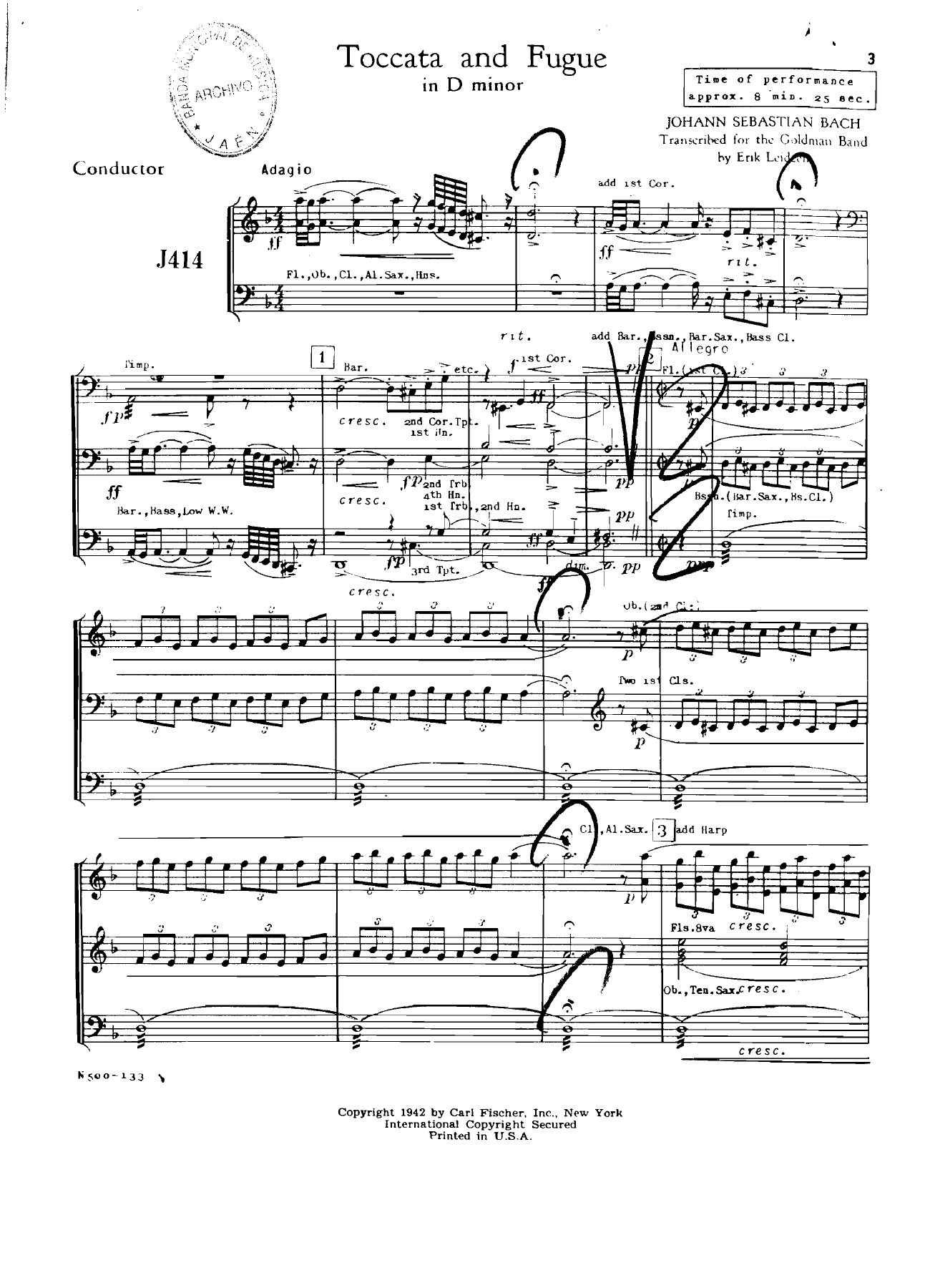
Toccata & Fugue In D Minor (B.Leidzen)
Composed by Johann Sebastian Bach
Arranged by Bach - Arr. Leidzen
- Ensemble: Concert Band
- Style: Traditional
- Pages: 110
- Difficulty: advanced
- Content: Sheet Music
- Format: PDF Download (Instant)
- Price: $22.99
Johann Sebastian Bach's iconic "Toccata and Fugue in D Minor," BWV 565, stands as one of the most recognizable and enduring compositions from the Baroque era. While its exact date of composition is debated, it is generally believed to have been written between 1703 and 1707, during Bach's early years as an organist in Arnstadt or Mühlhausen. This monumental work, originally conceived for pipe organ, has transcended its origins to become a cornerstone of classical repertoire, frequently featured in film, television, and popular culture, thereby cementing its status as a piece of universal recognition. Its dramatic opening, characterized by a virtuosic, improvisatory toccata, followed by a meticulously constructed fugue, showcases Bach's unparalleled mastery of counterpoint and harmonic invention. The piece's inherent drama, intricate voice leading, and powerful emotional arc have fascinated audiences and musicians for centuries. This particular concert band arrangement, meticulously crafted by the esteemed American composer and arranger Erik Leidzen, transforms Bach's organ masterpiece into a vibrant and compelling experience for modern wind ensembles. Leidzen, renowned for his masterful transcriptions and original works for brass bands and concert bands, approaches this Baroque classic with a deep respect for its original integrity while skillfully re-orchestrating it for the diverse timbres of the concert band. The musical character remains true to the original: a powerful, often dramatic, and highly energetic work, primarily in D minor, evoking a sense of grandeur, introspection, and ultimately, triumph. Leidzen’s treatment maintains the original tempo indications, allowing the dramatic contrasts between the improvisatory toccata and the structured fugue to unfold naturally. Leidzen's distinctive arranging approach is evident throughout this 110-page score. He masterfully distributes Bach's intricate organ lines across the various sections of the concert band, utilizing the full spectrum of woodwind, brass, and percussion colors. Expect rich, full-bodied brass voicings that deliver the original's majestic power, alongside nimble woodwind passages that articulate Bach's rapid figurations with clarity and precision. The arrangement features prominent soli sections where specific instrument families carry the melodic and contrapuntal lines, such as the clarinets and flutes executing the toccata's rapid runs, or the low brass articulating the fugue subject with gravitas. While there are no improvised solos in the jazz sense, the arrangement highlights the virtuosic demands on individual sections, making each part integral to the overall tapestry. Leidzen's orchestration often employs doublings to achieve a massive sound, particularly in the climactic moments, and he intelligently uses percussion to enhance the dramatic impact without overshadowing the core melodic material. Performing this arrangement is immensely rewarding, offering an ensemble the opportunity to engage with one of history's greatest compositions through a new lens. Technical challenges include maintaining precise articulation in rapid passages, achieving balanced voicings across the large ensemble, and navigating the complex contrapuntal lines of the fugue. The ensemble must work cohesively to convey the dramatic shifts in mood and texture, from the imposing opening to the intricate interwoven voices. This arrangement is ideally suited for advanced high school, collegiate, community, and professional concert bands. Its demands on individual musicianship and ensemble precision make it an excellent choice for developing technical prowess, fostering deep musical understanding, and presenting a truly impressive and historically significant work to an audience. Approaching Leidzen's "Toccata and Fugue in D Minor" requires meticulous attention to detail and ensemble cohesion. The primary technical challenges lie in maintaining rhythmic precision and clean articulation, particularly in the rapid sixteenth-note passages of the Toccata and the intricate voice leading of the Fugue. Conductors should emphasize breath support and consistent air flow for sustained phrases, especially in the brass. The tempo, while not explicitly marked with a metronome indication in the original, should convey a majestic yet flowing character for the Toccata (often around quarter note = 60-72) and a clear, deliberate pace for the Fugue (quarter note = 80-92) to allow all contrapuntal lines to be heard. No special techniques like mutes or extended techniques are required, as the arrangement focuses on traditional concert band sonorities. Rehearsal time should be dedicated to isolating and balancing individual fugal entries, ensuring each voice emerges distinctly. Focus on dynamic contrasts, from the whispered entries to the full-ensemble climaxes, to fully realize the dramatic arc of Bach's original. Q: What instruments and parts are included in this arrangement? A: This is a full concert band arrangement, typically including standard instrumentation such as flutes, oboes, clarinets (Bb, bass), bassoons, saxophones (alto, tenor, baritone), trumpets, French horns, trombones, euphonium, tuba, and a comprehensive percussion section. Specific part counts and doublings will be detailed in the score. Q: What is the difficulty level of this concert band arrangement? A: This arrangement is considered advanced (Grade 5-6). It demands a high level of technical proficiency from all sections, requiring strong individual musicianship and sophisticated ensemble playing to accurately portray Bach's intricate counterpoint and Leidzen's rich orchestration. Q: What is the musical style and historical context of the original piece? A: The original "Toccata and Fugue in D Minor" is a foundational work of the Baroque era, composed by Johann Sebastian Bach. It exemplifies the dramatic and contrapuntal style of early 18th-century organ music, characterized by virtuosic improvisation and rigorous fugal construction. Q: What makes Erik Leidzen's arrangement unique compared to other versions of this piece? A: Leidzen's arrangement is renowned for its masterful orchestration that respects Bach's original intent while fully utilizing the diverse timbres and dynamic range of the modern concert band. He skillfully distributes the complex organ lines across the ensemble, creating a powerful and authentic rendition specifically tailored for wind ensembles. Q: What is the typical performance duration of this arrangement? A: The performance duration for Leidzen's arrangement of "Toccata and Fugue in D Minor" typically ranges from 8 to 10 minutes, depending on the conductor's interpretation of tempo and dynamics.
Musicians Also Search For
Toccata & Fugue In D Minor Bach - Arr. Leidzen PDF • Toccata & Fugue In D Minor Bach - Arr. Leidzen sheet music • Toccata & Fugue In D Minor arranged by Bach - Arr. Leidzen • Bach - Arr. Leidzen concert band charts • Bach - Arr. Leidzen jazz arrangements PDF • Toccata & Fugue In D Minor Johann Sebastian Bach sheet music • Toccata & Fugue In D Minor Johann Sebastian Bach concert band arrangement • Johann Sebastian Bach concert band charts • Toccata & Fugue In D Minor concert band arrangement • Toccata & Fugue In D Minor concert band PDF download • Toccata & Fugue In D Minor jazz ensemble sheet music • concert band sheet music instant download • Toccata & Fugue In D Minor sheet music with parts • Toccata & Fugue In D Minor Traditional chart • Traditional concert band arrangements • buy Toccata & Fugue In D Minor sheet music online • download Toccata & Fugue In D Minor PDF • Toccata & Fugue In D Minor jazz chart • best Bach - Arr. Leidzen concert band arrangements • Johann Sebastian Bach songs arranged by Bach - Arr. Leidzen • Toccata & Fugue In D Minor printable sheet music • concert band repertoire PDF